Is Forcibly Imposing Vande Mataram Unconstitutional?
Synopsis
Asaduddin Owaisi vehemently argues against the obligatory singing of Vande Mataram, asserting it violates constitutional rights. He emphasizes the need for diverse expressions of patriotism and warns against the dangers of conflating nationalism with religion. His insights challenge the current political discourse and call for a more inclusive approach to patriotism.
Key Takeaways
Forcible imposition of Vande Mataram is unconstitutional.
Patriotism should embrace diversity.
Separation of state and religion is vital.
Article 25 protects religious freedom.
Equating nationalism with religion can be dangerous.
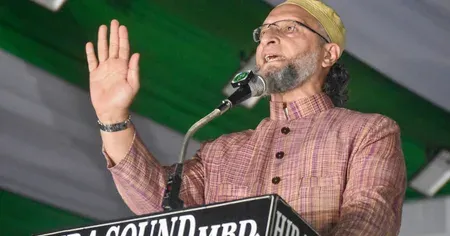
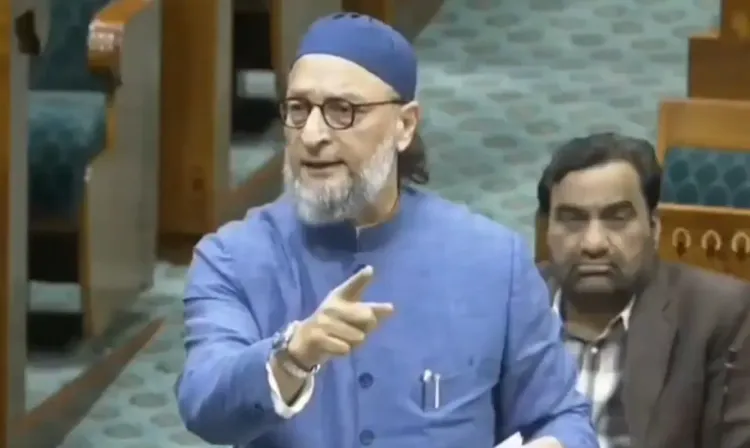
Hyderabad, Dec 8 (NationPress) AIMIM president Asaduddin Owaisi stated on Monday that the act of forcibly enforcing Vande Mataram is in direct violation of the Constitution.
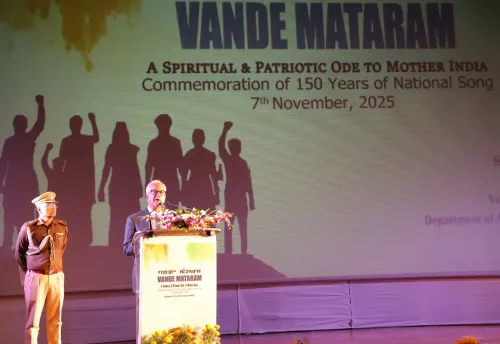
During the discourse on Vande Mataram in the Lok Sabha, the MP from Hyderabad emphasized that singing Vande Mataram cannot serve as a measure of patriotism.
He highlighted that India gained its independence and maintained it due to the separation of state and religion.
“If Vande Mataram becomes a criterion for loyalty, it would signify a departure from the principles upheld by Gandhi, Ambedkar, Tagore, Bose, and countless freedom fighters, thereby aligning with the ideology of Godse and Hindu nationalism,” he remarked.
Describing India as a diverse garden, Owaisi warned that if only one type of flower is allowed to flourish, it would ultimately turn the garden into a barren landscape, making the caretaker a ‘jallad’ (executioner).
He asserted that ‘tauheed’ (the oneness of Allah) is fundamental to Islam, and noted that Article 25 of the Constitution guarantees rights to Muslims. He cautioned that disregarding the freedom of thought, expression, belief, faith, and worship would pose a serious threat.
He clarified that being a Muslim does not diminish their affection for the nation.
“Being a Muslim does not hinder our patriotism. We cherish our country and will continue to do so,” he stated, adding that it is inappropriate for individuals not involved in the freedom struggle to instruct others on patriotism.
“Despite facing assaults in mosques and homes, as well as through our attire and businesses, our love for this nation remains steadfast, and we will never abandon it,” he expressed.
Criticizing the speeches given during the debate, Owaisi asserted that true patriotism necessitates the eradication of oppression, poverty, exploitation, and unemployment, alongside the establishment of peace and the elimination of terrorism from Pakistan.
“If one refers to Bharat as a Devi, it transforms nationalism and patriotism into a religious concept. It was claimed that to reside in India, one must recite Vande Mataram. This contradicts the Constitution and the rulings of the Supreme Court,” he pointed out, citing various judicial decisions.
Owaisi commenced his comments by condemning Prime Minister Modi's address. “We opposed Jinnah vehemently, and that is why we embraced India as our homeland. In 1942, your revered Veer and Jinnah’s faction formed coalition governments in the Northwest Frontier, Bengal, and Sindh, enlisting 150,000 Hindus and Muslims into the British Army.”
The AIMIM leader also expressed strong disapproval of Defence Minister Rajnath Singh’s comments, labeling his references to Ummul Momineen and Ummul Kitab as distressing.
“Ummul Momineen is our Prophet’s wife. We regard her as our mother, but we do not worship her. We do not worship our mother. Ummul Kitab is the Quran, yet we do not worship the Quran,” he stated.
He highlighted that the Constitution commences with the phrase ‘we the people’ and not with Bharat Mata. The Preamble emphasizes liberty of thought, expression, faith, belief, and worship.
“When the first page of the Constitution itself grants total freedom of thought, expression, belief, religion, and worship, how can any citizen be coerced into worshipping any deity or bowing in reverence?” he questioned.
Point of View
It's crucial to recognize the diverse perspectives within our country. Asaduddin Owaisi's remarks underscore the importance of constitutional rights and inclusivity in expressions of patriotism. In a nation rich in diversity, we must ensure that all voices are heard and respected, fostering unity amidst our differences.
NationPress
21 Oct 2026
Frequently Asked Questions
Why does Owaisi believe Vande Mataram should not be imposed?
Owaisi argues that forcing Vande Mataram contradicts the Constitution and undermines the principles of inclusivity and diversity that are inherent in India's identity.
What does Owaisi say about patriotism?
He asserts that patriotism should not be measured by a singular action, like singing Vande Mataram, but should encompass a broader range of expressions and respect for all citizens.
How does Owaisi relate religion to patriotism?
Owaisi emphasizes the separation of state and religion, cautioning against conflating nationalism with religious identity, which could lead to exclusion.
What is the significance of Article 25 in Owaisi's argument?
Owaisi points out that Article 25 guarantees the right to freedom of religion, underscoring that individuals should not be compelled to worship or express loyalty in a prescribed manner.
What warning does he give about nationalism?
He warns that if nationalism is viewed through a religious lens, it risks marginalizing diverse identities and turning India into a 'barren landscape.'