Did a 7.6-Magnitude Earthquake Strike Northeastern Japan?
Synopsis
A significant earthquake with a magnitude of 7.6 has struck northeastern Japan late Monday night, leading to the suspension of nuclear wastewater discharge from Fukushima. With tsunami warnings issued and widespread power outages reported, emergency measures are in place. Stay informed as we cover the unfolding situation.
Key Takeaways
A 7.6-magnitude earthquake struck northeastern Japan late Monday.
Tsunami warnings were issued for Aomori, Iwate, and Hokkaido.
TEPCO halted wastewater discharge from the Fukushima plant.
Several injuries and power outages were reported.
Emergency measures and evacuations are being implemented.
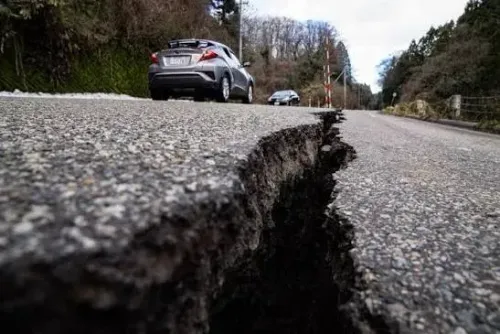
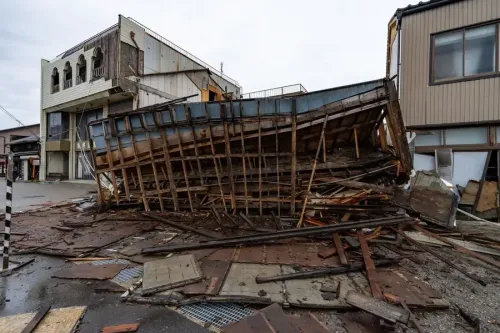
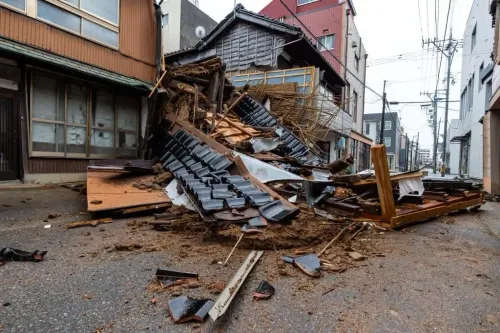
Tokyo, Dec 8 (NationPress) A powerful earthquake registering a preliminary magnitude of 7.6 impacted northeastern Japan late Monday night, leading to the immediate cessation of ocean discharge related to nuclear-contaminated wastewater from the damaged Fukushima Daiichi Nuclear Power Plant.
The earthquake was recorded at 11:15 p.m. local time, occurring at a depth of 50 km and reaching an upper 6 on Japan's seismic scale of 7 in Hachinohe, Aomori Prefecture. This triggered a tsunami warning for the coastal regions of Aomori, Iwate, and Hokkaido, as confirmed by the Japan Meteorological Agency (JMA), according to reports from Xinhua News Agency.
Fortunately, there have been no abnormalities reported from nuclear facilities in Hokkaido or the northeastern prefectures of Aomori, Miyagi, and Fukushima, as stated by public broadcaster NHK.
In light of the tsunami warning, the Tokyo Electric Power Company (TEPCO) announced that the discharge of nuclear-contaminated wastewater from the Fukushima plant was halted at 11:42 p.m. local time.
Reports from Aomori and Hokkaido indicated several non-life-threatening injuries, and approximately 2,700 homes experienced power outages, as reported by Kyodo News.
The JMA warned that waves could reach heights of up to 3 meters along the Iwate Prefecture coast, central Pacific coastal areas of Hokkaido, and the Pacific coast of Aomori Prefecture, urging residents in affected areas to evacuate to higher ground immediately.
Waves measuring 50 centimeters were recorded in Urakawa, Hokkaido, at 12:21 a.m. local time Tuesday, and at Kuji Port, Iwate Prefecture, at 12:10 a.m., JMA officials added.
Japan Railways has suspended Tohoku Shinkansen bullet train services in both directions between Fukushima Station and Shin-Aomori Station as a precaution due to the quake.
Chief Cabinet Secretary Minoru Kihara stated that the government is actively gathering information regarding casualties and property damage.
A crisis management office has been established at the Prime Minister's Office in response to the earthquake.
Point of View
It's our responsibility to provide timely and accurate information. The recent earthquake in northeastern Japan poses a serious threat to residents and infrastructure, and we must prioritize safety and awareness during this crisis. The government's response and public preparedness will be crucial in minimizing harm and addressing the aftermath effectively.
NationPress
30 Sept 2026
Frequently Asked Questions
What was the magnitude of the earthquake that struck Japan?
The earthquake registered a preliminary magnitude of 7.6.
Which areas were affected by the tsunami warning?
The tsunami warning was issued for coastal regions of Aomori, Iwate, and Hokkaido.
Were there any reported injuries or damage?
Yes, there were reports of non-life-threatening injuries and around 2,700 homes lost power.
What measures were taken regarding the Fukushima nuclear plant?
The discharge of nuclear-contaminated wastewater was halted immediately following the earthquake.
How is the government responding to the situation?
The government has set up a crisis management office and is gathering information on casualties and property damage.