What Happened During the 5.2-Magnitude Earthquake Off Aomori Prefecture, Japan?
Synopsis
On December 16, a 5.2-magnitude earthquake struck off Aomori Prefecture, Japan, causing concern among residents. The Japan Meteorological Agency confirmed the quake's details and urged caution after recent seismic activity. Find out more about the earthquake's impact and the region's history with seismic events.
Key Takeaways
5.2-magnitude earthquake struck off Aomori Prefecture.
Depth was recorded at 20 km .
The quake was registered at 2:38 p.m. local time.
No tsunami advisory was issued.
Japan remains a seismically active area with over 1,500 earthquakes annually.
Tokyo, Dec 16 (NationPress) A 5.2-magnitude earthquake occurred off the coast of Aomori Prefecture in northern Japan on Tuesday, as reported by the country's meteorological agency. The earthquake was registered at 2:38 p.m. local time (0538 GMT) at a depth of 20 km, registering a 3 on Japan's seismic scale of 7 in Hakodate City, located in Hokkaido Prefecture.
The epicenter of the quake was pinpointed at a latitude of 40.9 degrees north and a longitude of 143.1 degrees east. Fortunately, no tsunami warning was issued following this event.
A week-long alert regarding a potential strong earthquake was lifted at midnight on Monday, following a 7.5-magnitude quake that affected northern and northeastern Japan on December 8. Nevertheless, JMA officials have urged the public to remain vigilant, as reported by the Xinhua news agency.
Previously, on December 12, a tsunami advisory was issued for the northern coast of Japan following a 6.7-magnitude earthquake off Aomori Prefecture. The JMA had upgraded this quake's magnitude from 6.5 and warned coastal areas in Hokkaido, Aomori, Iwate, and Miyagi prefectures, anticipating waves up to 1 meter.
The epicenter for this quake was also located at a latitude of 40.9 degrees north and a longitude of 143.0 degrees east.
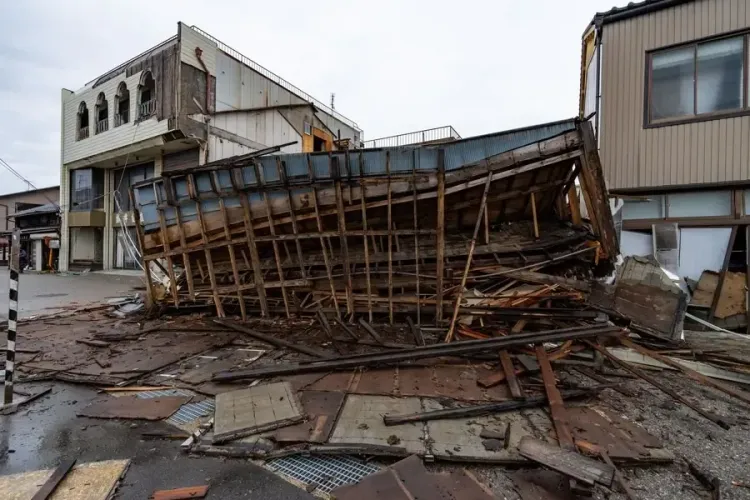
The earlier 7.5-magnitude quake on December 8 was significant, registering upper 6 on the seismic scale in parts of Aomori, which led to tsunami warnings for Iwate Prefecture and parts of Hokkaido and Aomori prefectures.
The Nuclear Regulation Authority reported that there are no immediate abnormalities at the nuclear facilities in the region.
The JMA had issued a rare special advisory warning, indicating that another earthquake of similar or greater magnitude could occur within a week. This advisory was directed at the Sanriku area on the northeastern tip of Japan's main island of Honshu and the northern island of Hokkaido, situated along the Pacific.
The region still bears the scars from the catastrophic 9.0-magnitude undersea earthquake in 2011, which triggered a tsunami that resulted in approximately 18,500 deaths or missing persons.
In August 2024, the JMA released its first special advisory for the southern half of Japan's Pacific coast, warning of a potential 'megaquake' along the Nankai Trough.
Japan lies atop four major tectonic plates along the western edge of the Pacific 'Ring of Fire' and is recognized as one of the most seismically active nations worldwide.
The archipelago, which has a population of around 125 million, experiences approximately 1,500 earthquakes each year. While most are mild, the impact varies based on their location and depth beneath the Earth's surface.
Point of View
It is crucial to acknowledge the ongoing seismic threats in Japan, particularly in regions like Aomori Prefecture. Given the recent pattern of earthquakes, including a significant 7.5 magnitude earlier this month, it is imperative for residents to stay informed and prepared. Our commitment is to deliver timely updates and expert analysis to ensure public safety and awareness.
NationPress
24 Sept 2026
Frequently Asked Questions
What magnitude was the earthquake off Aomori?
The earthquake off Aomori Prefecture was reported to have a preliminary magnitude of 5.2.
Was there a tsunami warning issued?
No tsunami advisory was issued following the 5.2-magnitude earthquake.
What is the depth of the earthquake?
The earthquake occurred at a depth of 20 km.
How does this earthquake compare to previous ones?
This earthquake follows a 7.5-magnitude quake that struck the region on December 8, prompting safety concerns.
Is the area prone to earthquakes?
Yes, Japan is located on the Pacific 'Ring of Fire', making it one of the most seismically active regions in the world.