7.2-magnitude earthquake hits Japan's Iwate, four injured
Synopsis
A 7.2-magnitude earthquake — revised up from an initial 6.9 — rattled northeastern Japan on Thursday morning, injuring four people and registering a near-maximum seismic intensity in parts of Aomori. No tsunami warning was issued and nuclear plants remained unaffected, but the quake's reach across Tokyo and multiple prefectures signals the scale of a tremor that struck one of the world's most seismically active coastlines.
Key Takeaways
A 7.2-magnitude earthquake struck off Iwate Prefecture , northeastern Japan, on 25 June at around 7:30 am local time .
At least four people were injured; the quake's depth was approximately 40 km .
Hashikami Town recorded an intensity of upper 6 — the second-highest on Japan's 7-point seismic scale.
No tsunami advisory was issued; Higashidori, Onagawa, Fukushima Daiichi and Daini nuclear plants reported no abnormalities.
Shaking was felt as far as Tokyo and across Hokkaido, Miyagi, Fukushima and other prefectures.
Separately, Venezuela was struck by twin quakes of magnitude 7.1 and 7.5 , prompting Acting President Delcy Rodriguez to declare a State of Emergency .
A 7.2-magnitude earthquake struck off the eastern coast of Iwate Prefecture in northeastern Japan on Thursday, 25 June, injuring at least four people, according to local media reports. The tremor, initially recorded at a preliminary magnitude of 6.9 before being revised upward, hit at approximately 7:30 am local time at a depth of around 40 km.
Seismic Intensity and Affected Regions
The Japan Meteorological Agency (JMA) recorded an intensity of upper 6 — the second-highest level on Japan's seismic scale of 7 — in Hashikami Town, and lower 6 in Hachinohe City, both in Aomori Prefecture. At an intensity of upper 6, it is reportedly impossible to remain standing or move without crawling, and most unfixed furniture moves or topples, according to the weather agency.
Shaking was felt across a wide swathe of the country, including Hokkaido, Akita, Fukushima, Miyagi, and Yamagata prefectures, as well as Tokyo and its neighbouring prefectures, the JMA said. The epicentre was located at 40.2 degrees north latitude and 142.3 degrees east longitude.
No Tsunami Warning, Nuclear Plants Unaffected
No tsunami advisory was issued following the quake, and authorities urged residents in the most severely affected areas to remain alert for aftershocks of similar magnitude. Operators of the Higashidori and Onagawa nuclear power plants in Aomori and Miyagi prefectures, respectively, as well as the Fukushima Daiichi and Daini plants in Fukushima Prefecture, reported no abnormalities. This is a significant reassurance given Japan's history with nuclear incidents following seismic events, most notably the 2011 Tohoku disaster.
Venezuela Also Hit by Twin Powerful Earthquakes
In a separate development on the same day, two powerful earthquakes struck Venezuela in quick succession, sending strong tremors through the capital Caracas. The US Geological Survey (USGS) recorded a magnitude 7.1 quake at 2204 GMT on Wednesday, followed just one minute later by an even stronger magnitude 7.5 tremor. Both struck near the coastal town of Moron, approximately 160 km west of Caracas.
The Venezuelan quakes were shallow, at a depth of only 10 km, a factor that can significantly intensify surface-level destruction. Venezuela's Acting President Delcy Rodriguez declared a State of Emergency in the wake of the twin strikes, citing widespread damage.
Context and What Comes Next
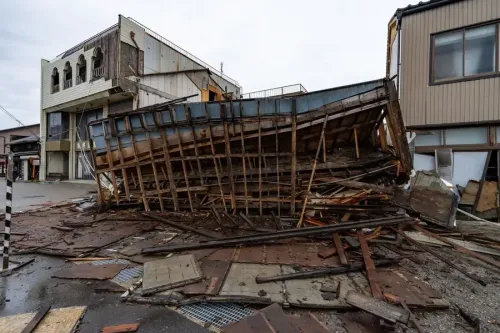
Japan sits atop the Pacific Ring of Fire and is among the world's most seismically active nations, recording hundreds of earthquakes annually. The northeastern Tohoku region, which includes Iwate Prefecture, remains particularly vulnerable — a reality underscored by the catastrophic 2011 earthquake and tsunami that triggered the Fukushima nuclear crisis. Authorities are continuing to assess damage from Thursday's event. Residents in the affected prefectures have been advised to stay vigilant as aftershock risk remains elevated in the hours following a major tremor.
Point of View
But the Tohoku region's continued exposure to major seismic events raises legitimate questions about long-term habitability and infrastructure resilience in communities still recovering from 2011. The near-simultaneous twin strikes in Venezuela, where emergency infrastructure is far weaker, could prove far more consequential — and deserve equal attention.
NationPress
24 Sept 2026
Frequently Asked Questions
What was the magnitude of the earthquake that hit Japan's Iwate on 25 June?
The earthquake measured 7.2 in magnitude, revised up from a preliminary reading of 6.9. It struck off the eastern coast of Iwate Prefecture at a depth of approximately 40 km at around 7:30 am local time on 25 June.
Was a tsunami warning issued after the Japan earthquake?
No tsunami advisory was issued following the 7.2-magnitude quake. Residents in the most severely affected areas were, however, urged to remain alert for aftershocks of similar magnitude.
Were any nuclear power plants affected by the Iwate earthquake?
No abnormalities were reported at the Higashidori, Onagawa, Fukushima Daiichi, or Fukushima Daini nuclear power plants, according to their respective operators.
Which areas of Japan felt the earthquake?
Beyond the epicentre off Iwate, the quake was felt across Hokkaido, Akita, Fukushima, Miyagi, Yamagata, Tokyo, and neighbouring prefectures, according to the Japan Meteorological Agency. Hashikami Town in Aomori recorded the highest intensity of upper 6.
What happened in Venezuela on the same day?
Two powerful earthquakes — magnitude 7.1 and 7.5 — struck near the coastal town of Moron, about 160 km west of Caracas, within one minute of each other. Venezuela's Acting President Delcy Rodriguez declared a State of Emergency following widespread damage.