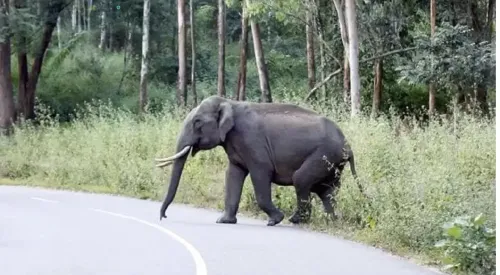
Two killed in wild elephant attacks in Assam's Nagaon district

Synopsis
Two men died within hours of each other in separate elephant attacks in Assam's Nagaon district — both in the same Samaguri area, both on a single Friday. The deaths are not isolated tragedies but symptoms of a structural crisis: shrinking forest corridors, expanding human settlements, and a forest department stretched thin across six conflict-prone districts.
Key Takeaways
Shariful Islam and Pranab Das died in separate wild elephant attacks in Samaguri, Nagaon district on 15 May 2025 .
Both victims were attacked in or near agricultural fields; Islam was working in a vegetable field when the elephant emerged from a forested area.
Forest department officials reached the affected areas to monitor elephant movement and appealed to villagers to avoid forest-fringe areas at dawn and dusk.
Assam's human-elephant conflict is driven by habitat loss, deforestation, and shrinking corridors — affecting at least six districts including Nagaon, Goalpara, Sonitpur, Udalguri, Golaghat, and Baksa.
Locals in Samaguri have demanded regular patrolling and installation of barriers in vulnerable zones.
Two persons died in separate wild elephant attacks in Assam's Nagaon district on Friday, 15 May, deepening concerns over the escalating human-elephant conflict that has long plagued several districts across the state, according to officials.
How the Attacks Unfolded
The first incident occurred at Bajiagaon in the Samaguri area, where a wild elephant emerged from a nearby forested area and attacked Shariful Islam while he was working in a vegetable field. Islam sustained critical injuries; local residents rushed him for medical assistance, but he did not survive.
In a separate incident from the same Samaguri area, a youth identified as Pranab Das was critically injured in another elephant attack. He was admitted to a hospital in serious condition but later succumbed to his injuries during treatment, officials confirmed.
Panic Among Villagers
The twin fatalities triggered widespread panic among residents of the region. Villagers alleged that wild elephants frequently stray into human habitations and agricultural fields in search of food — a pattern that intensifies during paddy cultivation and harvesting seasons. Local residents in Samaguri have demanded stronger preventive measures from authorities, including regular patrolling and installation of barriers in vulnerable areas.
Official Response
Forest department officials reached the affected areas and launched efforts to monitor elephant movement. Authorities also appealed to villagers to remain alert and avoid venturing alone into forest-fringe areas during evening and early morning hours.
A Worsening Pattern Across Assam
Assam has recorded a sharp rise in human-elephant conflict over the years, driven by habitat loss, deforestation, shrinking forest corridors, and increasing human encroachment near elephant habitats. Districts including Nagaon, Goalpara, Sonitpur, Udalguri, Golaghat, and Baksa regularly report incidents of crop damage, attacks on villagers, and elephant deaths.
According to forest department data, both human casualties and elephant deaths linked to conflict situations remain a major concern in the state. Environmental experts have repeatedly stressed the need for scientific management of elephant corridors and improved coordination between forest officials and local communities to minimise such incidents. Friday's deaths are a stark reminder that without structural intervention, the cycle of conflict is unlikely to break.
Point of View
Worsening trend that Assam's forest administration has struggled to reverse. The state sits at the intersection of high elephant density and rapid agricultural expansion, a combination that makes conflict mathematically inevitable without corridor protection. What is missing is not awareness — experts have called for scientific corridor management for years — but political will to enforce land-use boundaries near elephant habitats and fund community early-warning systems. Patrolling appeals and post-incident monitoring are necessary but insufficient responses to a problem that is fundamentally about land.
NationPress
28 Sept 2026
Frequently Asked Questions
Who were the victims of the elephant attacks in Nagaon on 15 May?
The two victims were Shariful Islam , who was attacked while working in a vegetable field at Bajiagaon in Samaguri, and Pranab Das , a youth from the same Samaguri area. Both died from injuries sustained in separate elephant attacks on the same day.
Where exactly did the elephant attacks take place?
Both incidents occurred in the Samaguri area of Nagaon district in Assam. The first attack happened at Bajiagaon, where a wild elephant emerged from a nearby forested area and attacked a man in a vegetable field.
Why are elephant attacks increasing in Assam?
According to environmental experts and forest department data, the rise in human-elephant conflict in Assam is linked to habitat loss, deforestation, shrinking forest corridors, and growing human encroachment near elephant habitats. Incidents tend to spike during paddy cultivation and harvesting seasons.
Which districts in Assam are most affected by human-elephant conflict?
Nagaon, Goalpara, Sonitpur, Udalguri, Golaghat, and Baksa are among the districts that regularly report elephant-related incidents including crop damage, attacks on villagers, and elephant deaths, according to officials.
What are authorities doing to prevent further attacks?
Forest department officials have reached the affected areas to monitor elephant movement. Authorities have appealed to villagers to stay alert and avoid forest-fringe areas during evening and early morning hours. Local residents are also demanding regular patrolling and installation of physical barriers in vulnerable zones.