UDF Launches Comprehensive Welfare and Infrastructure Manifesto for Kerala Elections
Synopsis
The United Democratic Front (UDF) has launched a detailed manifesto focusing on welfare and infrastructure ahead of the Kerala Assembly elections. Key initiatives include 'Mission Samudra' aimed at maritime development and significant welfare commitments, setting the stage for a competitive electoral battle.
Key Takeaways
Mission Samudra: Aims to develop Kerala as a global maritime hub.
Welfare Initiatives: Social security pensions and food access programs are prioritized.
Job Creation: Support for MSMEs and alignment of education with job trends.
Healthcare Focus: Increased funding and free medical services for the needy.
Educational Reforms: Scholarships and anti-ragging measures introduced.
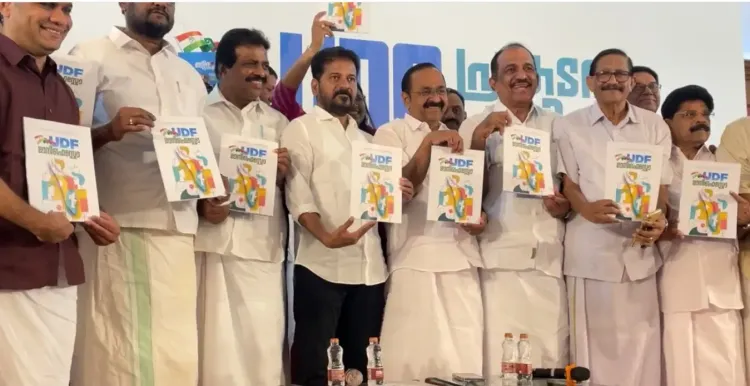
Kochi, April 2 (NationPress) The Congress-led United Democratic Front (UDF) has introduced a comprehensive manifesto for the upcoming Kerala Assembly elections, focusing heavily on welfare and infrastructure development. This significant document was launched by Telangana Chief Minister Revanth Reddy in Kochi, alongside prominent leaders from the alliance, marking a pivotal moment in their electoral strategy.
The Kerala Assembly elections are set for April 9, where 140 new legislators will be elected.
Central to this manifesto is the ambitious initiative known as “Mission Samudra”, aiming to establish Kerala as a global maritime hub by utilizing its extensive 600 km coastline, 44 rivers, and a network of ports.
This initiative proposes a systematic water transport grid that will integrate cargo transport, passenger services, and tourism, ultimately creating a cohesive coastal logistics ecosystem.
In alignment with this, a significant aviation expansion plan is also outlined, which includes upgrades to runways and terminals, the establishment of MRO (Maintenance, Repair, and Operations) hubs, logistics parks, and incentives for route development to enhance connectivity and attract investment.
The UDF is placing a strong focus on job creation and entrepreneurship, promising to support 10,000 MSMEs with annual revenues exceeding Rs 100 crore through specific financial instruments like revolving funds, technology funds, and venture support.
A proposed “Job Watch Tower” will monitor global employment trends and ensure that higher education aligns with the evolving job market.
On the welfare front, the manifesto aims to resonate with the public sentiment by pledging social security pensions of Rs 3,000, reinforced by legislation to guarantee these entitlements.
The alliance has committed to reviving programs such as the Karunya Benevolent Fund, enhancing access to subsidized rations, and launching “Indira Canteens” to provide affordable food options.
Special attention is allocated to youth and women, with 5 percent of planned funds designated for youth-led programs and improved support for women’s employment and safety.
Healthcare and education are key priorities, with the UDF promising increased budget allocations for health services, free dialysis for below-poverty-line families, the expansion of medical colleges, and strategies to reduce out-of-pocket expenses.
In the education sector, reforms will include anti-ragging measures, student mobility programs, and scholarships for studies both domestically and internationally.
Farmers and coastal communities are also targeted, with promises for fair pricing mechanisms, rubber price support, diesel subsidies for fishermen, and legal protection for fishing rights.
Additionally, the manifesto emphasizes tribal welfare, housing for the impoverished, and targeted initiatives for marginalized groups as essential components of its social agenda.
By combining infrastructure goals with welfare commitments, the UDF manifesto aims to present itself as both growth-oriented and socially responsible, setting the stage for a direct competition of development narratives in the upcoming elections.
Leader of Opposition V.D. Satheesan stated that the UDF administration will convene monthly to assess the progress of the manifesto's implementation.
Point of View
The United Democratic Front's manifesto presents a robust vision intertwining welfare initiatives with infrastructure development. By emphasizing 'Mission Samudra' and job creation, the UDF aims to resonate with a diverse electorate, positioning itself as a serious contender for the forthcoming polls.
NationPress
8 Oct 2026
Frequently Asked Questions
What is 'Mission Samudra'?
'Mission Samudra' is an initiative proposed by the UDF to transform Kerala into a global maritime hub, utilizing the state's extensive coastline and port network.
When are the Kerala Assembly elections scheduled?
The Kerala Assembly elections are scheduled for April 9.
What are the key welfare promises in the manifesto?
The manifesto includes promises for social security pensions, the revival of the Karunya Benevolent Fund, and the launch of 'Indira Canteens' for affordable food.
How does the UDF plan to support job creation?
The UDF aims to support 10,000 MSMEs through dedicated financial instruments and establish a 'Job Watch Tower' to align education with job market demands.
What measures are proposed for healthcare and education?
The manifesto promises increased healthcare funding, free dialysis for BPL families, and educational reforms including anti-ragging legislation and scholarships.