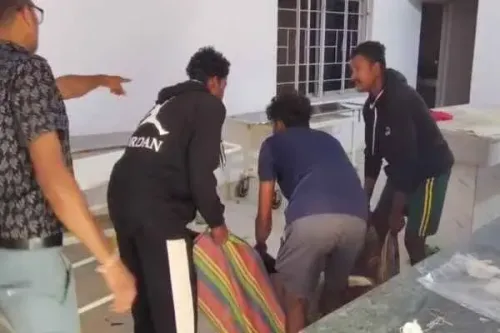
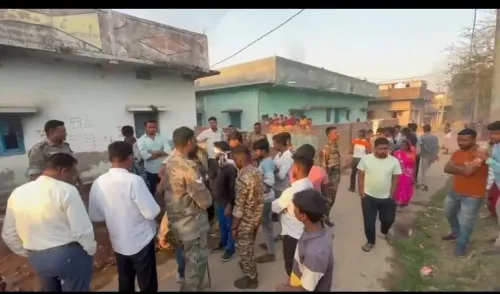
Udhampur woman dies after stepson sets her ablaze with petrol in J&K

Synopsis
A 42-year-old woman died in Udhampur, Jammu and Kashmir, after her stepson allegedly doused her in petrol and set her on fire, leaving her with burns across 70 per cent of her body. The accused has been arrested. The case adds to a documented rise in family-conflict-driven crimes involving juveniles in J&K, where NCRB data shows such cases nearly doubled between 2020 and 2022.
Key Takeaways
Sushma Devi , 42 , died at GMC Jammu after her stepson allegedly set her ablaze in Udhampur, J&K on 22 October 2026 .
The accused, Moksh Verma , allegedly sprinkled petrol or diesel on her inside their home in the Housing Colony area of Udhampur .
She sustained burn injuries over roughly 70 per cent of her body and was referred from District Hospital Udhampur to GMC Jammu , where she succumbed.
Moksh Verma has been arrested; police have initiated a detailed investigation into the incident.
According to NCRB data, juvenile-conflict cases in J&K rose from 171 in 2020 to 361 in 2022 .
A 42-year-old woman died in Jammu and Kashmir's Udhampur district after her stepson allegedly doused her with petrol and set her on fire inside their home, police confirmed on Thursday, 22 October 2026. The victim, identified as Sushma Devi, suffered burn injuries across roughly 70 per cent of her body and later succumbed at Government Medical College (GMC), Jammu.
How the Attack Unfolded
The incident took place on Wednesday evening in the Housing Colony area of Udhampur, when the accused, identified as Moksh Verma, allegedly sprinkled petrol or diesel on his stepmother inside their residence before setting her ablaze. Neighbours and family members rushed Sushma Devi to the District Hospital, Udhampur, where doctors assessed the extent of her injuries as critical. She was subsequently referred to GMC Jammu for specialised treatment, where she later succumbed to her burns, according to police.
Arrest and Investigation
Police said the accused, Moksh Verma, has been arrested. Authorities have taken cognisance of the incident and initiated a detailed investigation into the circumstances surrounding the alleged attack. Further forensic and circumstantial evidence is being gathered, officials added.
Broader Context: Juvenile Conflict and Family Violence in J&K
This comes amid a documented rise in cases of juveniles in conflict with the law across Jammu and Kashmir. According to National Crime Records Bureau (NCRB) data, registered cases rose significantly from 171 in 2020 to 323 in 2021, reaching 361 in 2022. A retrospective psychiatric study published in 2024 by the Institute of Mental Health and Neurosciences-Kashmir on juvenile offenders noted that common charges fell under the Unlawful Activities Prevention Act (UAPA), the Arms Act, and the POCSO Act.
Legal and mental health experts in the Union Territory note that a significant proportion of juveniles entering the justice system are first-time offenders driven by family conflict, severe financial stress, and an absence of parental guidance, rather than habitual criminal intent. Notably, crimes rooted in domestic discord — where the accused and victim share a household — present distinct investigative and rehabilitative challenges for the system.
What Happens Next
With the accused in custody, police are expected to file a charge sheet under relevant sections of Indian law. Investigators will probe the motive and whether prior grievances or disputes preceded the attack. The case is likely to draw scrutiny on the adequacy of support systems for families in conflict and the state's framework for addressing juvenile-linked domestic violence.
Point of View
Premeditated forms — and that the perpetrator being a family member does not make the crime any less deliberate. The NCRB trend of rising juvenile-conflict cases in J&K deserves more policy attention than it receives; the numbers have more than doubled in two years, yet rehabilitation infrastructure and early-intervention frameworks remain thin. What is also striking is the investigative gap: motive in domestic violence cases is routinely framed as a private dispute, when the pattern often points to systemic failures in family support and mental health access. The justice system's response to this case — from charge framing to sentencing — will be a test of whether J&K's courts treat family-perpetrated violence with the seriousness it demands.
NationPress
22 Oct 2026
Frequently Asked Questions
Who was Sushma Devi and what happened to her?
Sushma Devi was a 42-year-old woman from the Housing Colony area of Udhampur, Jammu and Kashmir. Her stepson, Moksh Verma, allegedly sprinkled petrol or diesel on her and set her ablaze on Wednesday evening, causing burn injuries over roughly 70 per cent of her body. She later died at Government Medical College, Jammu.
Has the accused been arrested?
Yes, Moksh Verma, identified as the stepson and alleged attacker, has been arrested by police. Authorities have taken cognisance of the incident and initiated a detailed investigation into the circumstances of the attack.
Where did the incident take place and where was Sushma Devi treated?
The attack occurred inside their residence in the Housing Colony area of Udhampur, J&K. Sushma Devi was first taken to the District Hospital in Udhampur, then referred in critical condition to Government Medical College (GMC), Jammu, where she succumbed to her injuries.
What is the broader context of rising juvenile conflict cases in J&K?
According to NCRB data, registered cases of juveniles in conflict with the law in Jammu and Kashmir rose from 171 in 2020 to 361 in 2022 — more than doubling in two years. Legal and mental health experts note that many such offenders are first-time perpetrators driven by family conflict, financial stress, and lack of parental guidance.
What charges is Moksh Verma likely to face?
With the accused in custody, police are expected to file a charge sheet under applicable sections of Indian law relating to culpable homicide or murder, as well as relevant provisions on causing death by fire. The investigation is ongoing, and the final charges will depend on the evidence gathered.