US Urges Private Sector Engagement to Compete with China Globally
Synopsis
In a bid to strengthen its global presence and counter China's influence, the U.S. is calling for enhanced private sector engagement. Deputy Secretary of State Christopher Landau emphasizes the critical role of commercial diplomacy in achieving long-term economic stability and geopolitical competitiveness.
Key Takeaways
The U.S. is prioritizing private sector engagement to counter China’s global influence.
Commercial diplomacy is a foundational aspect of American foreign policy.
Addressing barriers to U.S. investment abroad is essential for competitiveness.
Economic prosperity is crucial for stabilizing conflict-affected regions.
Private capital is key to job creation in emerging markets.
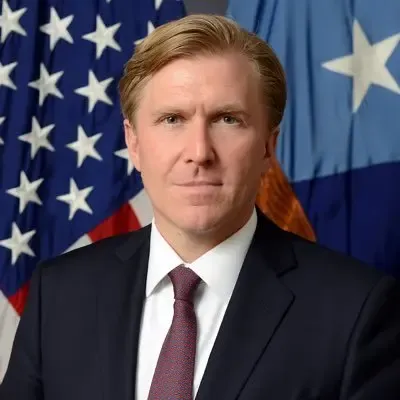
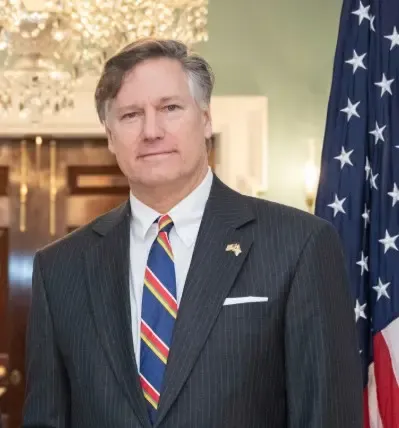
Washington, April 10 (NationPress) The United States needs to leverage its private sector more assertively in international markets to challenge China's growing influence, stated Deputy Secretary of State Christopher Landau, emphasizing that commercial diplomacy is a fundamental element of American foreign policy.
Landau articulated that positioning economic engagement as pivotal to both geopolitical competition and enduring global stability is essential, urging Washington to mobilize its businesses more effectively to compete internationally.
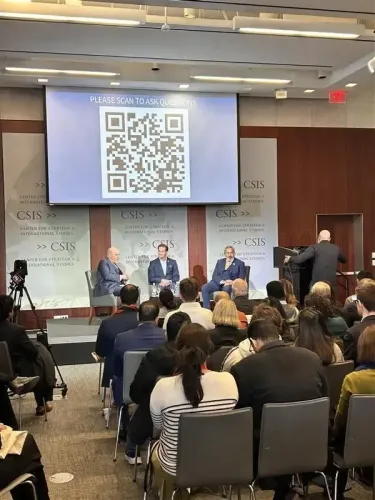
“Every single day, I ponder the question of how we can ensure that the U.S. private sector prevails over Chinese enterprises everywhere around the globe,” he remarked during his address at the Atlantic Council’s Global Prosperity Forum.
He recognized that while many nations show a preference for American companies, they often turn to China due to its persistent presence and financial backing. “You can’t surpass an established presence with inaction. The Chinese are operational here… What is the American private sector doing?” he questioned.
Landau emphasized the necessity for Washington to confront hurdles such as perceived risks, inadequate information, and complex regulations that inhibit U.S. companies from investing abroad. “We might be overstating some risks,” he commented, urging the government to assist firms in “accurately evaluating risks” and “mitigating those challenges.”
He proposed a strategy centered around what he referred to as a “three-legged stool” of commercial diplomacy: broadening export markets, promoting U.S. investment overseas, and drawing foreign direct investment into the United States.
“The overarching goal is to enhance our nation’s prosperity,” Landau stated, highlighting that economic engagement is not a zero-sum game. “The essence is to discover win-win scenarios that benefit both parties involved.”
He countered criticisms that an increased focus on commerce renders U.S. foreign policy excessively transactional. “All relationships… rely on a sense of mutual advantage,” he asserted.
Landau pointed to the Western Hemisphere as a “natural focal point” for U.S. engagement, citing its proximity and supply chain integration.
He identified Venezuela as a potential long-term opportunity, describing it as a “very, very rich country” whose economy has suffered significant decline.
In a broader context, he indicated that economic development could stabilize politically unstable regions. “Economic prosperity is crucial to resolving most of these conflicts,” he noted, referencing instances where investment initiatives have helped bridge political divides.
Regarding global conflicts, Landau mentioned that the U.S. is striving for a “lasting and effective ceasefire” in the Middle East, asserting that Washington has “successfully achieved military objectives” in diminishing adversarial capabilities.
He highlighted the critical role of access to capital in developing economies, labeling it as “the lifeblood of the entire system.”
He called for enhanced collaboration between government and business, stating, “What can I do to simplify your processes?” in his message to corporate leaders.
The Atlantic Council forum underscored a growing consensus among policymakers and financial institutions that private capital will be essential for global growth. Speakers remarked that most new jobs in emerging markets are anticipated to arise from the private sector, not government initiatives.
In recent years, the U.S. has increasingly prioritized economic statecraft alongside conventional diplomacy, particularly in response to China's Belt and Road Initiative. Washington has expanded resources such as the U.S. International Development Finance Corporation to bolster overseas investment and manage associated risks.
Point of View
The U.S. is positioned to enhance its influence in global markets through strategic engagement of its private sector. The emphasis on commercial diplomacy reflects a proactive approach to countering China’s dominance and fostering mutual economic benefits.
NationPress
20 Sept 2026
Frequently Asked Questions
Why is the U.S. focusing on private sector engagement?
The U.S. aims to enhance its competitiveness against China's expanding influence in global markets and believes that stronger private sector involvement is essential for achieving this goal.
What is commercial diplomacy?
Commercial diplomacy refers to the strategic use of economic relationships to achieve foreign policy objectives, emphasizing the role of businesses in international relations.
What are the barriers U.S. companies face in investing abroad?
U.S. companies encounter challenges such as perceived risks, lack of information, and regulatory complexities that can deter them from investing internationally.
How does economic engagement benefit global stability?
Economic engagement can lead to prosperity, which is crucial for stabilizing politically fragile regions and can help resolve conflicts by bridging political divides.
What role does private capital play in global growth?
Private capital is increasingly recognized as vital for driving job creation and economic development in emerging markets, surpassing government initiatives in impact.