Operation Sindoor: US report flags China support for Pakistan

Synopsis
A US commission says a Chinese engineer confirmed that personnel provided on-site technical support in Pakistan during the May 2025 conflict. Its report also cites Indian officials' unconfirmed assertion that Beijing may have supplied intelligence.
Key Takeaways
The 2026 report of the US-China Economic and Security Review Commission examines Chinese support for Pakistan during the May 2025 conflict.
Pakistan reportedly used advanced Chinese weapons during the fighting, according to the commission.
Chinese engineer Zhang Heng confirmed that he and other personnel provided on-site technical support in Pakistan, the report says.
Indian military officials asserted that Pakistan may have received Chinese intelligence support; the report says China's foreign ministry neither confirmed nor overtly denied the claim.
A Chinese survey vessel reportedly entered the Bay of Bengal in May 2025 , raising surveillance concerns, according to the report.
Operation Sindoor exposed how China's military support for Pakistan complicated India's security challenges, according to an annual report submitted to the US Congress. The report says Pakistan reportedly used Chinese weapons during the May 2025 fighting and cites a Chinese engineer who confirmed that technical personnel provided on-site support in Pakistan.
India launched the operation after the deadly April 2025 attack in Pahalgam, which New Delhi attributed to Pakistan-backed terrorists. The report also discusses alleged cyberattacks, possible intelligence assistance and the movement of a Chinese survey vessel, though it presents the evidence for each claim differently.
Chinese weapons and technical support
The 2026 annual report of the US-China Economic and Security Review Commission examines the conflict in a chapter titled ‘China's Second Front: India and the Future of US Strategy in the Indo-Pacific’. It describes Beijing's backing for Islamabad as part of a broader effort to counter India's growing economic and military influence while easing pressure on Pakistan.
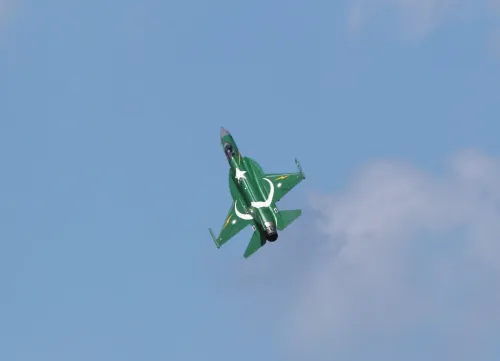
During the fighting, Pakistan reportedly used advanced weapons procured from China, the commission said. It also cited a May 2026 interview broadcast by China Central Television with Zhang Heng, an engineer at the Chengdu Aircraft Design and Research Institute of the Aviation Industry Corporation of China, a developer of Chinese fighter aircraft and unmanned aerial vehicles.
According to the report, Zhang confirmed that he and other personnel from the corporation supplied on-site technical support in Pakistan during the May 2025 conflict. The account distinguishes that confirmation from other claims in the report that are described as reported or asserted by officials.
Cyberattacks and intelligence claims
The commission said hackers reportedly attempted large-scale distributed denial-of-service attacks against India's critical infrastructure during the conflict. It identified government information technology infrastructure, telecommunications and digital services as targets of attempts to disrupt networks.
The cited account does not establish who carried out the reported cyberattacks. Separately, the report said Indian military officials asserted after the fighting that Pakistan may have received real-time satellite imagery or other intelligence support from Beijing.
China's Ministry of Foreign Affairs neither confirmed nor overtly denied that assertion, according to the commission. The report therefore presents the intelligence support as a possibility raised by Indian officials, rather than an established finding.
Survey vessel and Indian Ocean concerns
The report also said China increased pressure on India by deploying a survey vessel equipped with advanced sensors around the waters of India's Exclusive Economic Zone during the conflict. It noted separately that a Chinese survey vessel reportedly entered the Bay of Bengal in May 2025, as India-Pakistan tensions mounted.
That reported movement raised concerns that Beijing could monitor Indian forces and provide maritime intelligence to Pakistan during a crisis, the commission said. The concern is distinct from a confirmed finding that such intelligence was passed on.
The commission placed the vessel's reported activity within a wider assessment of China's commercial and military presence in the Indian Ocean. It said Beijing was expanding that presence to reduce vulnerability to disruptions at maritime chokepoints while weakening India's longstanding strategic advantages in the region.
Implications for India's security planning
The commission concluded that Chinese support for Pakistan could magnify India's security challenges across military, cyber and maritime domains. It also said India had taken notice and committed to accelerating military modernisation.
The report does not specify the outcome of the alleged cyberattack attempts or establish that China provided the intelligence described by Indian officials. As India pursues modernisation, the differing levels of evidence behind those claims will remain important to assessing the full extent of Chinese support.
Frequently Asked Questions
What did the US report say about China and Operation Sindoor?
The US commission said Chinese support for Pakistan compounded India's security challenges during the May 2025 conflict. It cited reported Chinese weapons use and an engineer's confirmation of on-site technical support in Pakistan.
Did China provide intelligence to Pakistan during Operation Sindoor?
The report says Indian military officials asserted that Pakistan may have received real-time satellite imagery or other intelligence from China. It says China's foreign ministry neither confirmed nor overtly denied the assertion.
Who provided Chinese technical support in Pakistan?
Chinese engineer Zhang Heng said he and other Aviation Industry Corporation of China personnel provided on-site technical support in Pakistan during the May 2025 conflict, according to the report. The commission cited his May 2026 television interview.
What did the report say about cyberattacks on India?
The report said hackers reportedly attempted distributed denial-of-service attacks on Indian critical infrastructure during the conflict. The cited account did not establish who carried them out.
Why did a Chinese survey vessel raise concerns?
Its reported entry into the Bay of Bengal in May 2025 raised concerns that China could monitor Indian forces and provide maritime intelligence to Pakistan. The report did not establish that such intelligence was passed on.