Government Onboards 100 Entities for Aadhaar Offline Verification
Synopsis
In a remarkable stride towards enhancing digital privacy, the Indian government has successfully onboarded over 100 entities to utilize Aadhaar-based offline verification, promising more efficient and secure identity verification methods.
Key Takeaways
Over 100 entities onboarded for Aadhaar offline verification.
Enhances privacy and security in identity verification.
Utilizes methods like QR codes and digitally signed documents.
Reduces reliance on physical documentation .
Streamlines service delivery for various sectors.
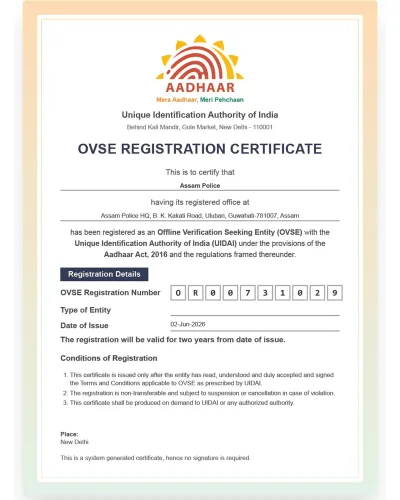
New Delhi, April 20 (NationPress) In a notable advancement towards privacy-centric digital solutions, the government announced on Monday that over 100 organizations have been integrated as Offline Verification Seeking Entities (OVSEs) within a mere three months following the introduction of Aadhaar-based offline verification.
This achievement, realized by the Unique Identification Authority of India, signifies a substantial progression in facilitating secure, consent-based, and paperless identity validation utilizing Aadhaar without necessitating immediate access to central databases.
“These organizations encompass a diverse array of sectors, including both central and state government bodies, financial technology companies, hospitality and event management firms, educational institutions, examination authorities, as well as organizations focused on background checks and workforce verification,” stated the Ministry of Electronics & IT.
“The incorporation of these entities into the ecosystem is anticipated to enhance service delivery, minimize processing durations, and lessen dependence on physical documentation,” the ministry further explained.
The Aadhaar offline verification framework enables users to share only essential identity information through techniques such as QR code-based verification and digitally signed documents.
This approach guarantees that individuals maintain authority over their personal data, deciding what to disclose and to whom, while upholding stringent standards of data security and privacy.
The ministry observed that the onboarding of these OVSEs illustrates a growing confidence in Aadhaar-enabled verification systems that emphasize user consent and transparency.
The decentralized structure of the system is crafted to bolster scalability and resilience, aligning with India’s wider vision of constructing a robust digital public infrastructure.
“This streamlined verification process simplifies interactions and fosters trust through transparent and consent-driven engagements,” the ministry noted.
This initiative also aims to enhance the “ease of living” by facilitating swifter and more efficient interactions between citizens and service providers.
Aadhaar holders can expect advantages such as accelerated onboarding procedures, diminished paperwork, and increased control over their data in everyday transactions.
Point of View
The onboarding of over 100 entities into the Aadhaar offline verification framework represents a commendable effort by the government to enhance privacy and security in digital transactions. This move could significantly streamline service delivery and reduce the reliance on physical documentation, thus fostering a more efficient and trustworthy ecosystem.
NationPress
16 Sept 2026
Frequently Asked Questions
What is Aadhaar offline verification?
Aadhaar offline verification is a system that allows users to verify their identity without real-time access to central databases, using methods like QR codes and digitally signed documents.
How many entities have been onboarded for this system?
As of now, over 100 entities have been integrated into the Aadhaar offline verification system.
What sectors do these entities belong to?
These entities span various sectors including government departments, fintech, hospitality, education, and workforce verification organizations.
What are the benefits of Aadhaar offline verification?
The benefits include improved service delivery, reduced processing time, less reliance on physical documents, and enhanced control over personal data for users.
How does this initiative contribute to privacy?
This initiative enhances privacy by allowing individuals to control the sharing of their identity data, ensuring that only necessary information is disclosed.