AI data centre 'phantom' loads make power demand harder to forecast: Capgemini

Synopsis
A Capgemini survey of over 600 senior electricity executives reveals that AI data centres are filing capacity requests that never materialise — and it is quietly breaking how power grids are planned. With 77% of utilities struggling to forecast demand and load concentration creating localised bottlenecks, the AI infrastructure boom is exposing structural cracks in global electricity systems before the real demand wave has even arrived.
Key Takeaways
67% of electricity executives say 'phantom' load requests from AI data centres have made demand forecasting harder.
19% of those load requests reportedly never materialise, distorting grid investment planning.
Nearly 80% of executives expect more extreme and volatile demand patterns; 77% report difficulty forecasting accurately.
Over 50% identified geographic load concentration of data centres as a major obstacle to reliable service.
60% of utilities expect AI to improve grid efficiency, but few have implemented advanced AI-driven grid management approaches.
Findings are from a Capgemini survey of over 600 senior electricity executives at firms with revenue above $500 million .
Around 67 per cent of electricity executives surveyed globally say that 'phantom' load requests from AI-driven data centres — 19 per cent of which never materialise — have made electricity demand forecasting significantly more difficult, according to a new report released on Friday, 26 June. The findings, from a Capgemini survey of over 600 senior electricity executives at organisations with annual revenue above $500 million, point to a structural crisis forming at the intersection of AI infrastructure and power grid planning.
The Phantom Load Problem
Data centres serving AI workloads routinely file capacity requests that are later withdrawn or scaled back, creating a fog of uncertainty for grid planners. Nearly 80 per cent of executives surveyed expect more extreme and volatile demand patterns going forward, while 77 per cent report difficulty in accurately forecasting future demand. The consequence, the report warns, is a distortion of investment planning — raising the risk of both costly over-investment in surplus capacity and dangerous under-investment that could leave grids short.
'Utilities must decide not only how much capacity to invest in but also where and when to prioritise grid modernisation investments to support future demand while avoiding stranded assets,' the Capgemini report stated.
Geographic Concentration Adding Pressure
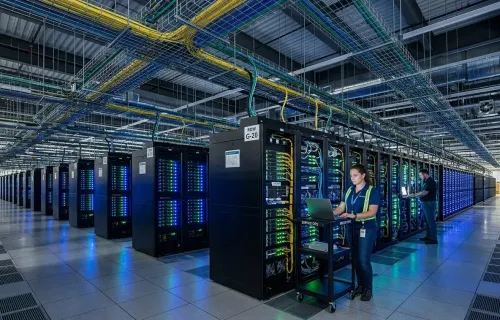
The challenge is compounded by where data centres are being built. Over 50 per cent of electricity executives identified load concentration as a major obstacle to reliable service. Large clusters of high-density facilities are creating localised bottlenecks that strain system stability and complicate long-range investment planning. Hyperscalers — the large cloud and AI infrastructure providers — face a parallel dilemma, having to commit to major infrastructure decisions against a backdrop of uncertain demand forecasts, grid availability, and connection timelines.
AI as Both Problem and Potential Fix
Despite being the source of the forecasting disruption, AI is also seen as part of the solution. Around 60 per cent of utilities expect AI to play a growing role in improving grid efficiency and unlocking operational gains. However, the report found that only a small fraction have actually implemented advanced AI-driven approaches to grid management — highlighting a significant gap between expectation and execution.
Claire Gauthier, Global Head of Energy & Utilities at Capgemini, said: 'AI is transforming electricity systems far beyond demand growth. It is exposing structural constraints in grid capacity, planning, and power availability, while making demand more dynamic and harder to predict.'
Gauthier added that utilities have a 'defining role to play as system orchestrators, leveraging AI-enabled insights to balance grid and customer-owned resources, accelerate deliverable capacity, and enable the next phase of data-center growth.'
What This Means for Grid Investment
The report's findings arrive at a moment when power demand from AI infrastructure is accelerating globally, including in India, where hyperscaler investments in data centre capacity have surged. Demand variability is expected to emerge as a major system challenge, requiring new approaches to both planning and operations. Without better forecasting tools and coordination between data centre operators and utilities, the risk of stranded grid assets — built for demand that never arrives — grows considerably.
The Capgemini report underscores that the AI-power nexus is no longer a future concern: it is already reshaping how electricity systems must be planned, financed, and operated.
Point of View
Utilities are forced to either overbuild and risk stranded assets, or underbuild and risk blackouts. Neither outcome is acceptable for a grid that must also absorb EV charging, industrial electrification, and household demand growth. The deeper problem is structural: data centre operators and grid planners operate on fundamentally different planning horizons and incentive structures, with no binding mechanism to align them. Until regulators or market rules force hyperscalers to put real financial stakes behind their load forecasts, utilities will keep flying blind — and ratepayers will eventually foot the bill for the mismatch.
NationPress
25 Sept 2026
Frequently Asked Questions
What are 'phantom' load requests from AI data centres?
Phantom load requests are capacity reservations filed by AI data centre operators with electricity utilities that are later withdrawn or never actually used. According to the Capgemini report, 19% of such requests never materialise, making it significantly harder for grid planners to forecast real demand.
What did the Capgemini survey find about electricity demand forecasting?
The Capgemini survey of over 600 senior electricity executives found that 77% report difficulty forecasting future demand accurately, and nearly 80% expect more extreme and volatile demand patterns. The primary driver cited is unpredictable load requests from AI-driven data centres.
Why is the geographic concentration of data centres a problem for power grids?
When large clusters of high-density data centres are built in the same area, they create localised bottlenecks that strain grid stability and complicate investment planning. Over 50% of executives surveyed identified this load concentration as a major obstacle to reliable electricity service.
Can AI help solve the grid forecasting problem it is creating?
Potentially, yes. Around 60% of utilities expect AI to play a growing role in improving grid efficiency and operational performance. However, the Capgemini report notes that only a small fraction of utilities have actually deployed advanced AI-driven grid management tools, leaving a significant gap between expectation and practice.
What should utilities do to manage AI-driven demand uncertainty?
According to Capgemini's Claire Gauthier, utilities need to act as 'system orchestrators,' using AI-enabled insights to balance grid and customer-owned resources and accelerate deliverable capacity. The report also stresses that utilities must carefully decide where and when to prioritise grid modernisation to avoid stranded assets.