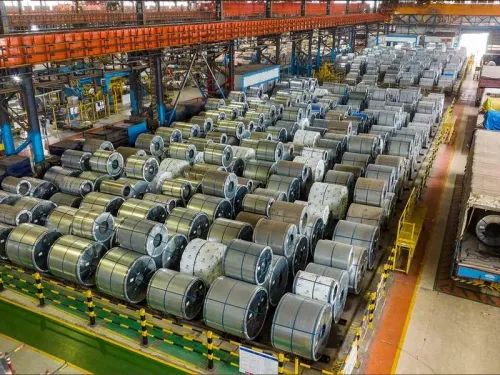
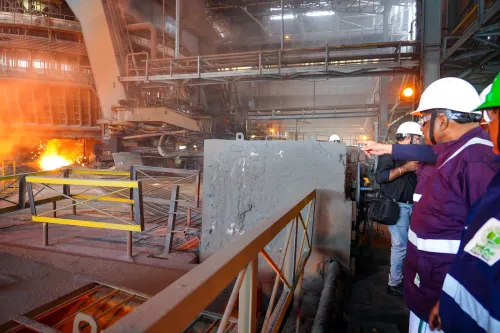
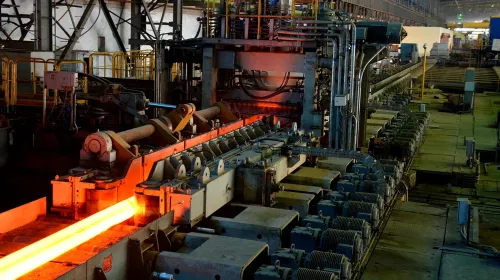
Anand Mahindra hails India steel output topping US and Japan combined
Synopsis
Mahindra Group chairman Anand Mahindra has reacted to data showing India now produces more steel than the United States and Japan combined, crediting Tata Steel, SAIL, JSW and decades of post-liberalisation growth for the historic milestone.
Key Takeaways
India's steel output now exceeds that of the United States and Japan combined , according to Anand Mahindra's post on 5 November 2026 .
India became the world's second-largest steel producer after China in 2023 , when it first overtook Japan alone.
Mahindra invoked his grandfather J.C.
Mahindra , India's first Iron and Steel Controller during the Second World War, to illustrate the scale of the transformation.
The growth traces back to 1991 economic liberalisation , which opened the sector to private investment and ended state monopoly on capacity.
The National Steel Policy 2017 set a target of 300 million tonnes of annual capacity by 2030 .
Mahindra credited Tata Steel , SAIL , and JSW Steel as key drivers of the industry's rise.
India has just crossed a steel milestone so staggering it stopped one of the country's most prominent industrialists mid-sentence. Mahindra Group chairman Anand Mahindra declared on 5 November 2026 that India is now producing more steel than the United States and Japan combined — and reached for the story of his own family to frame just how far the nation has travelled.
From Second World War controller to world-beating output
Mahindra's post carried a deeply personal undercurrent. His grandfather, J.C. Mahindra, was appointed India's first Iron and Steel Controller during the Second World War — a time when the country's industrial base was skeletal and its steel fate was dictated by colonial priorities. 'Somewhere in a parallel universe,' Anand Mahindra wrote, 'my grandfather must be celebrating.' That lineage makes the milestone more than a headline. It is a generational arc, compressed into a single data point.
Anand Mahindra had already flagged the trajectory in 2023, when India's crude steel production surpassed Japan's to claim the rank of world's second-largest producer after China — itself a moment he called 'almost unbelievable.' The latest figure pushes the story further still: India now outproduces the American and Japanese industries in aggregate. The pace of that leap, from trailing Japan to eclipsing both economies together, underlines just how dramatically the competitive map of global steel has been redrawn.
Three decades of reform behind one number
The number does not emerge from nowhere. India's steel sector was effectively thrown open to private capital after the 1991 economic liberalisation, ending state monopoly on capacity additions. The result, over three decades, was a wave of investment that transformed the sector from an import-dependent backwater into a global-scale exporter. The National Steel Policy 2017 formalised the ambition, targeting 300 million tonnes of annual capacity by 2030 to service surging demand from infrastructure, construction, and manufacturing.
Mahindra specifically credited Tata Steel — India's oldest integrated producer, founded in 1907 — alongside public-sector giant SAIL (Steel Authority of India Limited) and private powerhouse JSW Steel, as well as the broader ecosystem of companies and workers who built the capacity. The acknowledgement matters: this output is not the product of a single champion but of a layered industry where both state enterprises and private conglomerates scaled simultaneously.
What a steel superpower actually means
Steel is not a trophy industry. It is the material substrate of everything else — bridges, railways, defence platforms, affordable housing, electric-vehicle frames. A country that can produce steel at this scale on its own terms is a country that controls a critical input cost across its entire manufacturing economy. India's shift from net importer to confident producer changes its negotiating position in global supply chains and reduces a structural vulnerability that plagued industrial planning for decades.
The sector will now be watched closely for the next production figures from the Ministry of Steel and any revision of capacity targets under the National Steel Policy — signals that will tell investors and trading partners how far the ambition extends beyond the current landmark.
J.C. Mahindra's wartime ledgers once tracked a nation scraping for every tonne. His grandson is now celebrating a nation that makes more of it than America and Japan put together. That is not just industrial history — that is the story of modern India, forged in steel.
Point of View
Strategically vital sector that has compounded investment and policy support into genuine global leadership. For equity markets, it validates the long-running bet on domestic infrastructure spending as a demand engine. For corporate strategists, it signals that India is moving from 'cost-competitive assembler' to 'materials-sovereign manufacturer' — a structural shift with significant implications for input pricing, export competitiveness, and the depth of domestic supply chains in sectors from automotive to defence. The milestone also lifts the floor of ambition for every other heavy industry watching whether India can sustain the trajectory toward its 300-million-tonne capacity target.
NationPress
5 Nov 2026
Frequently Asked Questions
Is India now the second largest steel producer in the world?
Yes. India became the world's second-largest crude steel producer after China in 2023, surpassing Japan, and has since extended its lead significantly.
Who is J.C. Mahindra and what was his role in India's steel industry?
J.C. Mahindra was Anand Mahindra's grandfather and the co-founder of the Mahindra Group. He was appointed India's first Iron and Steel Controller during the Second World War, overseeing the nascent sector at a critical period in the country's industrial history.
Which companies lead India's steel production?
India's steel output is driven by a mix of private and public-sector producers. Tata Steel, founded in 1907, is the oldest integrated producer. SAIL (Steel Authority of India Limited) is the largest public-sector player, while JSW Steel is one of the biggest private-sector producers by capacity.
What is India's steel production target under the National Steel Policy?
The National Steel Policy 2017 set a target of 300 million tonnes of annual steel production capacity by 2030, aimed at supporting India's infrastructure and manufacturing expansion.
How did India's 1991 economic reforms affect the steel industry?
The 1991 liberalisation removed state monopoly on steel capacity additions and opened the sector to private investment. This triggered three decades of sustained capacity growth that transformed India from an import-dependent producer into one of the world's largest steel manufacturers.