What Were the Major Developments in Amaravati and Andhra Pradesh in 2025?
Synopsis
In 2025, Andhra Pradesh witnessed key advancements such as the revival of Amaravati capital development and Google's $15 billion AI data center project in Visakhapatnam. These initiatives, coupled with substantial investments, signal a transformative phase for the region's economy and infrastructure.
Key Takeaways
Amaravati capital development works have resumed, signaling a significant investment in infrastructure.
Google's $15 billion AI data center in Visakhapatnam is a game-changer for local employment.
The state government aims to create 20 lakh jobs in five years.
Ambitious plans to transform Andhra Pradesh into a $2.4 trillion economy by 2047.
Welfare schemes are set to uplift various communities and improve living standards.
Amaravati, Jan 1 (NationPress) The revival of development efforts for the Amaravati capital, along with Google’s significant announcement to establish a $15 billion AI data center in Visakhapatnam, and numerous agreements for substantial investments across various sectors stood out as pivotal events in Andhra Pradesh throughout the year 2025.
A key highlight was the recommencement of capital development activities, fulfilling a promise made by the Telugu Desam Party (TDP)-led coalition during the 2024 elections. With backing from the BJP-led central government, Chief Minister N. Chandrababu Naidu revived his ambitious project.
On May 2, 2025, Prime Minister Narendra Modi officially re-launched the Amaravati development initiatives, almost a decade after the original foundation stone was laid for the new capital of Andhra Pradesh. The state government resumed work on projects worth Rs 56,000 crore, which include the High Court, Legislative Assembly, State Secretariat, and four towers designated for Heads of Departments (HoDs).
Naidu expressed optimism that these projects would be finalized by March 2028.
The year also marked the initiation of the second phase of land pooling in Amaravati, with plans to acquire 16,666 acres across seven mandals in the Amaravati capital region. Naidu highlighted that the current 29-village footprint is insufficient for creating a metropolitan area comparable to Hyderabad.
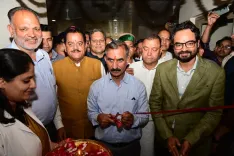
In October, he inaugurated the Andhra Pradesh Capital Region Development Authority (APCRDA) office, a notable advancement in the capital’s evolution. The modern seven-storey building, covering a built-up area of 28,562 square metres, has been established in the anticipated administrative core of Amaravati.
In November of the previous year, CM Naidu, together with Union Finance Minister Nirmala Sitharaman, laid the foundation stone for the regional headquarters of 15 public sector banks and insurance companies in Amaravati.
The government has also unveiled ambitious plans to develop Amaravati as a Quantum Valley, mirroring the concept of Silicon Valley in the USA. Naidu is confident that Andhra Pradesh will spearhead the quantum revolution in India.
“Within six months, the first quantum computer will be operational in Amaravati, and within two years, we will manufacture quantum computers here for global supply,” he stated during a recent event.
Google’s decision to establish its largest data center in Visakhapatnam has provided a significant boost to the state. Andhra Pradesh IT Minister Nara Lokesh believes this development will elevate Visakhapatnam similarly to how Microsoft’s facility transformed Hyderabad.
It is projected that Google’s $15 billion investment over five years will create employment for 1.88 lakh individuals, generate a Rs 48,000-crore impact on the local economy during this period, and produce a 25-times multiplier effect.
The state government claims to have attracted investments totaling $120 billion (Rs 10 lakh crore) over the past 16 months. During the recent CII Summit in Visakhapatnam, the government entered into 610 memoranda of understanding (MoUs) involving investments of Rs 13.25 lakh crore, expected to create 16.13 lakh jobs.
Plans to establish MSME parks in all 175 Assembly constituencies have also been announced. Lokesh asserted that Andhra Pradesh is drawing in massive investments due to its efficiency in business operations, where the state ranks first.
With a focus on a cluster-based approach and both vertical and horizontal integration, the government aims to transform Andhra Pradesh into a $2.4 trillion economy by 2047. The Greater Visakhapatnam Economic Corridor alone is envisioned as a $1 trillion economy. The state plans to develop three economic corridors, with the other two situated in Amaravati and Rayalaseema.
Anantapur has been developed into a mobility valley centered around the KIA Motors plant, while the northern regions of Anantapur and Kurnool are becoming hubs for renewable energy, pumped storage projects, and cement factories. An electronics manufacturing ecosystem is being built across Chittoor and Kadapa districts, while Nellore already boasts a significant industrial ecosystem in the form of Sri City.
The government is committed to fulfilling its ‘Super Six’ promise of creating 20 lakh jobs over five years, with a target of five lakh jobs specifically in the IT sector.
To support these commitments, the coalition government has rolled out various welfare schemes. Under the Talliki Vandanam scheme, financial assistance of Rs 10,090 crore was provided to benefit 67.27 lakh students, offering Rs 15,000 annually for each child enrolled in a government school.
On August 15, the government launched the Stree Sakthi scheme, which provides free transportation for women on APSRTC buses. To date, 3.25 crore women have utilized this service, with the government investing Rs 1,144 crore in the initiative.
The government has also distributed three free LPG cylinders annually, benefiting two crore women at a cost of Rs 2,684 crore. Under the Annadata Sukhibhava scheme, Rs 6,310 crore has been credited to the accounts of 46 lakh farmers.
Through the NTR Bharosa pension scheme, Rs 33,000 crore is disbursed annually to over 63 lakh beneficiaries.
To enhance governance delivery, the government has implemented citizen services via WhatsApp Governance and adopted data-driven decision-making for disaster management.
In August, the government introduced the ambitious P4 Initiative (Public-Private-People Partnership) aimed at achieving zero poverty by 2029. This initiative seeks to empower underprivileged families through community involvement, mentorship, and access to resources.
The P4 model emphasizes connecting affluent individuals and institutions with those in need, offering tailored support for employment, healthcare, and entrepreneurship, while integrating current welfare programs and leveraging technology, including AI, for needs assessment.
Point of View
It's crucial to recognize that the developments in Andhra Pradesh are not merely regional updates but significant milestones that can impact national growth. The ambitious projects initiated by the state government reflect a strategic vision for economic development, creating job opportunities and enhancing infrastructure, which is vital for India's progress.
NationPress
26 Sept 2026
Frequently Asked Questions
What is the significance of the Amaravati capital development?
The Amaravati capital development is crucial as it aims to establish Andhra Pradesh's capital as a modern metropolitan hub, driving economic growth and providing essential infrastructure.
How will Google's investment impact Visakhapatnam?
Google's investment is expected to transform Visakhapatnam into a major IT and tech hub, generating significant employment opportunities and boosting the local economy.
What are the government's plans for job creation in Andhra Pradesh?
The government aims to create 20 lakh jobs in five years, with a focus on the IT sector, through various initiatives and investments.
What welfare schemes have been introduced by the Andhra Pradesh government?
The Andhra Pradesh government has rolled out several welfare schemes, including financial aid for students and free transportation for women, to support the community.
What is the P4 Initiative?
The P4 Initiative is a government program aimed at achieving zero poverty by 2029, focusing on empowering underprivileged families through community support and resources.