Ayushman Bharat crosses 90 crore ABHA accounts; women near 50% of holders
Synopsis
India's Ayushman Bharat Digital Mission has enrolled 90 crore citizens into its digital health ID system — with women making up nearly half the base. Four union territories have hit full saturation, and the growth curve from 14.7 crore in 2021 to 90 crore in 2026 positions ABHA as one of the world's largest digital health enrolment drives.
Key Takeaways
The Ayushman Bharat Digital Mission has crossed 90 crore ABHA accounts as of 30 May 2026 .
Uttar Pradesh leads with 15.3 crore ABHAs; Rajasthan and Maharashtra follow with 7.1 crore each.
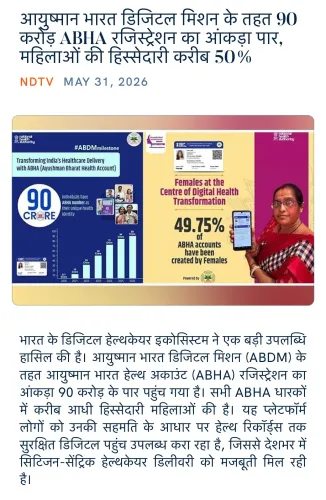
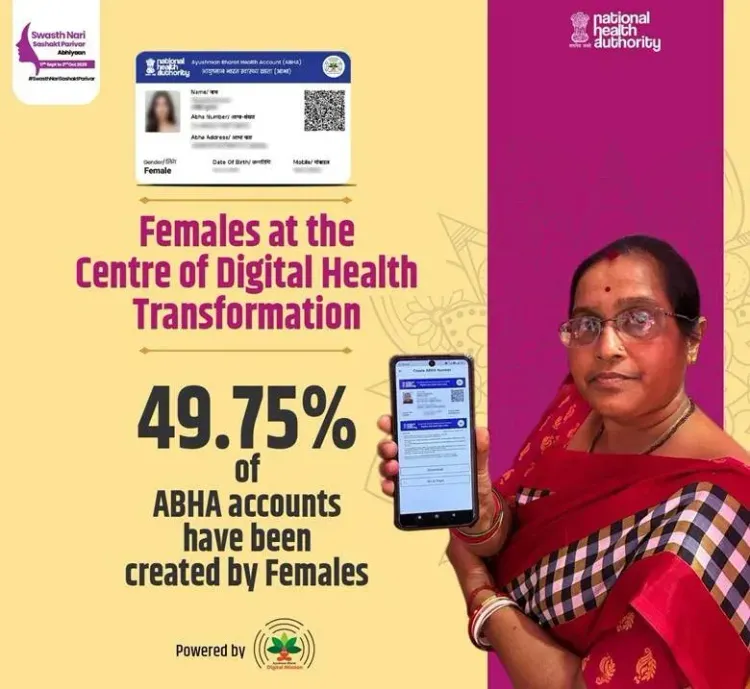
Women account for 49.75% of all ABHA holders, reflecting strong female participation including in rural areas.
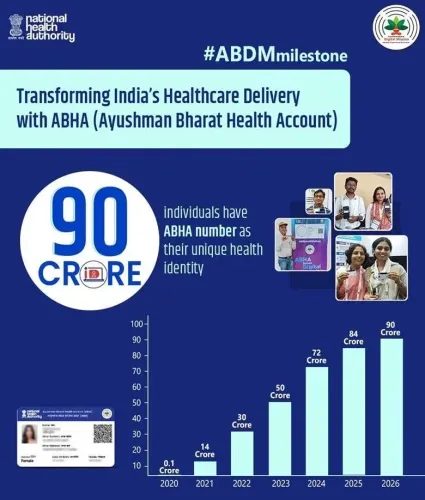
ABHA creation grew from 14.7 crore in 2021 to 90 crore in 2026, according to the Health Ministry .
Andaman and Nicobar Islands , Ladakh , Lakshadweep , and Dadra and Nagar Haveli and Daman and Diu have achieved full saturation.
The Ayushman Bharat Digital Mission (ABDM), implemented by the National Health Authority (NHA), has crossed 90 crore Ayushman Bharat Health Accounts (ABHAs) across India, the government announced on 30 May 2026. The milestone marks a significant leap in the country's push toward a connected, interoperable digital health ecosystem — and notably, women account for nearly half of all account holders.
State-wise Breakdown
Uttar Pradesh leads the country with over 15.3 crore ABHAs, followed by Rajasthan and Maharashtra with 7.1 crore each, Bihar with 6.3 crore, and West Bengal with 5.9 crore. Significant adoption has also been recorded in Madhya Pradesh, Gujarat, Andhra Pradesh, Odisha, and Karnataka.
Four union territories — Andaman and Nicobar Islands, Ladakh, Lakshadweep, and Dadra and Nagar Haveli and Daman and Diu — have achieved full saturation, meaning every resident in these regions has an ABHA.
Growth Trajectory Since Launch
The cumulative growth in ABHA creation has been steep and consistent. According to the Health Ministry, accounts rose from 14.7 crore in 2021 to 30.4 crore in 2022, 50.6 crore in 2023, 72.2 crore in 2024, and 84.5 crore in 2025, before crossing the 90-crore mark in 2026. This trajectory reflects one of the fastest digital health enrolment drives globally.
Women's Participation
Females constitute 49.75% of total ABHA holders — nearly half the entire base. This is particularly significant given that women in rural areas have historically faced barriers to accessing formal healthcare records. ABHA's digital architecture enables maternal and child healthcare tracking, immunisation records, and other essential health services to be linked from the first point of contact with the health system.
What the Government Said
Dr. Sunil Kumar Barnwal, CEO of the National Health Authority, said: 'The creation of over 90 crore ABHAs reflects the growing participation of citizens, States, UTs and ecosystem partners in the Ayushman Bharat Digital Mission. ABHA is an important step towards empowering citizens with secure, consent-based access to their own health information.'
He added that as ABDM adoption deepens, ABHA will enable continuity of care, reduce dependence on physical records, and support a more seamless, transparent and citizen-centric healthcare delivery system.
What ABHA Means for Citizens
For individuals, an ABHA facilitates digital linking of health records generated across different healthcare facilities and applications. It reduces the need to carry physical medical documents and enables secure, consent-based sharing of health information with providers. The system is designed to ensure data portability and interoperability across public and private health infrastructure. With 90 crore accounts now active, India's digital health backbone is approaching population-scale coverage — a foundation for the broader rollout of the Ayushman Bharat scheme's insurance and primary-care components.
Point of View
But the harder question is utilisation — how many of these accounts are actively linked to health records versus created during enrolment drives and left dormant. The near-50% female share is encouraging, but rural women's ability to exercise consent-based data sharing depends on digital literacy and infrastructure that remains uneven. India's digital health stack is now large enough to matter; whether it delivers continuity of care at scale will depend on how aggressively states integrate ABHA into frontline health worker workflows, not just registration counts.
NationPress
19 Sept 2026
Frequently Asked Questions
What is an Ayushman Bharat Health Account (ABHA)?
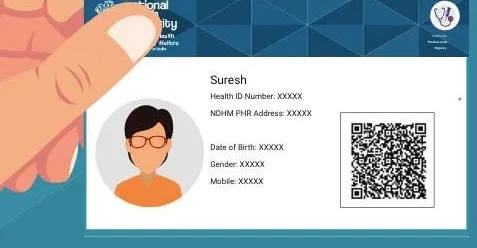
An ABHA is a unique digital health ID issued under the Ayushman Bharat Digital Mission that allows citizens to digitally link and access their health records across hospitals and clinics. It enables secure, consent-based sharing of medical information with healthcare providers, reducing dependence on physical documents.
How many ABHA accounts have been created so far?
As of 30 May 2026, over 90 crore ABHAs have been created across India, according to the Health Ministry. The count has grown from 14.7 crore in 2021 to 90 crore in 2026.
Which state has the most ABHA accounts?
Uttar Pradesh leads with over 15.3 crore ABHAs, followed by Rajasthan and Maharashtra with 7.1 crore each, Bihar with 6.3 crore, and West Bengal with 5.9 crore.
What is the share of women among ABHA holders?
Women constitute 49.75% of all ABHA holders — nearly half the total base. This is seen as a significant step toward giving women, including those in rural areas, secure digital access to their health records.
Which regions have achieved full ABHA saturation?
Andaman and Nicobar Islands, Ladakh, Lakshadweep, and Dadra and Nagar Haveli and Daman and Diu have achieved full saturation, meaning every resident in these union territories has been enrolled under the ABHA system.