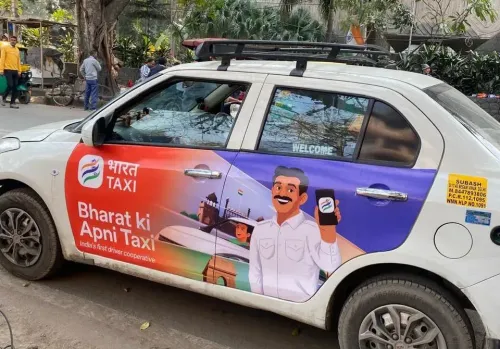
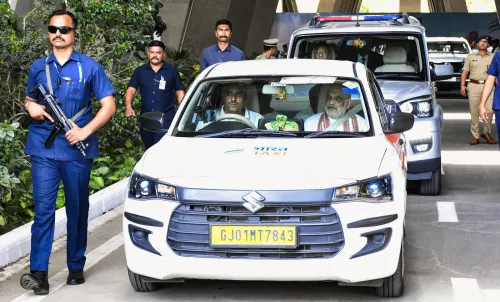
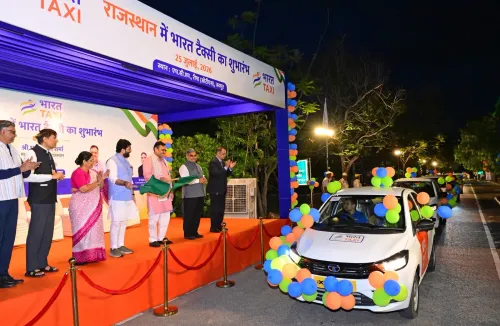
Bharat Taxi registers 8.48 lakh drivers, clocks 11,106 daily rides across India
Synopsis
Bharat Taxi, India's cooperative-led answer to Ola and Uber, now has 8.48 lakh drivers and 44.27 lakh customers — but Delhi-NCR alone accounts for over half its 11,106 daily rides, exposing how thin its footprint remains outside the capital. A fresh MoU with West Bengal's Yatri Sathi signals an attempt to scale through state partnerships rather than direct expansion.
Key Takeaways
Bharat Taxi has registered 8.48 lakh drivers and 44.27 lakh customers as of 12 August 2026 .
The platform facilitates 11,106 daily rides nationally, with Delhi-NCR contributing 5,574 — more than half the total.
Cumulative earnings for Sarathis (driver-partners) stand at ₹83.70 crore .
Operated by Sahakar Taxi Cooperative Limited (STCL) under the Multi-State Cooperative Societies Act, 2002 ; active in Delhi-NCR , Gujarat , Maharashtra , and Rajasthan .
STCL signed an MoU with the Government of West Bengal on 19 July 2026 to support the state-run Yatri Sathi platform.
Cooperative-led digital mobility platform Bharat Taxi has registered 8.48 lakh drivers and 44.27 lakh customers, facilitating 11,106 daily rides across the country, Parliament was informed on Wednesday, 12 August 2026. The platform has generated cumulative earnings of ₹83.70 crore for its driver-partners, known as Sarathis.
Key Figures Tabled in Rajya Sabha
Union Home Minister and Minister of Cooperation Amit Shah disclosed the figures in the Rajya Sabha, stating that the platform is operated by Sahakar Taxi Cooperative Limited (STCL) under the provisions of the Multi-State Cooperative Societies Act, 2002. The service has been officially launched in Delhi-NCR, Gujarat, Maharashtra, and Rajasthan.
City-wise Daily Ride Breakdown
The regional distribution of average daily rides, as presented to Parliament, shows Delhi-NCR leading with 5,574 rides, followed by Gujarat at 3,817, Pune at 632, Jaipur at 372, Lucknow at 324, Mumbai at 197, and Chandigarh at 190 — aggregating to the national daily total of 11,106.
Phased Expansion and Onboarding Process
According to the Ministry of Cooperation, the rollout to additional states is being carried out in phases, subject to operational preparedness, availability of Sarathis, completion of statutory requirements, and coordination with state governments, cooperative institutions, and other stakeholders. The implementation process covers driver registration and onboarding, customer enrolment, and structured training programmes.
MoU with West Bengal's Yatri Sathi Platform
STCL signed a memorandum of understanding with the Government of West Bengal on 19 July 2026 to collaborate with Yatri Sathi, a mobility platform developed and operated by the state's Department of Information Technology and Electronics (DITE). Under the MoU, Bharat Taxi will extend support in driver enrolment, cooperative membership, driver welfare, and public outreach. Notably, the two platforms operate under distinct legal frameworks — Bharat Taxi under central cooperative law and Yatri Sathi under a state government department — making the collaboration an unusual Centre-state cooperative model in the ride-hailing space.
What Comes Next
With Delhi-NCR accounting for more than half of all daily rides, the platform's growth will depend heavily on deepening penetration in smaller cities where ride counts remain in the hundreds. Further state-level expansions are contingent on approvals and ground-level coordination, suggesting a measured rather than aggressive rollout strategy in the near term.
Point of View
106 tells a different story. That works out to roughly one active ride per 76 registered drivers on any given day, pointing to a deep engagement gap. The platform's cooperative structure is its political differentiator, but without competitive pricing technology and driver-incentive depth, it risks becoming a well-intentioned registry rather than a functioning mobility alternative. The West Bengal MoU is a pragmatic move, but partnering with a state-run platform whose own scale is limited may not be the growth lever the Centre is hoping for.
NationPress
26 Sept 2026
Frequently Asked Questions
What is Bharat Taxi and who operates it?
Bharat Taxi is a cooperative-based digital ride-hailing platform operated by Sahakar Taxi Cooperative Limited (STCL) under the Multi-State Cooperative Societies Act, 2002. It is overseen by the Ministry of Cooperation and positions itself as a driver-welfare-focused alternative to private ride-hailing platforms.
How many drivers and customers has Bharat Taxi registered?
As of 12 August 2026, Bharat Taxi has registered 8.48 lakh drivers and 44.27 lakh customers, facilitating 11,106 daily rides across its active cities. Cumulative earnings for driver-partners stand at ₹83.70 crore.
In which cities and states is Bharat Taxi currently operational?
Bharat Taxi has been officially launched in Delhi-NCR, Gujarat, Maharashtra, and Rajasthan. Delhi-NCR leads with 5,574 average daily rides, followed by Gujarat at 3,817, Pune at 632, Jaipur at 372, Lucknow at 324, Mumbai at 197, and Chandigarh at 190.
What is the Bharat Taxi–Yatri Sathi MoU about?
STCL signed a memorandum of understanding with the Government of West Bengal on 19 July 2026 to collaborate with Yatri Sathi, the state's own mobility platform run by its Department of Information Technology and Electronics. Under the MoU, Bharat Taxi will support driver enrolment, cooperative membership, driver welfare, and public outreach on the Yatri Sathi platform.
How is Bharat Taxi expanding to new states?
Expansion is being carried out in phases, based on operational preparedness, availability of Sarathis, completion of statutory requirements, and coordination with state governments and cooperative institutions. No fixed timeline for new state launches has been announced.