Mumbai-Ahmedabad Bullet Train: First power substation nears completion at Bilimora
Synopsis
India's first bullet train project has crossed a quiet but critical milestone: the first of 14 traction substations powering the 508-km Mumbai-Ahmedabad corridor is nearly ready at Bilimora in Gujarat. The substation's completion would prove that the project's power backbone is advancing alongside its civil structures — a prerequisite before train trials can begin.
Key Takeaways
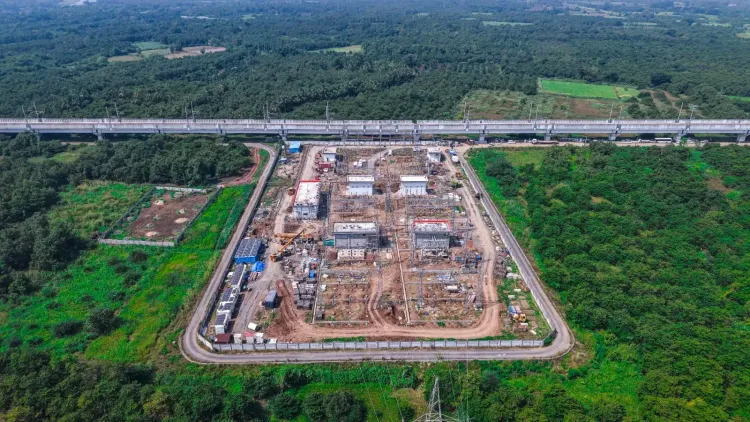
The first Traction Substation (TSS) for the Mumbai-Ahmedabad Bullet Train project is nearing completion at Bilimora , Navsari district , Gujarat.
The substation covers approximately 18,000 square metres ; installation of control panels, transformers, circuit breakers, and gantry towers is complete.
A total of 14 traction substations are planned along the 508-km corridor — five in Maharashtra and nine in Gujarat .
Gujarat substations will draw power from GETCO's 220 kV Ambetha Grid Substation via a 2 × 25 kV traction power supply system.
The entire network will be monitored in real time from a centralised control centre .
The first Traction Substation (TSS) for India's maiden Mumbai-Ahmedabad High-Speed Rail corridor is nearing completion at Bilimora in Gujarat's Navsari district, marking a significant milestone in the 508-km bullet train project. The substation is one of 14 planned along the corridor to ensure uninterrupted power supply for high-speed train operations.
Construction Progress at Bilimora
The substation, spread across approximately 18,000 square metres, is at an advanced stage of construction. Equipment installation, testing, and commissioning activities are currently under way at the site.
Installation work in the control panel, changeover switch, transformer, and circuit breaker buildings has been completed. Work on all gantry towers and beams has also been finished, signalling that the substation is close to being operational.
How the Power Supply System Works
The 14 traction substations will receive electricity from the grid, transform it to the required voltage levels, and feed it into the traction power system that drives the trains. In Gujarat, the substations will draw electricity from the Gujarat Energy Transmission Corporation Limited's (GETCO) 220 kV Ambetha Grid Substation.
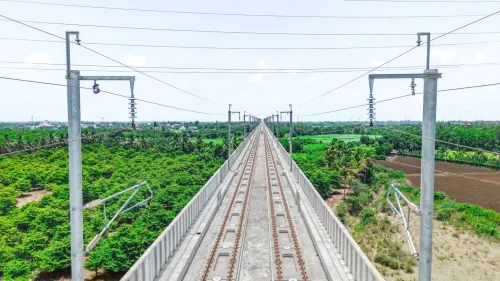
Power will then be distributed to the overhead equipment (OHE) installed along the viaduct through a 2 × 25 kV traction power supply system — the same standard used in Japan's Shinkansen network and several European high-speed lines. The OHE transfers electricity to the trains via their pantographs. The entire network will be monitored in real time from a centralised control centre.
Distribution Across Maharashtra and Gujarat
Of the 14 traction substations, five will be located in Maharashtra — at Mumbai, Thane, Virar, Boisar, and Thane Depot. The remaining nine will be in Gujarat — at Vapi, Bilimora, Surat, Bharuch, Vadodara, Anand, Mahemdavad, Ahmedabad, and Sabarmati Depot.
This split reflects the longer Gujarat segment of the corridor, which accounts for a greater share of the 508-km route between the two states.
Why This Milestone Matters
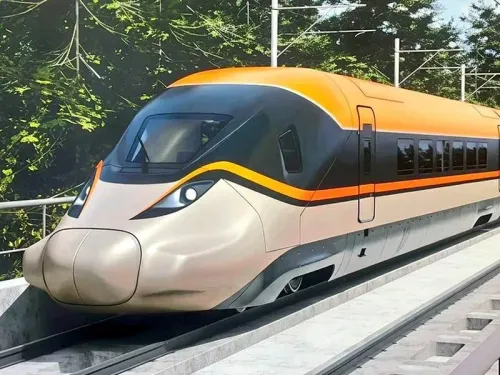
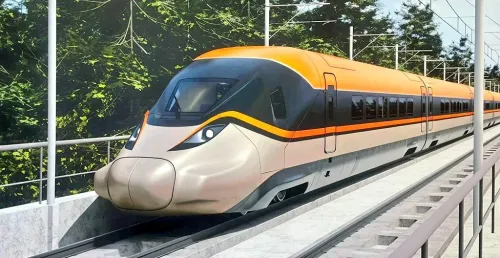
The completion of the first traction substation represents a concrete step toward operational readiness for India's first bullet train project. Traction power infrastructure is among the most technically complex elements of any high-speed rail system; delays in substation commissioning can cascade into broader schedule slippages for train trials and eventual passenger services.
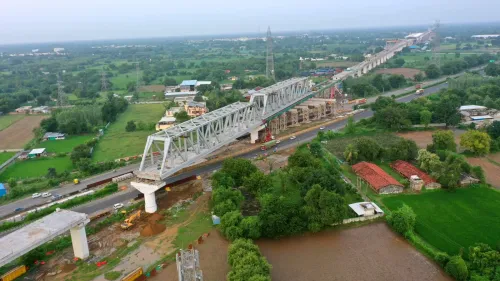
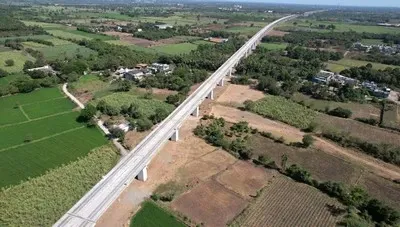
Notably, the Bilimora substation's near-completion signals that at least the Gujarat segment of the power backbone is advancing in tandem with civil construction work on the viaduct. With 13 more substations still in varying stages of development, the pace of commissioning across the corridor will be closely watched in the months ahead.
Point of View
Creating costly last-mile delays. If the remaining 13 substations can be commissioned at a comparable pace, the Mumbai-Ahmedabad corridor would avoid one of the most common failure modes of mega infrastructure projects. The real question — which official updates have consistently sidestepped — is whether the Maharashtra segment, with its denser urban geography and land acquisition complexities, is keeping up with Gujarat's comparatively smoother progress.
NationPress
31 Oct 2026
Frequently Asked Questions
What is the traction substation being built at Bilimora for the bullet train?
It is the first of 14 Traction Substations (TSS) planned along the 508-km Mumbai-Ahmedabad High-Speed Rail corridor. The substation will receive electricity from the grid, step it down to the required voltage, and supply it to the overhead equipment that powers the trains.
Where are the 14 bullet train traction substations located?
Five substations will be in Maharashtra, at Mumbai, Thane, Virar, Boisar, and Thane Depot. The remaining nine will be in Gujarat, at Vapi, Bilimora, Surat, Bharuch, Vadodara, Anand, Mahemdavad, Ahmedabad, and Sabarmati Depot.
How will the bullet train's power supply system work?
Gujarat's substations will draw electricity from GETCO's 220 kV Ambetha Grid Substation, which will be distributed through a 2 × 25 kV traction power supply system to overhead equipment along the viaduct. The trains collect this power through their pantographs, and the entire network will be centrally monitored in real time.
How far along is the Mumbai-Ahmedabad Bullet Train project?
The 508-km Mumbai-Ahmedabad High-Speed Rail corridor is India's first bullet train project. While civil construction has been advancing in Gujarat, the near-completion of the first traction substation at Bilimora marks a key milestone in building the project's power infrastructure.
Why are traction substations important for high-speed rail?
Traction substations are a critical part of any high-speed rail system; they convert grid electricity to the precise voltage needed for train operations and ensure stable, uninterrupted power across the corridor. Delays in their commissioning can directly delay train trials and passenger service launches.