Tata Consumer's Chandrasekaran: AI, geopolitics redefining global business
Synopsis
At TCPL's AGM, Chairman N. Chandrasekaran revealed that quick commerce now accounts for more than 35% of the company's India business — a striking milestone for a brand built on traditional retail. Paired with a full-scale AI deployment across supply chains and product development, TCPL is rewriting what a legacy tea-and-salt company looks like in 2025.
Key Takeaways
Chandrasekaran addressed shareholders at the company's AGM on 10 June in New Delhi .
He identified geopolitical shifts , AI advances , supply-chain realignments, energy transitions, and climate risks as the key forces reshaping global business.
Quick commerce and new-age channels now contribute more than 35% of TCPL's India business.
TCPL is deploying AI across product development, demand forecasting, consumer preference tracking, and supply-chain optimisation.
The West Asia conflict in early March raised stagflation concerns, though Chandrasekaran expressed confidence in India's growth outlook .
Traditional retail remains the backbone of TCPL's go-to-market strategy despite rapid digital channel growth.
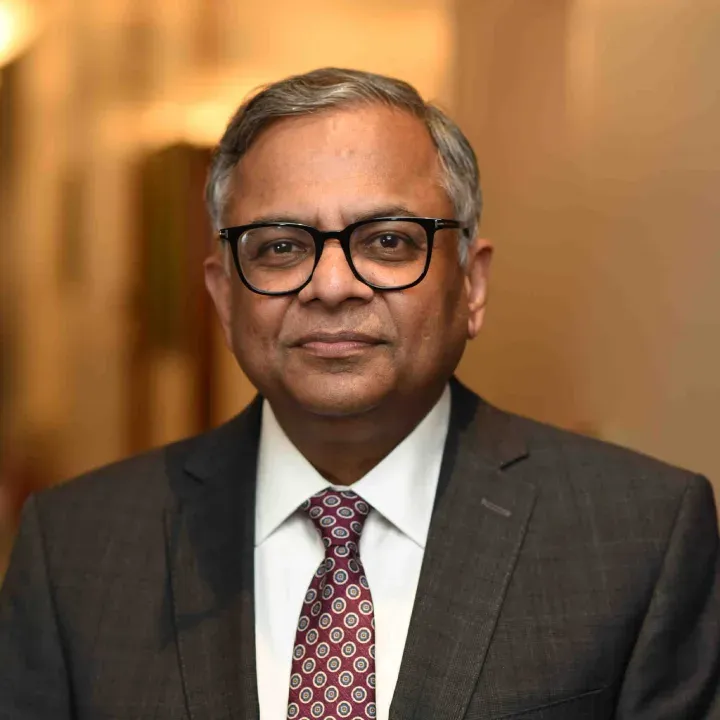
Tata Consumer Products Limited (TCPL) Chairman N. Chandrasekaran on Wednesday, 10 June said the global business environment is being fundamentally reshaped by geopolitical shifts, supply-chain realignments, energy transitions, rapid advances in artificial intelligence (AI), and climate-related disruptions. Speaking at the company's annual general meeting (AGM) in New Delhi, Chandrasekaran outlined how TCPL is positioning itself to navigate this complexity while capitalising on India's expanding consumer market.
AI at the Core of TCPL's Strategy
Chandrasekaran said TCPL is deploying AI across multiple operational layers — from accelerating product development cycles and improving demand forecasting to tracking emerging consumer preferences and optimising supply chains. 'TCPL is leveraging AI across several areas of its operations, including accelerating product development cycles, improving demand forecasting, tracking emerging consumer preferences, optimising supply chains and driving innovation,' he told shareholders.
This push reflects a broader industry trend where companies are racing to embed AI into core operations to improve productivity and build resilience against external shocks. For TCPL, a company that has already navigated a significant transformation from a tea-and-salt business into a diversified fast-moving consumer goods (FMCG) player, the AI investment signals the next phase of that evolution.
Global Macro Headwinds and India's Resilience
Chandrasekaran offered a mixed reading of the global macro environment. The year began on a constructive note, he said, with the India-European Union trade agreement and an interim India-US trade deal providing tailwinds. However, the outbreak of the West Asia conflict in early March raised fresh concerns about stagflation — the combination of slowing growth and rising inflation that is particularly difficult for central banks to address.
Despite these headwinds, Chandrasekaran expressed confidence in India's trajectory. 'India remains the fastest-growing major economy, led by its demographic strength, expanding digital infrastructure and rising aspirations. It continues to offer strong growth and a large market,' he said. This comes amid a broader global consensus that India is one of the few large economies where structural demand drivers remain intact.
Quick Commerce Crosses 35% of India Business
One of the sharper data points from the AGM: new-age sales channels, particularly quick commerce, now contribute more than 35% of TCPL's India business, according to the company. Chandrasekaran described this as a reflection of the rapid shift in Indian consumer behaviour driven by evolving lifestyles, new retail formats, and the rise of digital commerce.
Notably, he was careful to stress that traditional retail remains the backbone of TCPL's go-to-market strategy — a signal that the company is not abandoning its distribution depth even as it chases digital-first channels. The dual-channel approach is increasingly common among large FMCG players navigating India's fragmented retail landscape.
TCPL's Transformation and the Road Ahead
Chandrasekaran also reflected on TCPL's structural evolution, describing how the company has moved well beyond its origins as a tea-and-salt business into a broader FMCG portfolio. 'In response, companies across industries are focusing on building resilience, improving productivity and making trust-based decisions,' he said, framing TCPL's strategy within the wider corporate response to global uncertainty.
With quick commerce scaling fast, AI investments deepening, and India's consumption story intact despite global turbulence, TCPL's AGM signalled a company betting on execution discipline as its primary competitive edge in an unpredictable environment.
Point of View
If sustained, will force TCPL to renegotiate its relationship with the kirana network that built its distribution moat. The AI pivot is real but still largely operational; the harder question is whether AI can help TCPL win in premium categories where it remains a challenger. On the macro side, the stagflation warning tied to the West Asia conflict deserves more scrutiny: FMCG margins are acutely sensitive to commodity and logistics cost spikes, and a prolonged conflict could erode the rural demand recovery that underpins much of TCPL's India growth thesis.
NationPress
22 Sept 2026
Frequently Asked Questions
What did N. Chandrasekaran say at the TCPL AGM?
Tata Consumer Products Chairman N. Chandrasekaran said at the company's AGM on 10 June that geopolitical shifts, AI advances, supply-chain realignments, energy transitions, and climate risks are fundamentally reshaping the global business landscape. He outlined TCPL's AI-driven strategy and expressed confidence in India's growth prospects.
How is TCPL using AI in its operations?
TCPL is deploying AI to accelerate product development cycles, improve demand forecasting, track emerging consumer preferences, optimise supply chains, and drive innovation, according to Chandrasekaran. The company views AI as central to building resilience and improving productivity in a complex global environment.
What share of TCPL's India business comes from quick commerce?
New-age sales channels, particularly quick commerce, now contribute more than 35% of TCPL's India business, according to figures shared at the AGM. Despite this rapid growth, Chandrasekaran stressed that traditional retail remains the backbone of the company's distribution strategy.
What global risks did Chandrasekaran flag for businesses?
Chandrasekaran flagged geopolitical developments, supply-chain realignments, energy transitions, rapid AI advances, and climate-related events as the primary forces reshaping global business. He also specifically cited the West Asia conflict that broke out in early March as raising stagflation concerns.
Why is Chandrasekaran optimistic about India despite global uncertainty?
Chandrasekaran said India remains the fastest-growing major economy, supported by demographic strength, expanding digital infrastructure, and rising consumer aspirations. He told shareholders that India continues to offer strong growth potential and a large, expanding market.