Punjab drug money, narco-terror shadow Assembly elections as crackdown data mounts
Synopsis
Punjab heads into Assembly elections with a stark warning embedded in its own data: over 73,500 NDPS cases in four years, six ultrasensitive districts, 298 drone-smuggling incidents in a single year, and ₹74 crore in drug proceeds reportedly routed to Afghanistan for terror funding. The nexus between heroin networks and electoral money is what enforcement agencies are watching most closely now.
Key Takeaways
Punjab has six 'ultrasensitive' drug districts — Amritsar, Fazilka, Ferozepur, Gurdaspur, Tarn Taran and Ludhiana — out of 73 such districts nationwide under the Nasha Mukt Bharat campaign.
73,541 NDPS cases were registered in Punjab between 2022 and April 2026 , a rise of over 40 per cent from 52,255 in 2017–21.
In 2025 , 298 of the country's 305 drone-related drug trafficking incidents occurred along the Punjab border , yielding seizures of 460 kg of narcotics including 448 kg of heroin .
The Haryana ATS arrested seven accused linked to an international narco-terror network; ₹74 crore in drug proceeds was allegedly routed via hawala to Afghanistan for terror funding.
The NIA has filed six charge sheets against a syndicate linked to Afghan, Pakistani ISI and Dubai -based operatives, with wanted accused Vitaysh Koser alias Raju Dubai named as a mastermind.
The Centre released ₹5.67 crore under the NAPDDR scheme to Punjab in 2024–25 and 2025–26 , and is deploying anti-drone systems and hi-tech surveillance along the border.
Punjab is heading into Assembly elections under the shadow of a deepening narcotics crisis, with fresh enforcement data and a high-level national conference on 22 September 2026 underscoring just how far the state's drug problem extends — from border villages to suspected electoral financing. Despite a reported 40 per cent rise in drug cases since 2022, trafficking networks continue to evolve, employing drones, encrypted communications and hawala channels to move money across borders.
The Scale of Punjab's Drug Problem
Of 73 districts classified by the Union government as 'ultrasensitive' under the Nasha Mukt Bharat (Drug-free India) campaign, six lie in Punjab. These include Amritsar, Fazilka, Ferozepur, Gurdaspur and Tarn Taran — all along the Pakistan border — plus the industrial city of Ludhiana. A further 274 districts nationally carry 'sensitive' designation.
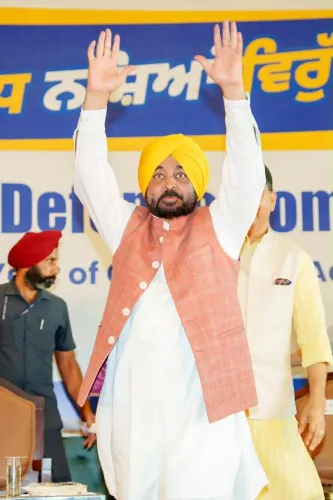
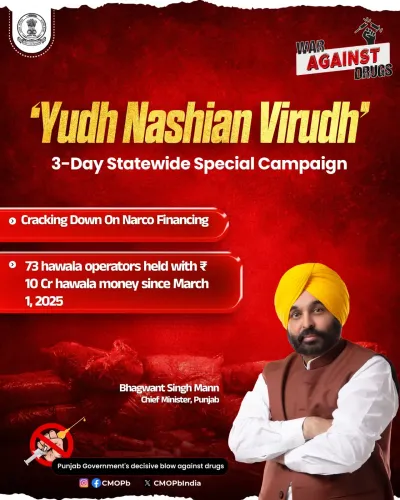
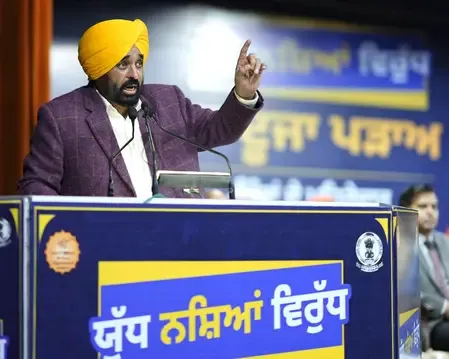
The Bhagwant Mann-led state government has reportedly intensified its flagship anti-drug drive, Yudh Nasheyan Virudh. According to official data, 73,541 cases under the Narcotic Drugs and Psychotropic Substances (NDPS) Act, 1985 were registered between 2022 and the end of April 2026 — a rise of more than 40 per cent from 52,255 cases logged between 2017 and 2021. Arrests in the same period reached 98,596, up nearly 45 per cent from 68,064 previously. The administration attributed the surge in figures to sustained, large-scale action against trafficking networks.
National Conference and Fresh Arrests
On Tuesday, 22 September, New Delhi hosted the third National Conference of the Anti-Narcotics Task Force (ANTF), signalling a push to tighten the Centre-State framework against drug trafficking. The same day, the Enforcement Directorate (ED) arrested a narcotics smuggler in Delhi, allegedly connected with large-scale import of heroin concealed in semi-processed talc, with contraband seizures spanning Delhi, Punjab and Haryana.
Separately, the Haryana Anti-Terrorist Squad (ATS) unearthed an international narco-terrorism case with the arrest of seven accused. Investigators found that proceeds of approximately ₹74 crore from illegal drug sales had been transferred via hawala to Afghanistan and used to fund terrorist activities, according to reports.
Drone-Led Smuggling: A Rapidly Escalating Threat
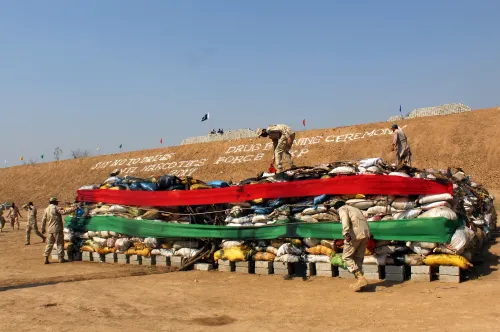
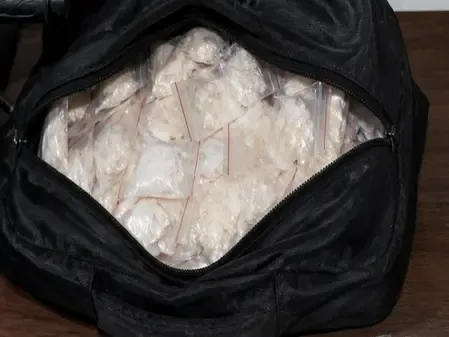
Punjab has emerged as the country's most drone-affected border state for drug trafficking, according to Minister of State for Home Affairs Nityanand Rai, who raised the issue in the Rajya Sabha. In 2025 alone, 305 drone-related trafficking incidents were recorded nationally — of which 298 occurred along the Punjab border, resulting in the seizure of roughly 460 kg of narcotic drugs, including 448 kg of heroin, 9 kg of methamphetamine and 3 kg of opium.
Trafficking syndicates operating from across the border have increasingly deployed sophisticated methods: GPS-enabled consignments, encrypted communications and local receiver networks. Official records confirm that Punjab is the primary gateway for narcotics trafficked from Afghanistan via Pakistan, with National Narcotics Control Bureau (NCB) data pointing to massive seizures year after year.
NIA Charge Sheets and the Afghanistan–Pakistan–Dubai Nexus
The National Investigation Agency (NIA) has filed six charge sheets against multiple accused for conspiring with an international drug-smuggling syndicate based out of Afghanistan, Pakistan and Dubai. The network allegedly operated under the direction of a wanted accused identified as Vitaysh Koser alias Raju Dubai, alongside Pakistani ISI agents and Afghan nationals. The charge sheets illustrate the transnational architecture behind what investigators describe as narco-terrorism.
Money, Elections, and What the Centre Is Doing
Agencies remain on alert over narco-terror money being funnelled into Punjab through heroin smuggling networks, with proceeds reportedly used for terror financing and suspected to be influencing local politics ahead of elections. This comes amid concerns that illicit drug money could distort the electoral process in a state already identified as hypervulnerable.
The Centre has deployed advanced anti-drone systems along vulnerable border stretches, alongside hi-tech surveillance cameras, new-design fencing and floodlighting. The Ministry of Social Justice and Empowerment has also released ₹5.67 crore during 2024–25 and 2025–26 under the National Action Plan for Drug Demand Reduction (NAPDDR) scheme to Punjab.
With elections approaching and trafficking networks showing no sign of retreat, Punjab's drug challenge is set to remain both a law-enforcement and a political flashpoint in the months ahead.
Point of View
But it also confirms that supply-side pressure has not broken the trafficking networks — it has, at most, documented them more thoroughly. The more alarming thread is the hawala-to-terrorism pipeline: when drug proceeds fund cross-border militancy and that money is then suspected to flow into election campaigns, the problem crosses from law enforcement into democratic integrity. The Centre's anti-drone deployments are reactive fixes to a structural vulnerability — Punjab's long, porous border — that no fencing programme has yet resolved. As elections near, the question is not whether agencies are cracking down, but whether political will exists to sever the ties between narco-money and electoral finance, which is far harder to prosecute than a drone intercept.
NationPress
22 Sept 2026
Frequently Asked Questions
Why is Punjab particularly vulnerable to drug trafficking?
Punjab shares a long border with Pakistan and is the primary gateway for narcotics trafficked from Afghanistan via Pakistan, according to official records. The state has six of the Union government's 73 'ultrasensitive' drug districts, including Amritsar, Ferozepur, Fazilka, Gurdaspur and Tarn Taran along the border, and the industrial hub of Ludhiana.
How many drug cases have been registered in Punjab since 2022?
A total of 73,541 NDPS Act cases were registered in Punjab between 2022 and the end of April 2026, a rise of over 40 per cent compared to 52,255 cases between 2017 and 2021. Arrests in the same recent period reached 98,596, up nearly 45 per cent.
What is the drone drug trafficking threat on the Punjab border?
In 2025 alone, 298 of the 305 drone-related drug trafficking incidents reported nationally occurred along the Punjab border, resulting in seizures of approximately 460 kg of narcotics, including 448 kg of heroin. Minister of State for Home Affairs Nityanand Rai told the Rajya Sabha that drone-assisted trafficking has seen an exponential rise since 2021.
How is drug money linked to terrorism and elections in Punjab?
The Haryana ATS found that roughly ₹74 crore in proceeds from illegal drug sales was transferred via hawala to Afghanistan and used for terrorist financing. Agencies are also monitoring the suspected use of narco-terror money to influence Punjab's upcoming Assembly elections, though specific electoral links remain under investigation.
What is the Centre doing to combat cross-border drug trafficking in Punjab?
The Centre has deployed advanced anti-drone systems along vulnerable border stretches, installed hi-tech surveillance cameras, erected new-design fencing and set up floodlights. It has also released ₹5.67 crore under the NAPDDR scheme to Punjab for 2024–25 and 2025–26, and convened the third National Conference of the Anti-Narcotics Task Force (ANTF) on 22 September 2026 to strengthen the Centre-State enforcement framework.