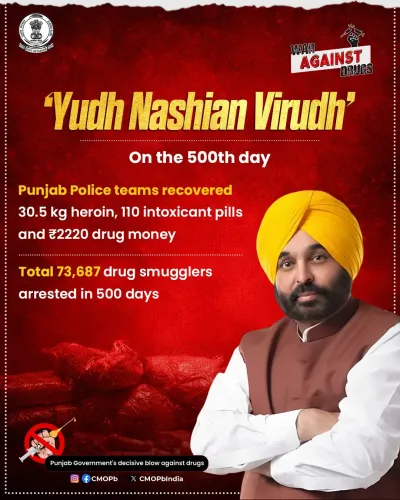
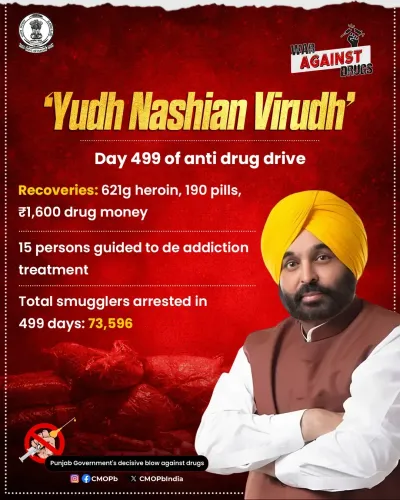
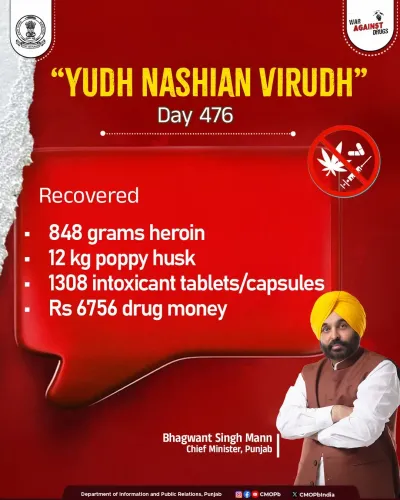
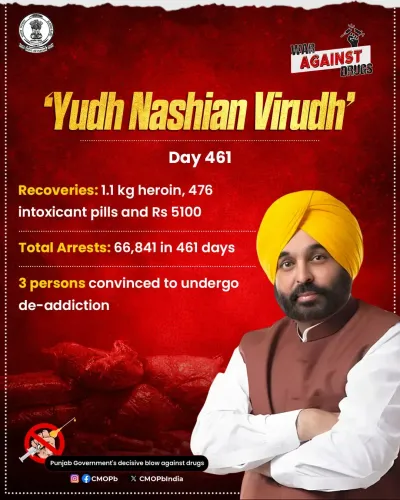
Punjab's 'Yudh Nashian Virudh' hits 87,600 arrests in 602 days
Synopsis
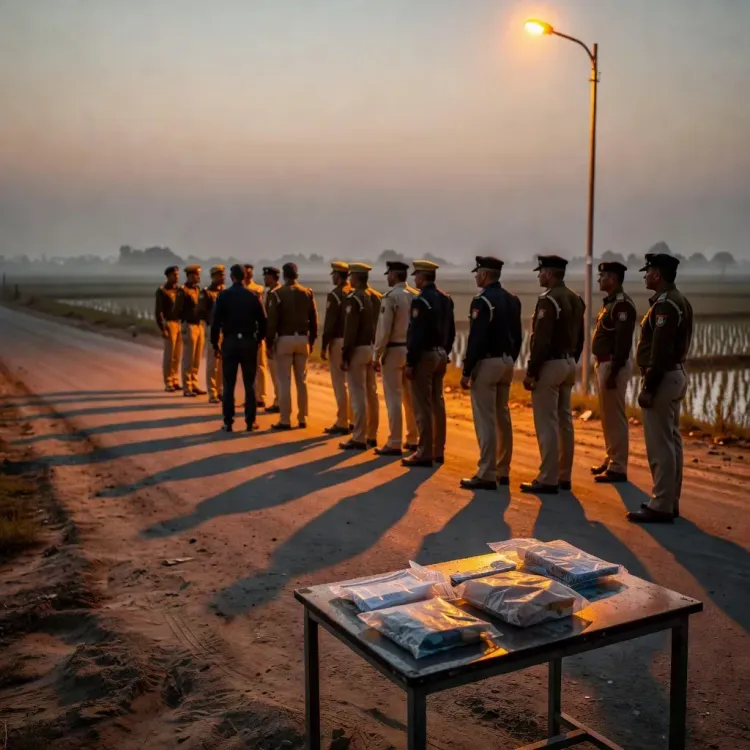
On day 602 of Punjab's 'Yudh Nashian Virudh' campaign, police arrested drug smugglers and seized 358g heroin and 1,920 pills, bringing total arrests to 87,600. CM Bhagwant Mann's office announced the milestone, underscoring the AAP government's daily anti-narcotics accountability drive launched in 2022.
Key Takeaways
Day 602 of the 'Yudh Nashian Virudh' campaign was reported by the Chief Minister's Office of Punjab on 25 October 2026 .
Sunday's seizure: 358 grams of heroin , 1,920 intoxicant pills , and Rs 3,160 in drug money .
Cumulative arrests since the campaign launched now stand at 87,600 in 602 days .
The campaign averages approximately 145 arrests per day over its full run.
The drive was launched in 2022 by Chief Minister Bhagwant Mann 's AAP government as a flagship anti-narcotics initiative.
Analysts will watch whether the 1,00,000-arrest milestone and future data include rehabilitation outcomes alongside enforcement numbers.
On the 602nd consecutive day of Punjab's relentless anti-drug campaign, police teams arrested fresh drug smugglers and seized 358 grams of heroin, 1,920 intoxicant pills, and Rs 3,160 in drug money — pushing the cumulative arrest tally to a staggering 87,600. The Chief Minister's Office of Punjab announced the milestone on Sunday, 25 October 2026, marking another daily data point in a drive that has become one of the most sustained anti-narcotics enforcement pushes in the state's history.
What 'Yudh Nashian Virudh' is — and why it keeps counting
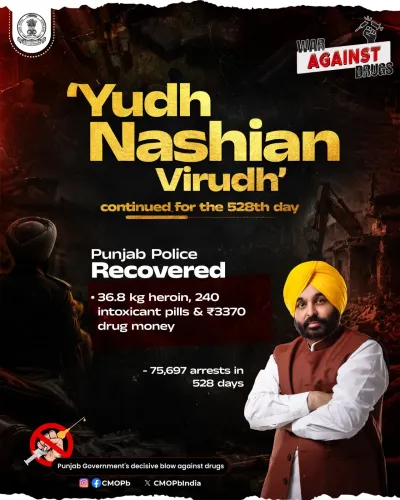
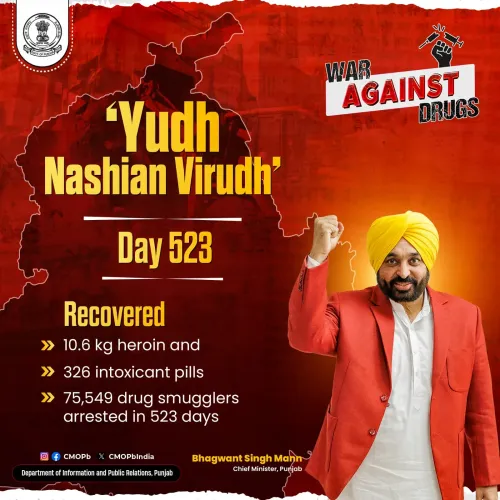
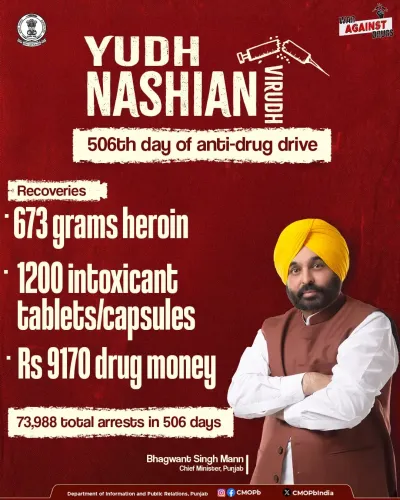
The campaign Yudh Nashian Virudh — Punjabi for 'War Against Drugs' — was launched by Chief Minister Bhagwant Mann's Aam Aadmi Party government in 2022, almost from the first week it took office. The signature feature is deliberate and disciplined: every single day, the state publicly reports arrests, seizures, and recovered drug money. That daily cadence transforms enforcement from an episodic news event into a running accountability clock — one that now reads 602 days without a gap.
Punjab's vulnerability to drug trafficking is structural. The state shares a long border with Pakistan, sits on historical narcotics supply corridors, and has for decades contended with an addiction crisis that devastated rural households and fuelled a generation of political promises. The AAP government's pitch in the 2022 assembly election leaned heavily on breaking that cycle through intensified police action — and the daily public reporting format is designed to show the work, not just announce it.
The numbers behind day 602
Sunday's haul — 358 grams of heroin, 1,920 pills, and just over Rs 3,000 in drug cash — is modest in isolation but significant in aggregate logic. The campaign's power is not in any single day's seizure but in the cumulative pressure it claims to maintain on supply networks. With 87,600 arrests logged over roughly 20 months, Punjab Police is averaging approximately 145 arrests per day across the entire campaign period — a pace that, if sustained, would push the tally past 1,00,000 by early 2027.
The daily reports also create a public audit trail. Each number — heroin grams, pill counts, drug money — is placed on the record by the Chief Minister's own office, making it harder for the administration to quietly walk back claims about campaign momentum.
From electoral promise to 600-day benchmark
When the AAP swept Punjab in March 2022 on a platform that included a direct promise to 'end the drug menace', sceptics were quick to note that every previous government had made similar pledges. The Mann administration's response was to build a visible, hard-to-hide metric: the day count. Reaching day 600 is a deliberate milestone — the kind of number that anchors a political narrative heading into the next phase of the government's term.
Analysts watching the campaign will track whether cumulative seizure data at future benchmarks — 700 days, or eventually 1,000 days — is accompanied by linked rehabilitation and de-addiction data, which would provide a fuller picture of whether enforcement is translating into reduced consumption on the ground.
Six hundred days of daily arrests is a commitment in itself. Whether it is also a solution is the question Punjab's families are still waiting to answer.
Point of View
600 arrests over 602 days builds an imposing headline number, but without matching data on seizure-to-conviction rates and rehabilitation uptake, the narrative risks remaining supply-side only. Punjab's drug crisis is historically rooted in both supply networks and demand cycles, meaning sustained enforcement gains are most meaningful when paired with de-addiction infrastructure. The 600-day benchmark will sharpen pressure on the government to show that disrupting supply chains is translating into measurable improvements in addiction rates on the ground.
NationPress
25 Oct 2026
Frequently Asked Questions
What is the 'Yudh Nashian Virudh' campaign in Punjab?
'Yudh Nashian Virudh' (War Against Drugs) is an ongoing anti-drug campaign launched by the Bhagwant Mann-led AAP government in Punjab in 2022, under which Punjab Police conduct daily anti-narcotics operations and publicly report arrests and seizures every day.
How many drug smugglers have been arrested under Yudh Nashian Virudh?
As of day 602 of the campaign (25 October 2026), a cumulative total of 87,600 drug smugglers have been arrested under the Yudh Nashian Virudh drive.
What was seized on day 602 of Punjab's anti-drug campaign?
On the 602nd day of the campaign, Punjab Police recovered 358 grams of heroin, 1,920 intoxicant pills, and Rs 3,160 in drug money from arrested smugglers.
Who launched the Yudh Nashian Virudh campaign?
The campaign was launched by Chief Minister Bhagwant Mann's Aam Aadmi Party government in Punjab in 2022, following the party's election victory on a platform that included a promise to combat the state's drug menace.
Why is Punjab particularly affected by drug trafficking?
Punjab's border location with Pakistan and its position along historical narcotics supply corridors have made it structurally vulnerable to drug trafficking and addiction, a challenge that successive state governments have tried to address through enforcement drives.