India's creative economy next growth frontier: MoS Murugan at Jindal Conclave
Synopsis
India's creative economy — spanning film, gaming, animation, and digital content — has a ₹2.5 trillion base today and a $100 billion target by 2030. MoS Dr. L. Murugan's address at the Jindal Policy Conclave signals the Centre is treating creative industries not as cultural spending but as a hard economic bet, with 57 million Indians already in the sector and 2 million more AVGC professionals needed by decade's end.
Key Takeaways
Murugan addressed the Jindal Policy Conclave on 18 September , declaring India's creative economy the country's next major growth frontier.
India's media and entertainment sector stands at ₹2.5 trillion and is projected to reach ₹3,067 billion by 2027 at a 7% CAGR .
The government targets a $100 billion creative ecosystem by 2030 , transitioning India into a global IP exporter.
The AVGC sector is projected to need nearly 2 million skilled professionals by 2030.
The Centre plans AVGC Creator Labs in 15,000 schools and 500 colleges , alongside support for the Indian Institute of Creative Technologies .
An estimated 57 million Indians already work in cultural and creative occupations globally.
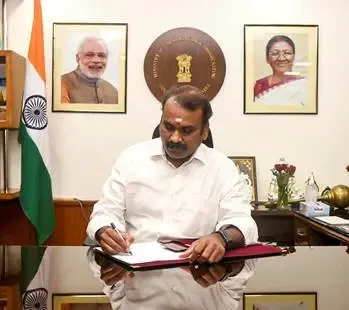
Minister of State for Information and Broadcasting Dr. L. Murugan on Friday, 18 September declared that India's creative economy is emerging as the country's next major growth frontier, capable of generating significant employment and entrepreneurship opportunities for young Indians. Speaking at the Jindal Policy Conclave in New Delhi, Murugan outlined a sweeping vision for sectors ranging from film and gaming to animation and digital content.
Key Developments
Dr. Murugan highlighted that the animation, visual effects, gaming and comics (AVGC) sector alone is expected to require nearly 2 million skilled professionals by 2030. He noted that an estimated 57 million Indians are already working in cultural and creative occupations, anchoring India's position as a global creative powerhouse. India's media and entertainment economy currently stands at ₹2.5 trillion, with the sector projected to grow at a compound annual growth rate (CAGR) of approximately 7 per cent, reaching roughly ₹3,067 billion by 2027, according to government data.
Government Initiatives for Creative Skilling
The Centre has announced support for the Indian Institute of Creative Technologies and the establishment of AVGC Creator Labs in 15,000 schools and 500 colleges across the country. These measures are designed to equip youth with the skills required for emerging creative roles. The government has projected the creative ecosystem to scale up to $100 billion by 2030, signalling an ambition to transition India from a content-consuming nation to a global creator and exporter of intellectual property.
Global Context and India's Share
Dr. Murugan contextualised India's creative push within a global framework, noting that the creative economy contributes 3.1 per cent to global GDP and accounts for 6.2 per cent of global employment. Sectors such as film, music, gaming, animation, design, publishing, advertising and digital content are converging to create layered opportunities for both employment and enterprise. This comes amid a broader global recognition of the creative industries as resilient, high-value economic drivers — a shift that India is now positioned to leverage at scale.
Policy and Legal Framework Emphasis
The minister stressed that the creative economy's growth must be underpinned by robust legal and policy safeguards, including copyright protection, fair compensation for creators, and responsible use of artificial intelligence. Critics and industry observers have long flagged that India's intellectual property enforcement mechanisms remain inconsistent, and that AI-generated content poses fresh challenges for creator rights. Dr. Murugan urged young people to 'question assumptions and institutions with respect, reason and evidence' and channel their ideas and skills towards building a Viksit Bharat by 2047.
What's Next
With AVGC Creator Labs rollout across schools and colleges expected to gain momentum, the focus will shift to whether skilling infrastructure can match the sector's projected talent demand of 2 million professionals by 2030. Industry stakeholders will watch closely for concrete policy timelines around copyright reform and AI governance — two pillars that will determine whether India's creative economy ambition translates from headline numbers into a durable growth engine.
Point of View
But the gap between aspiration and infrastructure is wide. AVGC Creator Labs in 15,000 schools sound transformative on paper, yet skilling initiatives in India have historically struggled with quality, placement linkages, and industry alignment. The minister's emphasis on copyright protection and AI governance is the most substantive part of the speech — without those frameworks, creator incomes will remain fragile even as platform valuations soar. India's 57 million creative workers deserve more than a headline number; they need enforceable rights and a functioning IP ecosystem that mainstream coverage has largely glossed over.
NationPress
18 Sept 2026
Frequently Asked Questions
What is India's creative economy and how large is it?
India's creative economy encompasses sectors such as film, music, gaming, animation, design, publishing, advertising and digital content. The country's media and entertainment sector currently stands at ₹2.5 trillion, with an estimated 57 million Indians already employed in cultural and creative occupations.
What is the government's target for India's creative economy by 2030?
The government has projected the creative ecosystem to reach $100 billion by 2030, aiming to position India as a global creator and exporter of intellectual property rather than primarily a content-consuming market.
What is the AVGC sector and why does it matter?
AVGC stands for animation, visual effects, gaming and comics — a high-growth segment of India's creative economy. According to MoS Dr. L. Murugan, the AVGC sector is expected to require nearly 2 million skilled professionals by 2030, making it a significant source of future employment.
What government schemes support the creative economy in India?
The Centre has announced support for the Indian Institute of Creative Technologies and the launch of AVGC Creator Labs in 15,000 schools and 500 colleges to prepare youth for creative sector roles. These initiatives are aimed at bridging the projected talent gap in the sector.
What policy safeguards did MoS Murugan call for in the creative sector?
Dr. Murugan emphasised the need for copyright protection, fair compensation mechanisms for creators, and responsible governance of artificial intelligence within the creative industries. He made these remarks at the Jindal Policy Conclave on 18 September.