Sarvam signs MoU with Defence Ministry's HQ IDS for tri-service AI projects
Synopsis
India's Sarvam has signed a sweeping MoU with the Defence Ministry's HQ IDS to bring its AI stack — including the 105B foundation model and the dedicated Chanakya division — across all three armed services. With sovereign infrastructure mandated and human oversight built in, this is one of the most comprehensive military AI frameworks an Indian tech firm has undertaken.
Key Takeaways
Sarvam signed an MoU with HQ IDS (Ministry of Defence) on 27 October 2026 for tri-service AI deployment.
The agreement covers the Indian Army , Indian Navy , and Indian Air Force , plus joint and integrated organisations under HQ IDS.
AI applications will address operational , training , and decision-support needs, with human oversight retained on all operational decisions.
Work will be carried out by Chanakya , Sarvam's firewalled national security division, using the Sarvam 105B foundation model.
All AI will be built and deployed on sovereign Indian infrastructure , advancing the Centre's Atmanirbharta agenda in defence.
Co-founder Pratyush Kumar confirmed the partnership, calling it 'an honour and a privilege.'
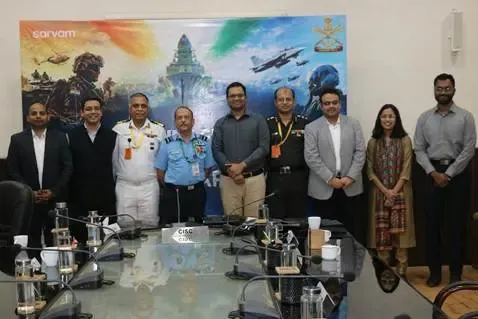
AI startup Sarvam on 27 October 2026 signed a Memorandum of Understanding (MoU) with the Headquarters Integrated Defence Staff (HQ IDS) — a body under the Ministry of Defence — to design, develop, and deploy artificial intelligence applications across the Indian Army, Indian Navy, and Indian Air Force. The agreement also covers joint, tri-service, and integrated organisations under HQ IDS, making it one of the broadest military AI partnerships an Indian technology firm has entered.
What the Agreement Covers
Under the pact, Sarvam will build and deploy AI solutions addressing operational, training, and decision-support requirements for all three services, with ongoing technical support included. The scope encompasses decision support, target acquisition, and data fusion across the sensor-to-shooter loop, with human oversight retained on operational decisions. Crucially, all AI infrastructure will be built and run on sovereign Indian infrastructure — a deliberate design choice, not an afterthought.
Shared Foundation, Cross-Service Learning
A notable structural feature of the MoU is that all three services and joint organisations will gain access to the same foundation models, agentic infrastructure, and geospatial and perception systems. This means doctrine and operational lessons from one service's AI deployment can directly inform the next — a force-multiplier logic that distinguishes this framework from siloed, service-specific tech contracts. The work will be executed through Chanakya, Sarvam's ring-fenced division focused exclusively on national security and defence, which will deploy the company's AI stack including its Sarvam 105B foundation model.
Atmanirbharta Push in Military AI
The agreement is positioned as a concrete step in the Centre's Atmanirbharta (self-reliance) drive in defence, extending indigenisation imperatives from hardware platforms to artificial intelligence. Officials and industry observers note that AI is increasingly consequential to military capability — governing targeting, logistics, surveillance, and command-and-control — making sovereign AI capability as strategically significant as sovereign weapons platforms. This MoU signals a direct government acknowledgement of that reality.
What Sarvam Said
Pratyush Kumar, Co-founder of Sarvam, said: 'Sarvam exists to build AI in India, for India. To work with the three Services on the nation's defence is an honour and a privilege. We are grateful to HQ IDS for its trust.'
What Comes Next
With HQ IDS facilitating engagement across all services, specific project timelines and deliverables will be defined jointly. The Chanakya division's firewalled structure is designed to insulate sensitive defence work from Sarvam's commercial operations, a model comparable to classified research arms at global defence-technology companies. How quickly the three services can operationalise AI outputs — and how rigorously human-oversight protocols are enforced — will determine the real-world impact of the partnership.
Point of View
Missiles, warships — but AI has remained a soft underbelly, often sourced from foreign platforms with opaque training data. This MoU attempts to close that gap, but the real test lies in execution: foundation models are only as useful as the quality and sensitivity of the data they are trained on, and defence data governance in India is still nascent. The Chanakya division's firewalled structure is a sound architectural choice, but firewalls are institutional promises, not technical guarantees. Sarvam is a credible technical actor, yet the leap from commercial AI to mission-critical military deployment — with zero tolerance for hallucinations in a targeting loop — is not incremental. The human-oversight clause is reassuring on paper; whether it survives operational pressure will define the programme's legacy.
NationPress
27 Oct 2026
Frequently Asked Questions
What is the Sarvam–HQ IDS MoU about?
It is an agreement under which AI firm Sarvam will design, develop, and deploy artificial intelligence applications for the Indian Army, Indian Navy, and Indian Air Force, covering operational tasks, training, and decision support. The pact was signed on 27 October 2026 with Headquarters Integrated Defence Staff, a body under the Ministry of Defence.
What is the Chanakya division and why is it significant?
Chanakya is Sarvam's ring-fenced division dedicated exclusively to national security and defence work, insulated from the company's commercial operations. It will deploy Sarvam's AI stack — including the Sarvam 105B foundation model — for the armed services, providing a structural safeguard for sensitive military data and applications.
How does this advance India's Atmanirbharta goals in defence?
The MoU extends the Centre's indigenisation drive from hardware platforms to artificial intelligence, ensuring that the AI layer used by the armed forces is built and run on sovereign Indian infrastructure. This reduces reliance on foreign AI platforms for mission-critical military functions.
Will AI be used to make autonomous lethal decisions under this agreement?
No. The agreement explicitly retains human oversight on operational decisions. The AI layer is designed for decision support, target acquisition, and data fusion — augmenting human judgement rather than replacing it in the sensor-to-shooter loop.
Which services and organisations are covered under the pact?
The MoU covers the Indian Army, Indian Navy, and Indian Air Force, as well as joint, tri-service, and integrated organisations under HQ IDS. HQ IDS facilitates the engagement across all these entities, enabling shared AI infrastructure and cross-service learning.