India solar installations could hit 85 GW by FY30, data centres key: Equirus
Synopsis
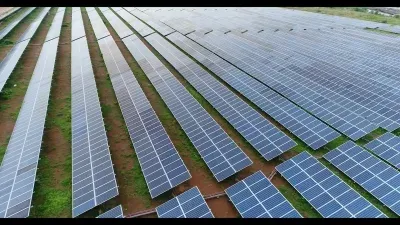
India's solar sector is on the cusp of a demand step-change — and it has little to do with traditional power targets. Data centres backed by AWS, Microsoft and Google, a 5-million-tonne green hydrogen mission, and a decisive pivot to firm power formats could push annual solar installations from 50 GW to 85 GW by FY30, with integrated IPPs holding storage capability emerging as the decade's defining winners.
Key Takeaways
India's annual solar installations could rise from 50 GW in FY27 to 85 GW by FY30 , according to an Equirus Securities report dated 29 June .
Data centres, green hydrogen, and night-time connectivity could add 15–20 GW of incremental solar demand annually from FY29 .
India holds a 2.5-year utility solar pipeline — 215 GW of LOAs from FY18–FY26 — with 70 GW balance yet to be executed.
AWS , Microsoft , and Google have each committed ₹2–3 lakh crore across 300+ approved data centre projects in India.
India's BESS demand is forecast to jump from 34.7 GWh (2022–2027) to 236.2 GWh (2027–2032).
Integrated IPPs with firm supply and storage capability are identified as the structural winners of the current re-tendering cycle.
India's annual solar installations could surge from approximately 50 GW in FY27 to nearly 85 GW by FY30, driven by emerging demand from data centres, green hydrogen, and round-the-clock power needs, according to a report released on 29 June by Equirus Securities. The projection marks a significant acceleration in the country's renewable energy trajectory.
Pipeline and Execution Outlook
India's utility solar sector currently holds a robust multi-year pipeline, with 145 GW of signed power purchase agreements (PPAs) and 68 GW of pending awards underpinning sustained execution demand. The country has accumulated a 2.5-year utility solar pipeline, with 215 GW of Letters of Award (LOA) secured between FY18 and FY26.
Of these, 75 GW has already been executed, leaving a balance pipeline of 70 GW — comprising 58 GW of solar and 12 GW of wind — against annual utility installations running at around 21 GW.
Unsigned PPAs and Signing Probability
Around 58 GW of unsigned solar PPAs remain outstanding. Of these, 73% are plain solar or hybrid projects, with approximately 43 GW falling under plain solar and hybrid tenders where the probability of signing is considered low. However, 15 GW of Round-The-Clock (RTC), Firm and Dispatchable Renewable Energy (FDRE), and Solar+Battery Energy Storage Systems (BESS) projects carry a high signing probability, the Equirus report noted.
Data Centres and AI Driving Incremental Demand
The report identified data centres as a structural new demand driver. India has approved over 300 data centre projects, with AWS, Microsoft, and Google each committing ₹2–3 lakh crore in investments. AI inference workloads require round-the-clock power, making Solar+BESS the most cost-effective solution at scale, according to Equirus.
Each 100 MW data centre would require approximately 250 MW of solar, 150 MW of wind, and nearly 450 MWh of battery energy storage to operate entirely on renewable power. Data centres, green hydrogen, and night-time connectivity could collectively add 15–20 GW of incremental solar demand annually from FY29 onwards.
Green Hydrogen and BESS Growth
India's National Green Hydrogen Mission targets 5 million tonnes of annual green hydrogen production by 2030. The Equirus report estimates that every 1 million tonne of hydrogen output would require approximately 20 GW of dedicated solar capacity — adding a substantial layer to long-term solar demand.
On the storage front, India's BESS-based demand is projected to rise sharply from 34.7 GWh during 2022–2027 to 236.2 GWh during 2027–2032. This growth is being propelled by renewable integration requirements, grid stability mandates, and improving project economics.
Structural Winners: Integrated IPPs
The report identified a decisive shift in new tenders toward firm power formats — specifically BESS and FDRE/RTC structures — as electricity distribution companies (DISCOMs) pivot away from intermittent supply toward power available during both solar and non-solar hours. Integrated independent power producers (IPPs) with storage and firm supply capability are positioned as the structural winners of this re-tendering cycle, Equirus concluded.
With policy momentum, large-scale tech investment, and a maturing project pipeline converging, India's solar sector appears set for a step-change in annual capacity additions through the end of the decade.
Point of View
Round-the-clock power to data centres and electrolysers. That structural shift — from intermittent to dispatchable renewables — explains why DISCOMs are pivoting toward FDRE and RTC formats, and why plain solar PPAs are stalling at the signing stage. The 85 GW FY30 projection is credible only if the data centre pipeline converts at speed and green hydrogen projects move from mission targets to actual electrolyser procurement. Both remain execution risks. The real indicator to watch is not LOA volumes but PPA signing rates on the 58 GW unsigned backlog.
NationPress
29 Jun 2026
Frequently Asked Questions
What is India's solar installation forecast for FY30?
According to an Equirus Securities report released on 29 June, India's annual solar installations could reach nearly 85 GW by FY30, up from around 50 GW projected for FY27. The jump is driven by new demand from data centres, green hydrogen production, and round-the-clock power requirements.
How are data centres driving solar demand in India?
India has approved over 300 data centre projects, with AWS, Microsoft, and Google each committing ₹2–3 lakh crore in investments. Because AI inference requires continuous power, each 100 MW data centre needs roughly 250 MW of solar, 150 MW of wind, and 450 MWh of battery storage to run entirely on renewables, making Solar+BESS the preferred solution.
What is India's current utility solar pipeline?
India has a 2.5-year utility solar pipeline built on 215 GW of Letters of Award secured between FY18 and FY26. Of these, 75 GW has been executed, leaving a balance of 70 GW — 58 GW solar and 12 GW wind — against annual utility installations of around 21 GW.
How much battery storage capacity is India expected to add by 2032?
India's BESS-based storage demand is projected to surge from 34.7 GWh during 2022–2027 to 236.2 GWh during 2027–2032, driven by renewable integration needs, grid stability mandates, and improving project economics, according to the Equirus report.
What role does green hydrogen play in India's solar demand outlook?
India's National Green Hydrogen Mission targets 5 million tonnes of annual green hydrogen production by 2030. Equirus estimates that every 1 million tonne of hydrogen output requires approximately 20 GW of dedicated solar capacity, adding up to 100 GW of potential long-term solar demand if the full target is met.