How is India Rethinking Human Capital for the AI Era at IIT Guwahati?
Click to start listening
Synopsis
The Working Group Meeting at IIT Guwahati highlights the urgency for India to prepare its workforce for an AI-driven future. Experts from various sectors converge to discuss innovative strategies for education reform and human capital development, setting the stage for impactful discussions leading up to the India AI Impact Summit 2026.
Key Takeaways
- Human capital is essential for India's AI journey.
- There is a need for lifelong learning and adaptability in education.
- Collaboration between policymakers, academia, and industry is crucial.
- Inclusive AI ecosystems must be prioritized.
- The IndiaAI Mission aims to build future-ready talent.
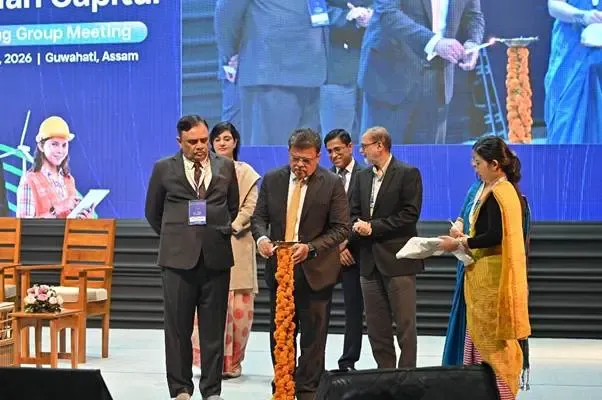
New Delhi, Jan 5 (NationPress) A two-day Working Group Meeting on Human Capital commenced at IIT Guwahati on Monday, uniting senior policymakers, scholars, industry leaders, and practitioners to deliberate on how India should equip its workforce for the Artificial Intelligence era.
The meeting is being organized by the Ministry of Electronics and Information Technology (MeitY), the IndiaAI Mission, the Government of Assam, and IIT Guwahati.
The discussions, taking place on January 5 and 6, are centered on education reform, workforce transition, and the adoption of inclusive, human-centric AI.
Chaired by T. G. Sitharam, this meeting serves as a significant lead-up to the India AI Impact Summit 2026, scheduled to occur in New Delhi from February 15 to 20.
The outcomes from the Guwahati meeting are expected to influence national policy decisions and enrich discussions at the global level during the summit.
The inaugural session included addresses from Syedain Abbasi, Special Chief Secretary of Assam; K. S. Gopinath Narayan, Principal Secretary (IT), Government of Assam; Prof. T. G. Sitharam; Devendra Jalihal, Director of IIT Guwahati; and Shikha Dahiya, Joint Director at IndiaAI, MeitY.
Speakers emphasized that human capital is crucial in India's AI journey, urging the country to evolve beyond traditional skilling models to adopt lifelong learning and institutional preparedness.
Welcoming the attendees, Prof. Devendra Jalihal expressed that IIT Guwahati aims to serve as a connector among policymakers, academia, industry, and students in crafting a future-ready workforce.
He underscored the institute's endeavors at the nexus of technology, education, and society, noting that robust student engagement signifies a growing interest in developing inclusive AI ecosystems.
Shikha Dahiya articulated the vision behind the India AI Impact Summit 2026, focusing on human capital, democratization of AI resources, and responsible AI adoption, especially pertinent to the Global South.
According to her, the IndiaAI Mission is dedicated to nurturing future-ready talent through enhanced computing capacity, indigenous datasets and models, and extensive AI skilling initiatives nationwide.
Prof. T. G. Sitharam asserted that the transition to an AI-driven economy must prioritize people and inclusivity.
He highlighted that India requires robust lifelong learning systems that emphasize not only technical skills but also adaptability, judgement, and human values, ensuring that technological advancements contribute to dignity and opportunities for all.
From the government's perspective, K. S. Gopinath Narayan stated that AI is revolutionizing economies and societies, carrying profound implications for human capital.
He stressed the importance of continuous learning, micro-skilling, and basic AI literacy as vital public competencies.
Point of View
The discussions at IIT Guwahati are vital for shaping a workforce that is adaptable and future-ready. The convergence of various stakeholders reflects a collective commitment to ensuring that India not only embraces technology but does so in a way that upholds human values and promotes inclusive growth.
NationPress
09/01/2026
Frequently Asked Questions
What is the purpose of the Working Group Meeting on Human Capital?
The meeting aims to discuss strategies for preparing India's workforce for the challenges and opportunities presented by the age of Artificial Intelligence.
Who are the key participants in the meeting?
The meeting includes senior policymakers, academics, industry leaders, and practitioners from various sectors.
What are the main topics of discussion?
Discussions focus on education reform, workforce transition, and the adoption of inclusive, human-centric AI.
When is the India AI Impact Summit 2026 scheduled?
The summit is set to take place in New Delhi from February 15 to 20, 2026.
How will the outcomes of this meeting influence future policies?
The insights gained from this meeting are expected to shape national policy decisions and contribute to global discussions during the upcoming summit.