Has the Government Eased DSIR Recognition for Deep-Tech Startups?
Synopsis
In a groundbreaking move, the Indian government has eliminated the three-year existence requirement for deep-tech startups to gain recognition under the DSIR’s Industrial Research and Development Promotion Programme. This initiative aims to foster innovation and support budding entrepreneurs, reflecting the government’s commitment to enhancing India’s startup ecosystem.
Key Takeaways
Three-year existence requirement lifted for deep-tech startups.
Encouragement for early-stage innovators to access support.
The Rs 1 lakh crore RDI Fund aims to promote innovation.
Government's trust in Indian innovators emphasized.
Focus on technology sovereignty in current geopolitical context.
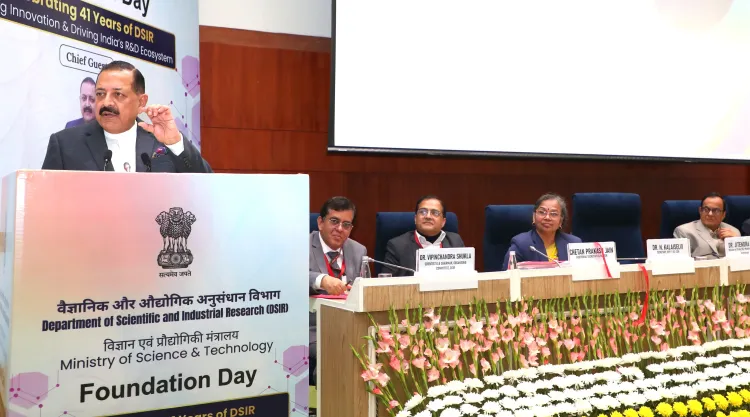
New Delhi, Jan 4 (NationPress) In a significant announcement on Sunday, the government has lifted the mandatory three-year operational requirement for deep-tech startups seeking recognition under the DSIR’s Industrial Research and Development Promotion Programme. This strategic decision is poised to enhance India’s startup landscape by granting an early boost to novice entrepreneurs and innovators, according to Union Minister Dr. Jitendra Singh during the 42nd Foundation Day celebration of the Department of Scientific and Industrial Research (DSIR).
During his address, the minister noted that the Rs 1 lakh crore Research, Development, and Innovation (RDI) Fund has sparked a remarkable wave of enthusiasm nationwide, aimed at supporting startups that have reached a certain level of technological readiness.
“For early-stage innovators or startups, an array of initiatives already exists across various departments such as DST, CSIR, TDB, and others. The elimination of the three-year existence prerequisite serves as a substantial incentive for deep-tech startups to scale up quickly, even prior to achieving full independence,” he stated, emphasizing that this reform signifies the government’s confidence in Indian innovators and their ability to sustain their ventures.
Singh elaborated that CSIR had previously been providing financial support to startups, offering loans up to Rs 1 crore, contingent upon proving sustainability and viability through a minimum three-year existence. “That stipulation has now been removed,” he asserted, labeling this step as a major encouragement with a commendable aim of fostering and sustaining new deep-tech startups before they are entirely established, while still ensuring appropriate assessment standards related to technological maturity.
The minister pointed out that India has surpassed the aspiration of “Atmanirbhar Bharat” and is entering a new era where other countries increasingly rely on Indian capabilities.
Professor Ajay Kumar Sood, the Principal Scientific Advisor to the government, highlighted the criticality of technology sovereignty amid current geopolitical dynamics. He referred to the Rs 1 lakh crore RDI Fund introduced by the Prime Minister, stressing the necessity to transition breakthroughs from labs to markets and bolster private sector R&D, especially at TRL-4 and above.
He also mentioned the development of the National Technology Readiness Assessment Framework (NTRF) to enhance the rigor and objectivity in technology evaluation and discussed initiatives like Manthan and Uthaan, which promote demand-driven innovation and encourage greater involvement of Tier-II and Tier-III institutions.
Point of View
It is vital to recognize that the government's decision to relax the three-year existence requirement for deep-tech startups is a strategic move to bolster innovation and entrepreneurship in India. This initiative not only reflects the government's trust in the capabilities of Indian innovators but also aligns with the broader vision of making India a global leader in technology and innovation.
NationPress
30 Sept 2026
Frequently Asked Questions
What is the main change announced for deep-tech startups?
The government has removed the mandatory three-year existence requirement for deep-tech startups to gain recognition under the DSIR’s Industrial Research and Development Promotion Programme.
Who announced this relaxation?
Union Minister Dr. Jitendra Singh announced this significant relaxation during the 42nd Foundation Day of the Department of Scientific and Industrial Research.
What is the purpose of the Rs 1 lakh crore RDI Fund?
The Rs 1 lakh crore RDI Fund is designed to support startups that have reached a certain level of technological maturity and to promote innovation across the country.
How does this change impact early-stage startups?
By eliminating the three-year existence requirement, early-stage startups can access recognition and support sooner, facilitating faster growth and innovation in the deep-tech sector.
What are the implications of this decision on India's startup ecosystem?
This decision is expected to stimulate India's startup ecosystem by encouraging more aspiring entrepreneurs, fostering innovation, and strengthening the overall technological landscape in the country.