How social media algorithms feed GenZ fake content, reshaping India's political future
Synopsis
India's 407 million young people are spending seven hours a day on feeds engineered for outrage, not truth. A new analysis by Lt Gen (retd) Abhay Krishna argues these platforms are the most efficient propaganda tools ever invented — and that India's democratic future depends on how it responds, without banning them outright.
Key Takeaways
India's GenZ cohort (ages 14–29) numbers 407 million , nearly 28% of the national population, according to UN World Population Prospects data.
An IIM Rohtak study of 39,000 respondents found average daily screen time of seven hours , with a significant portion on social platforms.
UN investigators and Amnesty International concluded that Meta's algorithms played a determining role in spreading anti-Rohingya hate in Myanmar .
In Nepal (September 2025) and Bangladesh , social media platforms reportedly structured the emotional arc of youth-led political uprisings.
India's NEET protests saw deepfakes and AI-generated content circulate at scale, with some traced to foreign-linked accounts.
Analysts recommend regulatory strategies based on economic leverage and legal ambiguity over outright platform bans.
India's 407 million young people aged 14 to 29 years — representing nearly 28 per cent of the national population — are spending an average of seven hours a day on algorithmically curated social media feeds, according to a study by IIM Rohtak covering nearly 39,000 respondents aged 18 to 25. The scale of this exposure, analysts warn, makes this cohort acutely vulnerable to algorithmically amplified misinformation and political manipulation.
The Algorithm Is Not Neutral
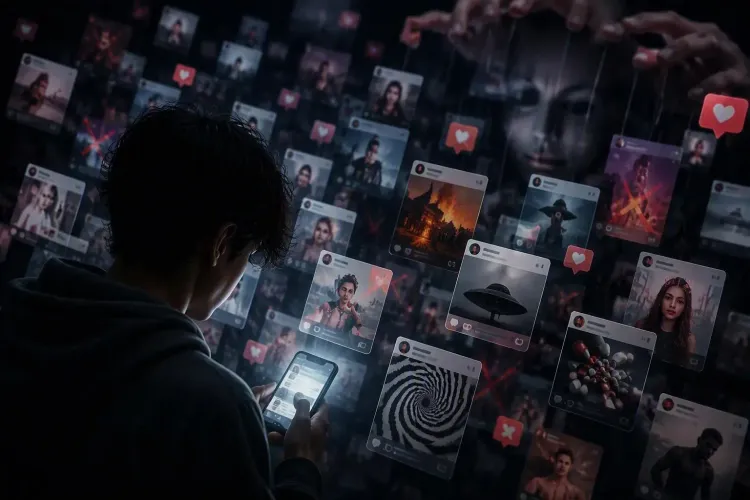
At the heart of the concern is how recommendation engines on platforms such as Meta, TikTok, and YouTube are designed. According to an analysis by Lt Gen (retired) Abhay Krishna, these systems function as 'attention merchants' — optimised not for truth or social good, but for engagement. 'The core issue is that algorithm-driven social media is not a neutral mirror of reality but is, rather, designed to maximise engagement — and that design often rewards outrage, polarisation and emotionally charged content,' he writes. 'In practice, this can distort public debate, suppress inconvenient information and even intensify real-world political violence. These platforms have become the most efficient propaganda tools ever invented.'
The analysis draws a direct line between platform design and social harm: the longer a user scrolls, the more advertisements can be sold — and outrage, fear, and emotionally charged content keep users scrolling longest.
Global Precedents: From Myanmar to the US
The consequences of unchecked algorithmic amplification are not hypothetical. UN investigators and a subsequent Amnesty International report concluded that Meta's recommendation engine played a determining role in radicalising populations in Myanmar, helping spread anti-Rohingya hate speech and contributing to atrocities. Meta has faced sustained criticism that its own internal systems prioritised engagement over safety, with especially severe consequences in conflict-prone regions.
In the United States, disclosures linked to the so-called Twitter Files suggested that platform decisions around the Hunter Biden laptop story were shaped by internal policies and, reportedly, outside government pressure — raising concerns that information was actively managed rather than simply moderated.
South Asia: A Region Already Affected
The analysis notes that the technology of 'mass emotional steering' has been operational for over a decade, with its effects visible as early as the Arab Spring. More recently, in Nepal in September 2025, a government ban on major social platforms triggered a rapid youth uprising organised primarily through TikTok, Discord, and other accessible channels. According to the analysis, the platforms did not merely transmit information — they structured the emotional sequence of the revolt. A similar pattern was reportedly visible in Bangladesh.
In India, the NEET paper leak protests demonstrated comparable dynamics. Instagram Reels, AI-generated videos, and coordinated influencer networks converted student grievance into sustained national mobilisation. Deepfake content and misinformation circulated at scale, with some material later traced to foreign-linked accounts, according to the analysis.
The Governance Challenge
The analysis argues that the organisations controlling these platforms — Meta foremost among them — now exercise a form of soft power that no democratic government has yet meaningfully constrained. Yet an outright ban is not seen as a viable solution. 'Invoking outright ban on platforms like Meta, Google and social platforms would provoke generational resistance leading to outright political costs,' the analysis observes. Instead, it calls for 'strategies of digital control without outright platform bans, such as prioritising legal ambiguity, economic leverage, infrastructural dependence and narrative framing instead of enforcing crude prohibition.'
With 407 million young Indians constituting the decisive voter base for the coming decades, the question of who shapes what they see, feel, and act upon each day is no longer peripheral to democratic governance — it is central to it.
Point of View
The integrity of democratic choice itself is at stake. The Myanmar and NEET examples are not outliers — they are proof-of-concept. Yet the recommended response, regulatory ambiguity and economic leverage, is notably vague for a problem of this scale. India has the data protection framework and the market leverage to demand algorithmic transparency; what it lacks is the political will to use them before the next election cycle makes the cost of inaction visible.
NationPress
2 Aug 2026
Frequently Asked Questions
How many Indians belong to the GenZ age group?
Approximately 407 million Indians fall in the 14 to 29 years age group, representing nearly 28 per cent of the national population, according to UN World Population Prospects data. This cohort is projected to be the decisive voter base in India for the coming decades.
How much time does Indian GenZ spend on social media daily?
An IIM Rohtak study covering nearly 39,000 respondents aged 18 to 25 found an average daily screen time of about seven hours, with a substantial portion devoted to social media platforms.
How did social media algorithms contribute to violence in Myanmar?
UN investigators and an Amnesty International report concluded that Meta's recommendation engine played a determining role in radicalising populations in Myanmar, amplifying anti-Rohingya hate speech and contributing to atrocities. Meta's systems were accused of prioritising engagement over user safety.
What role did social media play in India's NEET protests?
According to the analysis, Instagram Reels, AI-generated videos, and coordinated influencer networks amplified student grievances into sustained national mobilisation during the NEET paper leak protests. Deepfake content and misinformation circulated at scale, with some material later traced to foreign-linked accounts.
Why is an outright social media ban not recommended for India?
The analysis argues that banning platforms like Meta and Google would provoke generational resistance and carry significant political costs. It instead recommends strategies based on legal ambiguity, economic leverage, infrastructural dependence, and narrative framing as more viable tools of digital governance.