Hyundai Motor India targets 2 million connected car sales by 2030
Synopsis
Hyundai Motor India has set one of the most ambitious connected car targets in the Indian market — 2 million cumulative sales by 2030, with an intermediate 1 million milestone by 2027. The real signal: its upcoming mass-market electric SUV will ship Bluelink connectivity as standard across all variants, potentially making AI-powered connected features a baseline expectation rather than a premium perk.
Key Takeaways
Hyundai Motor India (HMIL) targets 2 million cumulative connected car sales by 2030 , with an intermediate goal of 1 million by 2027 .
Over 0.8 million Hyundai connected vehicles are currently active on Indian roads.
Hyundai Bluelink offers more than 70 features and supports over 450 AI-powered voice commands in five languages .
The platform has aided over 0.5 million motorists via SOS services and supported around 15,000 crash notification interventions .
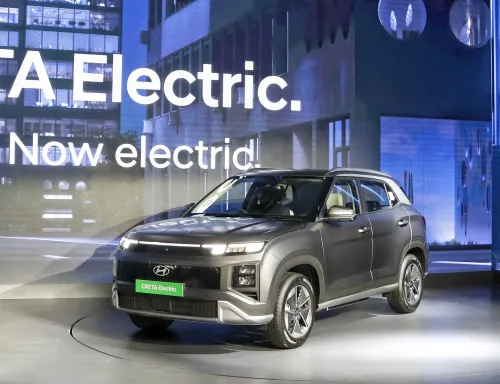
HMIL's upcoming mass-market electric SUV will include next-generation connected technology as standard across all variants.
Bluelink was first launched on the Hyundai Venue in 2019 ; the Connected Car Navigation Cockpit with OTA update capability followed in 2025 .
Hyundai Motor India Limited (HMIL) on Monday, 10 August announced a target of 2 million cumulative connected car sales by 2030, building on a current base of over 0.8 million connected vehicles already on Indian roads. The company has set an intermediate milestone of 1 million connected car sales by 2027, underpinned by strong customer uptake of its AI-powered Bluelink platform.
Bluelink at the Core
Hyundai Bluelink, first launched on the Hyundai Venue in 2019, has evolved steadily into one of India's most feature-rich connected car platforms. It now offers more than 70 features spanning safety, security, and convenience — including remote vehicle monitoring, vehicle health diagnostics, location tracking, trip history, remote commands, in-car payments via Hyundai Pay, Digital Key, Digital Passport, Remote Immobiliser, and Home-to-Car Connectivity.
The platform also supports over 450 AI-powered voice commands across five languages, broadening its accessibility across India's linguistically diverse market. Key capability upgrades include over-the-air map updates added in 2020, next-generation AVNT connected technology introduced in 2022, and the Connected Car Navigation Cockpit with controller OTA update capability launched in 2025 — a significant step in HMIL's Software Defined Vehicle (SDV) roadmap for India.
Safety Impact on Indian Roads
Beyond convenience features, Bluelink has demonstrated measurable safety outcomes. According to HMIL, the platform has assisted over 0.5 million motorists through SOS and roadside assistance services, supported approximately 15,000 crash notification interventions, and aided law-enforcement agencies in vehicle tracing and recovery efforts.
This positions Bluelink not merely as a premium add-on but as an active safety infrastructure layer — a distinction that could strengthen HMIL's case with regulators and fleet operators as India tightens vehicle safety norms.
Electric Mobility Integration
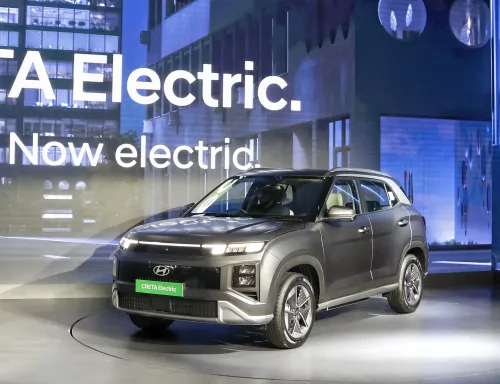
HMIL's upcoming mass-market electric SUV will feature next-generation connected car technology as standard across all variants, the company said — signalling a deliberate convergence of its connected and electric vehicle strategies. This is notable: making advanced connectivity standard rather than optional in a mass-market EV could accelerate adoption across price-sensitive segments.
Tarun Garg, MD & CEO of HMIL, said the move 'marks an important step in strengthening the convergence of connected and electric mobility while delivering future-ready ownership experiences for customers.' He added that 'the growing adoption of connected vehicles reflects the evolving expectations of customers and the increasing role of technology in shaping mobility.'
What This Means for India's Connected Car Market
India's connected car segment is still in early-to-mid growth phase, with penetration concentrated in mid-to-premium SUVs. HMIL's push to embed Bluelink across more accessible models — including its forthcoming mass-market EV — could reset the baseline for what buyers expect as standard. With 2 million units targeted by 2030, HMIL is betting that software-defined, connected ownership will become a decisive purchase criterion, not just a differentiator. How rivals respond, and whether India's telecom and data infrastructure scales in step, will shape whether this target holds.
Point of View
Bundling connectivity rather than charging for it could compress the timeline and pressure rivals to follow. The risk is infrastructure: AI voice commands and OTA updates are only as reliable as India's patchy 4G-5G coverage outside metros. If HMIL can crack rural and semi-urban connectivity quality, the 2 million target becomes a floor, not a ceiling.
NationPress
24 Sept 2026
Frequently Asked Questions
What is Hyundai Motor India's connected car sales target for 2030?
Hyundai Motor India (HMIL) is targeting 2 million cumulative connected car sales by 2030, with an intermediate milestone of 1 million by 2027. The company already has over 0.8 million connected vehicles on Indian roads as of August 2025.
What is Hyundai Bluelink and what does it offer?
Hyundai Bluelink is HMIL's AI-powered connected car technology platform, first launched on the Hyundai Venue in 2019. It offers more than 70 features including remote vehicle monitoring, health diagnostics, location tracking, in-car payments via Hyundai Pay, Digital Key, and over 450 AI-powered voice commands across five languages.
How has Bluelink contributed to road safety in India?
According to HMIL, Bluelink has assisted over 0.5 million motorists through SOS and roadside assistance services, supported around 15,000 crash notification interventions, and aided law-enforcement agencies in vehicle tracing and recovery.
Will Hyundai's upcoming electric SUV include connected car technology?
Yes. HMIL has confirmed that its upcoming mass-market electric SUV will include next-generation connected car technology as standard across all variants, integrating connected and electric mobility in a single platform.
How has Bluelink evolved since its launch?
Bluelink launched on the Hyundai Venue in 2019, added over-the-air map updates in 2020, introduced next-generation AVNT connected technology in 2022, and launched the Connected Car Navigation Cockpit with controller OTA update capability in 2025 as part of HMIL's Software Defined Vehicle roadmap for India.