Hyundai, Kia combined China sales crash 39% to 9,000 units in September
Synopsis
Hyundai and Kia's combined China market share has collapsed from over 10% in the mid-2010s to just 0.6% today — and September's sub-10,000-unit tally is the worst of 2026. Even China-specific EVs like the Elexio are barely moving, exposing just how thoroughly domestic brands have outflanked South Korea's auto giants on their own turf.
Key Takeaways
Hyundai Motor and Kia's combined China sales fell 39% year-on-year to approximately 9,000 units in September 2026 .
Hyundai's monthly sales dropped 47% to ~ 4,000 units ; Kia's fell 31% to ~ 5,000 units .
Combined market share has shrunk to just 0.6% , down from over 10% in the mid-2010s .
China-specific EV Elexio sold only 251 units in the first nine months of 2026 , down from 1,216 units in Q4 2025.
Hyundai Motor plans to expand global production capacity by 1.27 million units by 2030 , with over 100 new and updated models including 18 all-new launches.
Hyundai Motor and Kia's combined retail sales in China tumbled 39 percent year-on-year to approximately 9,000 units in September 2026, falling below the 10,000-vehicle threshold for the first time this year, according to a Hana Securities report based on China Passenger Car Association (CPCA) data. The figures underscore the deepening crisis facing South Korean automakers in what was once one of their most lucrative markets.
How Far Sales Have Fallen
Hyundai Motor's China sales plunged 47 percent on-year to around 4,000 units in September, while Kia's contracted 31 percent to approximately 5,000 units. The two brands' combined market share has slipped to just 0.6 percent — a dramatic collapse from over 10 percent recorded in the mid-2010s. This is the lowest combined monthly volume the two brands have posted in China so far in 2026.
EV Push Fails to Arrest the Slide
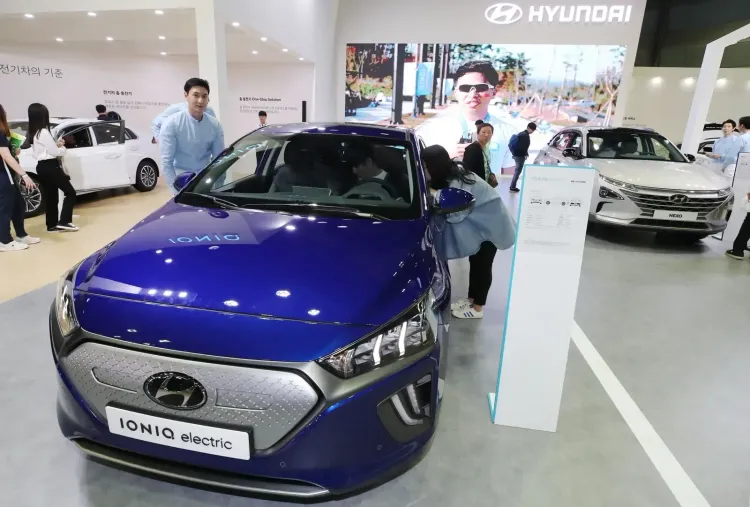
Despite rolling out electric vehicles specifically engineered for the Chinese market, the recovery has been elusive. Hyundai's China-specific electric SUV Elexio sold just 251 units in the first nine months of this year, a steep drop from the 1,216 units it moved in the final three months of last year. The Ioniq V — Hyundai's first China-specific model under its Ioniq brand — logged 558 units in September alone, offering a modest bright spot but far short of what would be needed to shift the broader trend. Analysts note that domestic Chinese EV brands have moved faster on software integration, pricing, and charging infrastructure, leaving foreign marques struggling to compete on home turf.
Global Expansion Plans Contrast With China Woes
The China numbers stand in sharp contrast to Hyundai Motor's ambitious global strategy. In August, the company announced plans to expand overall production capacity by 1.27 million units by 2030, up from roughly 5 million vehicles at present, and to launch more than 100 new and updated models over the same period. Hyundai Motor CEO Jose Munoz outlined the roadmap at the company's CEO Investor Day event in Seoul, citing intensifying competition — particularly from Chinese rivals — as the key strategic challenge. The expanded lineup will include 18 all-new models, alongside facelifts, partial redesigns, and other variants.
Upcoming Model Launches
On the product pipeline, Hyundai Motor plans to launch the Genesis GV80 hybrid in South Korea and the United States later this year, followed by an extended-range electric vehicle (EREV) in the first half of 2027. The company's bestselling Tucson SUV and its hybrid variants are also scheduled for launch in the second half of 2026. Whether these global launches can offset the structural decline in China remains an open question — and one that investors will be watching closely.
Point of View
000 monthly reading is more than a bad quarter — it is a structural signal. Hyundai and Kia have been losing China ground since THAAD-era diplomatic fallout in 2017, and each recovery attempt has undershot. The Elexio's 251-unit nine-month tally suggests that simply badge-engineering a China-specific EV is no longer enough; Chinese consumers now expect software-defined vehicles, longer ranges, and competitive pricing that legacy foreign marques struggle to match at scale. Meanwhile, Hyundai's 1.27-million-unit global capacity expansion by 2030 is pitched as an offensive play, but it could just as easily widen the gap between global ambition and China reality if the mainland slide continues at this pace.
NationPress
25 Oct 2026
Frequently Asked Questions
Why have Hyundai and Kia's China sales fallen so sharply?
Hyundai and Kia's combined China sales have dropped 39% year-on-year to around 9,000 units in September 2026, driven by fierce competition from domestic Chinese EV brands that have moved faster on pricing, software, and charging infrastructure. The two South Korean automakers' combined market share has shrunk from over 10% in the mid-2010s to just 0.6%.
How are Hyundai's China-specific EVs performing?
Performance has been disappointing. The Elexio, Hyundai's China-specific electric SUV, sold only 251 units in the first nine months of 2026, a steep fall from 1,216 units in the final quarter of 2025. The Ioniq V, Hyundai's first China-specific Ioniq-branded model, sold 558 units in September 2026.
What is Hyundai Motor's global expansion plan?
Hyundai Motor announced in August 2026 that it plans to increase global production capacity by 1.27 million units by 2030, from roughly 5 million vehicles currently, and launch over 100 new and updated models including 18 all-new vehicles. CEO Jose Munoz outlined the strategy at the company's CEO Investor Day in Seoul.
What new models is Hyundai planning to launch soon?
Hyundai Motor plans to launch the Genesis GV80 hybrid in South Korea and the United States later in 2026, followed by an extended-range electric vehicle (EREV) in the first half of 2027. The Tucson SUV and its hybrid variants are also scheduled for the second half of 2026.
How significant is the China market decline for Hyundai and Kia?
It is highly significant. The two brands once held over 10% of the Chinese passenger car market in the mid-2010s; that share now stands at just 0.6%. September 2026 was the first month this year where their combined sales fell below 10,000 units, marking a fresh low point in a multi-year structural retreat.