India opens FDI in inventory-based e-commerce for exports, shields small retailers

Synopsis
India has quietly redrawn its FDI rulebook for e-commerce — allowing foreign-funded inventory models, but only for exports. The move gives global platforms a legal route to warehouse and ship Indian-made goods abroad, potentially unlocking a faster export channel for domestic manufacturers, while keeping small retailers shielded from FDI-backed domestic competition.
Key Takeaways
The DPIIT issued a Press Note on 23 July 2025 permitting FDI in the inventory-based e-commerce model exclusively for exports of Indian-made goods.
The existing ban on FDI in B2C inventory-based e-commerce for the domestic market remains fully in place.
Exports under the new provision must comply with Foreign Trade Policy 2023 and FEMA (Export of Goods and Services) Regulations, 2015 .
India ranked 11th globally in FDI receipts in 2025, up from 13th in 2024 , with inflows rising 44% to $38.89 billion , per UNCTAD .
The policy aims to give domestic manufacturers easier access to global markets via foreign-capitalised platforms without disrupting small retailers.
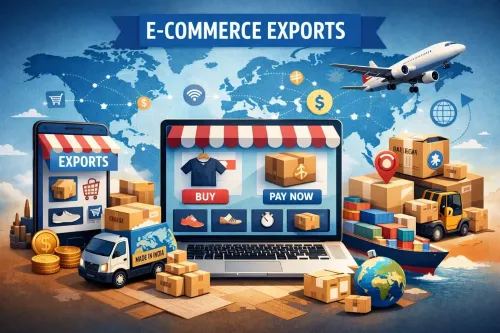
The Indian government on Thursday, 23 July 2025, permitted foreign direct investment (FDI) in the inventory-based model of e-commerce, but exclusively for the export of goods manufactured or produced in India — a targeted policy shift designed to expand global market access for domestic sellers while leaving protections for small retailers intact.
What the Policy Change Covers
The Department for Promotion of Industry and Internal Trade (DPIIT) issued a Press Note announcing that the existing restrictions on the inventory-based e-commerce model will no longer apply when the model is used solely for exporting domestically made goods. A new provision has been inserted into the consolidated FDI policy to formalise this carve-out.
Under the revised framework, e-commerce entities can now hold and sell inventory — something previously barred under FDI rules for the business-to-consumer (B2C) segment — provided the transactions involve exports only. All such exports must comply with the Foreign Trade Policy 2023 and the Foreign Exchange Management (Export of Goods and Services) Regulations, 2015.
How the Existing FDI Framework Works
Under the current rules, FDI is permitted in business-to-business (B2B) e-commerce and the marketplace model, where platforms act as intermediaries connecting buyers and sellers. However, FDI in the B2C inventory-based model — where an e-commerce entity owns the goods and sells directly to consumers — has remained prohibited.
The new provision does not alter those domestic restrictions. It creates a parallel export-only channel where foreign-funded platforms can operate an inventory model, giving Indian manufacturers and producers a potentially faster route to international buyers through well-capitalised global platforms.
Why the Move Matters for Indian Exporters
The policy targets a structural gap: Indian small and medium manufacturers often lack the logistics, warehousing, and last-mile capabilities that large global e-commerce platforms can provide. By allowing FDI-backed inventory models for exports, the government is effectively inviting global platforms to front the capital and infrastructure costs, with Indian-made goods as the beneficiary.
Notably, the safeguard clause — restricting the model to exports only — is designed to prevent any spillover into domestic retail, where small traders have historically resisted FDI-backed inventory models over fears of predatory pricing and market displacement.
India's Rising FDI Profile
The announcement comes as India climbs the global FDI rankings. According to the United Nations Conference on Trade and Development (UNCTAD)'s World Investment Report, India rose two places to become the world's 11th largest FDI recipient in 2025, with inflows surging nearly 44% to $38.89 billion — up from $27.09 billion in 2024, when India ranked 13th.
The UNCTAD report noted that 'India continued to strengthen its position as a major investment destination in 2025, supported by an active policy agenda aimed at broadening its investment base beyond services and accelerating advanced manufacturing.'
What Comes Next
The revised FDI policy is effective from the date of the DPIIT Press Note. Industry bodies and export-focused e-commerce platforms are expected to begin structuring compliant models in the near term. The government's broader push to lift merchandise exports — amid a shifting global trade order — makes this a policy to watch for its implementation pace and uptake by international platforms.
Point of View
Or whether they will lobby for a phased domestic opening once the model is established. India's jump to 11th in UNCTAD's FDI rankings adds political tailwind, but merchandise export growth — not FDI rankings — will be the true test of whether this policy delivers.
NationPress
22 Oct 2026
Frequently Asked Questions
What has India changed about FDI in e-commerce?
India has allowed FDI in the inventory-based e-commerce model, but strictly for the export of goods manufactured or produced in India. The ban on FDI in inventory-based B2C e-commerce for the domestic market has not changed.
Why does the government restrict this to exports only?
The export-only restriction is designed to protect small domestic retailers, who have long opposed FDI-backed inventory models over fears of predatory pricing. By limiting the model to exports, the government aims to boost outbound shipments without disrupting the domestic retail ecosystem.
Which regulations must export transactions comply with?
All exports under the new FDI provision must comply with the Foreign Trade Policy 2023 and the Foreign Exchange Management (Export of Goods and Services) Regulations, 2015.
How has India's overall FDI performance changed recently?
India rose two places to rank 11th globally in FDI inflows in 2025, according to UNCTAD's World Investment Report, with inflows climbing nearly 44% to $38.89 billion from $27.09 billion in 2024, when India ranked 13th.
What is the difference between the marketplace model and the inventory-based model in e-commerce?
In the marketplace model, the platform acts as an intermediary connecting buyers and sellers and does not own the goods — FDI is permitted here. In the inventory-based model, the e-commerce entity owns the goods and sells directly to consumers — FDI was previously barred and remains barred for domestic sales, but is now permitted for exports.