India approves first dengue vaccine QDENGA for ages 4-60

Synopsis
India has cleared its first dengue vaccine — Takeda's QDENGA — for everyone aged 4 to 60, with no prior infection screening needed. Backed by seven years of follow-up data and trials covering 28,000-plus participants, the approval plugs a critical gap in a country where all four dengue serotypes circulate simultaneously and no licensed preventive option previously existed.
Key Takeaways
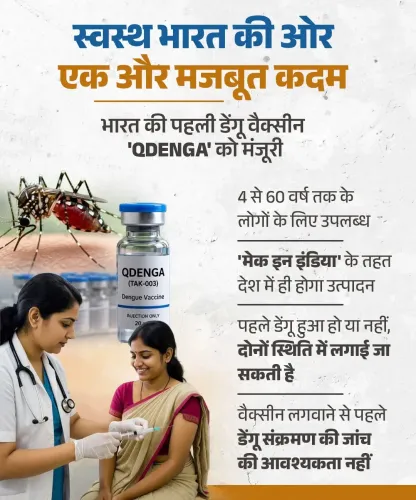
The DCGI granted market authorisation to Takeda's QDENGA on 20 July , making it India's first approved dengue vaccine.
The vaccine is cleared for individuals aged 4 to 60 years , with no pre-vaccination screening required.
It covers all four dengue virus serotypes and is given as two 0.5 ml injections, three months apart .
Approval was supported by 19 clinical trials involving more than 28,000 participants , including India's own Phase III DEN-302 trial .
Since its 2022 global launch, QDENGA has been approved in 43 countries with more than 32 million doses distributed.
Seven-year follow-up data shows continued protection against dengue infection and hospitalisation across all four serotypes.
India has cleared its first dengue vaccine, with the Drug Controller General of India (DCGI) granting market authorisation to Takeda Biopharmaceuticals India's QDENGA on Monday, 20 July. The approval covers individuals aged 4 to 60 years and marks a landmark shift in the country's public health response to one of its most persistent mosquito-borne disease burdens.
What Makes QDENGA Different
A key distinction of QDENGA is that it does not require pre-vaccination screening to determine prior dengue infection — a requirement that complicated earlier dengue vaccine rollouts globally. Eligible individuals can receive the two-dose regimen regardless of their prior exposure history, simplifying administration at scale.
The vaccine is delivered as two subcutaneous injections of 0.5 ml each, administered three months apart. It is designed to protect against all four dengue virus serotypes, which are simultaneously circulating across several regions of India.
Clinical Evidence Behind the Approval
The DCGI's decision was backed by data from Takeda's global clinical development programme, which comprised 19 Phase I, II and III clinical trials involving more than 28,000 participants across both dengue-endemic and non-endemic countries. Regulators also considered findings from the Phase III DEN-302 trial conducted in India, which specifically evaluated safety and immune response in the 4 to 60 age group.
According to Takeda, long-term follow-up data collected over seven years showed that QDENGA continues to provide protection against dengue infection and dengue-related hospitalisation caused by all four serotypes.
Global Footprint and India Context
Since its global launch in 2022, QDENGA has received approval in 43 countries, with more than 32 million doses distributed worldwide. India's clearance adds one of the world's largest dengue-endemic populations to that footprint.
Mahender Nayak, Head of Intercontinental Markets at Takeda, said: 'This approval marks an important step forward in strengthening dengue prevention in India.'
Goh Choo Beng, Medical Affairs Head for Takeda's Southeast Asia and India Cluster, described the approval as 'an important step in strengthening India's comprehensive approach to dengue prevention, alongside vector control, surveillance, community awareness and other public health measures.'
Why This Matters for India
India consistently ranks among the countries with the highest dengue burden globally, with all four virus serotypes in active circulation. The absence of a licensed vaccine until now left vector control and hospitalisation management as the primary public health tools. QDENGA's approval adds a preventive layer that could reduce severe dengue cases and ease pressure on healthcare infrastructure, particularly during seasonal outbreak peaks.
Notably, the vaccine's screening-free eligibility makes it operationally viable for India's large-scale immunisation infrastructure. Whether QDENGA will be incorporated into the national immunisation programme remains to be seen, and health authorities are expected to outline deployment priorities in the coming months.
Point of View
But the harder question is what comes next. A vaccine approved for market is not a vaccine deployed at scale — India's immunisation machinery will need clear guidance on whether QDENGA enters the Universal Immunisation Programme or remains a private-market product accessible mainly to urban, paying populations. The screening-free eligibility removes one major logistical barrier, but price point and cold-chain requirements will determine real-world reach. With all four serotypes in circulation and dengue hospitalisations spiking each monsoon season, a private-only rollout would be a missed public health opportunity of considerable scale.
NationPress
20 Oct 2026
Frequently Asked Questions
What is the QDENGA dengue vaccine approved in India?
QDENGA is a dengue vaccine developed by Takeda Biopharmaceuticals that has received market authorisation from India's Drug Controller General of India (DCGI). It is approved for individuals aged 4 to 60 years and protects against all four dengue virus serotypes without requiring prior infection screening.
Who can receive the QDENGA vaccine in India?
Any individual between the ages of 4 and 60 years is eligible to receive QDENGA. Unlike some earlier dengue vaccines, it does not require pre-vaccination testing to determine whether a person has previously been infected with dengue.
How is the QDENGA vaccine administered?
QDENGA is given as two subcutaneous injections of 0.5 ml each, spaced three months apart. The vaccine is designed to be administered regardless of the recipient's prior dengue exposure history.
What clinical evidence supports QDENGA's approval in India?
The approval is backed by 19 Phase I, II and III clinical trials involving more than 28,000 participants globally, as well as the Phase III DEN-302 trial conducted in India. Seven-year long-term follow-up data also demonstrated continued protection against all four dengue serotypes.
Is QDENGA available in other countries?
Yes. Since its global launch in 2022, QDENGA has been approved in 43 countries, with more than 32 million doses distributed worldwide. India's approval is the latest addition to that list.