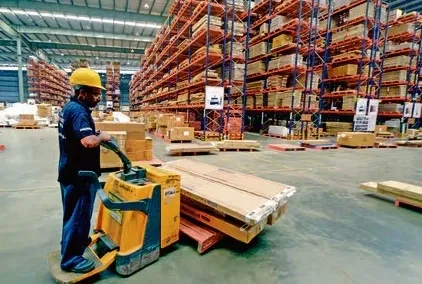
India data centre boom to drive 35 million sq ft warehousing demand by 2030

Synopsis
India's data centre buildout isn't just a tech story — it's a real estate one too. Savills India projects 30–35 million sq ft of warehousing demand by 2030, driven by a 5 GW IT capacity addition. Every 1 MW of data centre capacity pulls in 6,000–7,000 sq ft of aligned warehousing, making Hyderabad and Mumbai the cities to watch in this infrastructure-led property cycle.
Key Takeaways
India's data centre sector could generate 30–35 million sq ft of warehousing demand by 2030 , per a Savills India report.
Operator-based data centre stock is projected to reach 7 GW IT capacity by 2030, with over 5 GW IT of new capacity added in the period.
Every 1 MW of IT data centre capacity typically drives 6,000–7,000 sq ft of aligned warehousing demand.
Hyderabad and Mumbai are expected to be the primary beneficiaries, followed by Chennai , Delhi-NCR , Bengaluru , and Pune .
Data centre growth is also expected to create a manufacturing multiplier effect, boosting demand for industrial land and specialised facilities.
India's rapidly expanding data centre sector could generate between 30 and 35 million square feet of aligned warehousing demand by 2030, according to a new report by property consulting firm Savills India released on 16 November 2026. The findings point to a sizeable secondary opportunity for the country's industrial and logistics real estate market, one that extends well beyond the data centre campuses themselves.
Key Projections and the Scale of Growth
The Savills India report projects that India's operator-based data centre stock will grow to 7 GW IT capacity by 2030, underpinned by accelerating digitalisation, enterprise cloud adoption, artificial intelligence workloads, favourable government policy, and rising data consumption. The addition of over 5 GW IT of new capacity within this period is what directly drives the warehousing demand estimate.
A core metric cited in the report illustrates the relationship: every 1 MW of IT data centre capacity typically generates demand for approximately 6,000–7,000 square feet of aligned warehousing space. Applied across the projected capacity addition, that arithmetic produces the 30–35 million sq ft figure.
Why Warehousing Demand Follows Data Centre Growth
'As data centre capacity scales across major hubs, the supporting ecosystem is expected to play an increasingly important role across the data centre lifecycle, from storing and staging critical equipment during construction to supporting maintenance, replacement and operational requirements once facilities become operational,' the report noted.
In practical terms, this means Grade-A warehousing facilities located near major data centre clusters will be in sustained demand — not just during the construction phase, but as an ongoing operational requirement. The report describes this as a structural, multi-year demand driver rather than a one-time construction spike.
Manufacturing Multiplier and Industrial Land Demand
Srinivas N, Managing Director, Industrial & Logistics, Savills India, highlighted that the opportunity extends beyond storage. 'Beyond the data centre campuses, the supporting ecosystem will require strategically located warehousing for equipment storage, installation and ongoing operations,' he said.
Srinivas also pointed to 'equally significant potential to accelerate domestic manufacturing of critical equipment and components, driving demand for industrial land and specialised facilities.' He described the convergence of digital infrastructure, manufacturing and logistics as 'an important growth driver for India's industrial real estate market.' This manufacturing multiplier effect could meaningfully amplify demand for industrial land beyond what warehousing alone accounts for.
Cities Positioned to Benefit
Hyderabad and Mumbai are expected to emerge as the primary beneficiaries of this warehousing and logistics opportunity, according to the report. They are followed by Chennai, Delhi-NCR, Bengaluru, and Pune — all cities that already host significant data centre clusters and have the physical and connectivity infrastructure to support dedicated logistics facilities in their orbit.
Notably, this demand projection arrives at a time when India's industrial and logistics real estate sector has already seen strong post-pandemic absorption, and institutional investors have increasingly treated warehousing as a core asset class. The data centre-linked demand wave could provide a fresh, technology-anchored leg to that cycle.
What This Means Going Forward
With policy tailwinds from the government's push on digital infrastructure and AI readiness, analysts expect data centre investments to remain robust through the decade. How quickly that capacity translates into warehousing absorption will depend on how fast operators move from planning to commissioning — and whether domestic manufacturing of data centre equipment can scale in parallel. The industrial real estate sector will be watching both timelines closely.
Point of View
000–7,000 sq ft per MW rule-of-thumb is a useful anchor, but the actual absorption will hinge on execution pace and geographic concentration — if capacity clusters in just two or three cities, so will the warehousing windfall, sharpening competition for industrial land in Hyderabad and Mumbai's peripheries. The more strategically interesting angle is the manufacturing multiplier: if India can localise production of data centre equipment at scale, the industrial real estate demand could substantially exceed the warehousing headline. That linkage between digital infrastructure policy and Make in India outcomes deserves closer scrutiny than a single metric.
NationPress
16 Nov 2026
Frequently Asked Questions
How much warehousing demand could India's data centre boom generate by 2030?
According to a Savills India report, India's data centre expansion could generate approximately 30–35 million square feet of aligned warehousing demand by 2030. This is based on a projected addition of over 5 GW IT of new data centre capacity and a rule-of-thumb of 6,000–7,000 sq ft of warehousing per 1 MW of IT capacity.
What is driving India's data centre growth toward 7 GW IT by 2030?
The Savills India report attributes the projected growth to rising digitalisation, enterprise cloud adoption, artificial intelligence workloads, favourable government policy initiatives, and growing data consumption across the country.
Which cities are expected to benefit most from data centre-linked warehousing demand?
Hyderabad and Mumbai are identified as the primary beneficiaries, followed by Chennai, Delhi-NCR, Bengaluru, and Pune. These cities already host major data centre clusters and have the infrastructure to support dedicated logistics facilities nearby.
Why does data centre expansion create warehousing demand?
Data centres require strategically located warehousing for storing and staging critical equipment during construction, as well as for supporting maintenance, replacement, and ongoing operational needs once facilities are live. This creates sustained, lifecycle-long demand rather than a one-off spike.
Does the data centre boom only benefit the warehousing sector?
No. Beyond warehousing, the Savills India report highlights a manufacturing multiplier effect — data centre growth is expected to accelerate domestic production of equipment and components, driving additional demand for industrial land and specialised manufacturing facilities.