CM Joseph Vijay raises salt pan workers' monsoon relief to ₹7,000
Synopsis
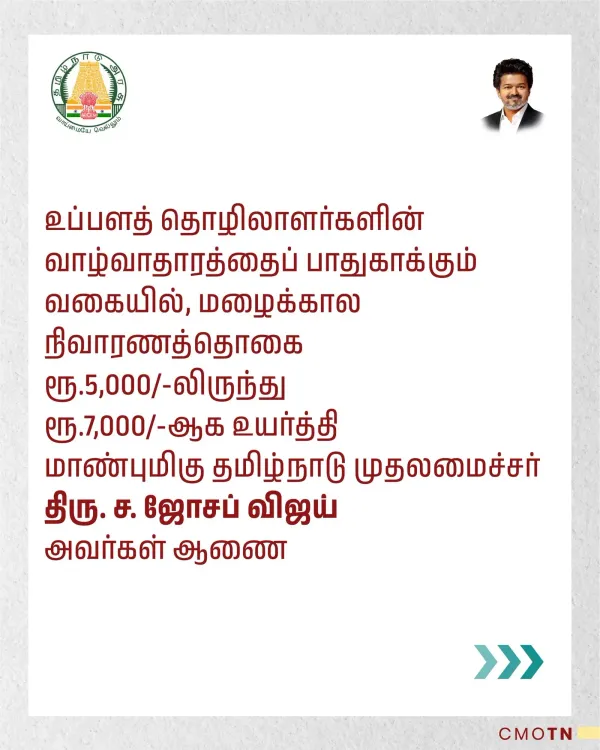
Tamil Nadu Chief Minister C. Joseph Vijay has raised the monsoon-relief allowance for salt pan workers from ₹5,000 to ₹7,000 — a 40 per cent increase — protecting coastal labourers who lose all income when rains halt salt production.
Key Takeaways
Joseph Vijay issued an order on 16 November 2026 raising salt pan workers' monsoon-relief allowance.
The relief amount increases from ₹5,000 to ₹7,000 per worker — a 40 per cent hike .
The measure targets salt pan workers who lose income during the monsoon season when open-air production halts.
Salt production in Tamil Nadu is centred in coastal districts, particularly around Thoothukudi .
Disbursement timelines and eligibility details are expected to be outlined in a separate government order.
The revision follows Tamil Nadu's established practice of periodic seasonal-welfare adjustments for weather-dependent labourers.
Salt pan workers along Tamil Nadu's coastal belt — whose livelihoods vanish with the first monsoon clouds — are getting a bigger financial cushion this season. The Chief Minister's Office of Tamil Nadu announced on Monday, 16 November 2026 that Chief Minister C. Joseph Vijay has ordered the monsoon-relief allowance for salt pan workers to be raised from ₹5,000 to ₹7,000, a 40 per cent increase aimed at shielding one of the state's most vulnerable labour communities.
Who salt pan workers are — and why the rains hit them hardest
Salt production in Tamil Nadu is concentrated in the coastal districts, with Thoothukudi historically being the state's primary salt-harvesting hub. The work is entirely open-air and weather-dependent: once the northeast monsoon arrives, production halts, and so does daily income. These workers — many of them from marginalised communities — have no formal employment contract, no paid leave, and no corporate safety net. The monsoon period is, in effect, a forced furlough they cannot afford.
Seasonal cash-relief programmes for such workers have been a recurring feature of Tamil Nadu's welfare architecture, recognising that weather-dependent labourers face an income cliff that general social-security schemes do not fully address. The earlier relief of ₹5,000 per worker was widely seen as inadequate given rising living costs.
The ₹7,000 order — what CM Vijay's directive means on the ground
The Chief Minister's Office confirmed the revision in a post in Tamil, stating that the order was issued 'உப்பளத் தொழிலாளர்களின் வாழ்வாதாரத்தைப் பாதுகாக்கும் வகையில்' — 'in order to protect the livelihood of salt pan workers.' The revised amount of ₹7,000 will now be disbursed as monsoon-relief compensation, covering the period during which workers cannot earn through salt production. While the government order's disbursement timeline and full eligibility criteria are expected to be detailed separately, the announcement signals immediate intent.
A ₹2,000 increase per beneficiary may appear modest in isolation, but across the thousands of workers enrolled in the relief scheme, the cumulative state outlay rises substantially — representing a meaningful expansion of the welfare commitment.
Tamil Nadu's pattern of protecting weather-dependent workers
This move fits a recognisable pattern in Tamil Nadu governance: periodic upward revisions to seasonal-welfare amounts for fishing and salt-pan communities, usually tied to cost-of-living pressures or electoral cycles. Marine fishermen, for instance, have long received a separate monsoon-ban compensation during the annual fishing ban period. The salt pan sector has historically lagged behind in such adjustments, making this revision particularly notable for that community. Watch for the accompanying government order — G.O. — to specify whether the amount covers the full monsoon window or a fixed number of months.
Point of View
Weather-dependent workers, a constituency that has historically delivered reliable votes to the state's ruling parties. A ₹2,000 increase is modest against inflation but politically visible. The real test will be in implementation: whether the government order specifies a quick disbursal mechanism or whether the revised amount reaches workers before the monsoon season ends. If framed alongside other coastal-community welfare moves, this could indicate a broader pre-budget positioning toward the state's southern districts.
NationPress
16 Nov 2026
Frequently Asked Questions
What is the new monsoon relief amount for Tamil Nadu salt pan workers?
The monsoon-relief allowance for salt pan workers in Tamil Nadu has been increased to ₹7,000 , up from the earlier ₹5,000 , following an order by Chief Minister C. Joseph Vijay.
Why do salt pan workers in Tamil Nadu receive monsoon relief?
Salt production is an open-air, weather-dependent activity. When the monsoon arrives, production stops entirely, leaving workers without income. The state government provides seasonal cash relief to bridge this period of forced unemployment.
Which district in Tamil Nadu has the most salt pan workers?
Thoothukudi (Tuticorin) is Tamil Nadu's primary salt-production district and home to a large share of the state's salt pan worker community.
When was the salt pan worker relief amount last revised in Tamil Nadu?
The latest revision — from ₹5,000 to ₹7,000 — was announced on 16 November 2026 by CM C. Joseph Vijay. Prior revision dates are not confirmed in available official records.
How do salt pan workers in Tamil Nadu qualify for monsoon relief?
Eligibility is determined by state government orders that typically require workers to be registered as active salt pan labourers. The specific criteria for the revised ₹7,000 relief are expected to be detailed in the accompanying government order.