CM Vijay lays Rs 3,108 crore ring water main stone in Chennai
Synopsis
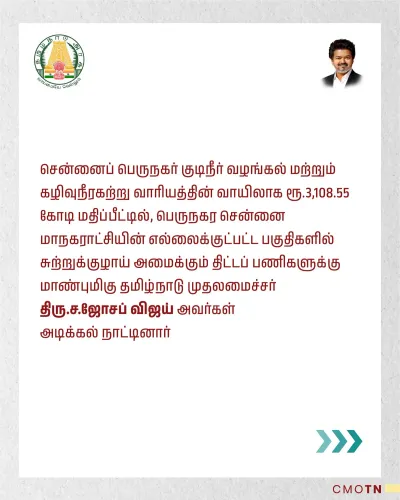
Tamil Nadu CM C. Joseph Vijay on 14 October 2026 laid the foundation for a Rs 3,108.55 crore Ring Main water distribution project for Chennai and reviewed Northeast Monsoon flood-mitigation preparedness at Okkiyam Maduvu and across multiple state departments.
Key Takeaways
Rs 3,108.55 crore Ring Main System foundation stone laid at CMWSSB's Sholinganallur pumping station by CM C.
Joseph Vijay on 14 October 2026 .
The project will be implemented through the Chennai Metropolitan Water Supply and Sewerage Board within Greater Chennai Corporation limits.
A ring-main network is designed to equalise water pressure and reduce supply inequity across the city's distribution zones.
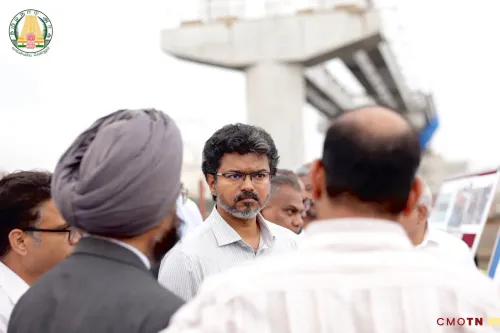
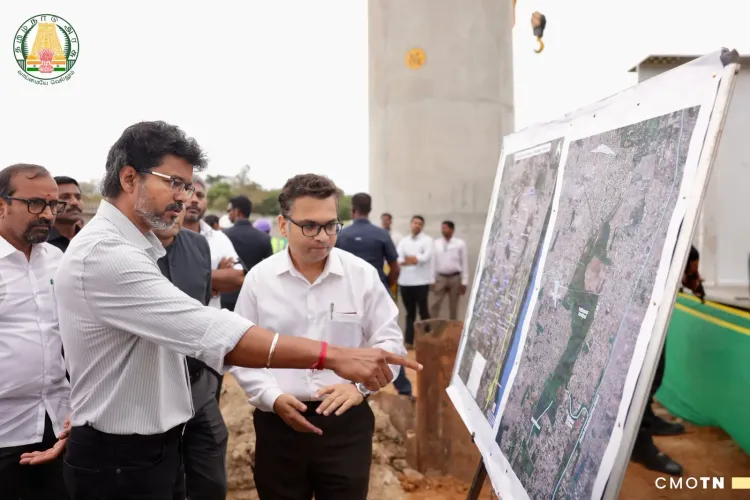
CM Vijay personally inspected Okkiyam Maduvu in Karapakkam, a major flood-retention waterbody on Chennai's southeastern edge.
Flood-mitigation preparedness reviewed across the Water Resources Department , Highways Department , and Greater Chennai Corporation ahead of the Northeast Monsoon season.
The multi-department coordination model traces back to lessons from Chennai's devastating 2015 floods .
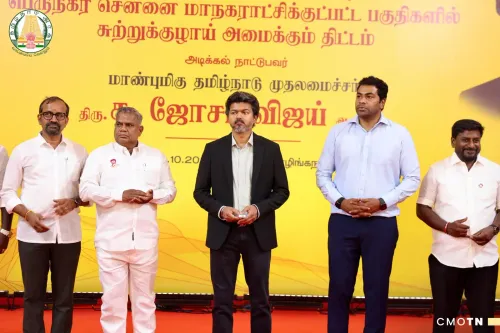
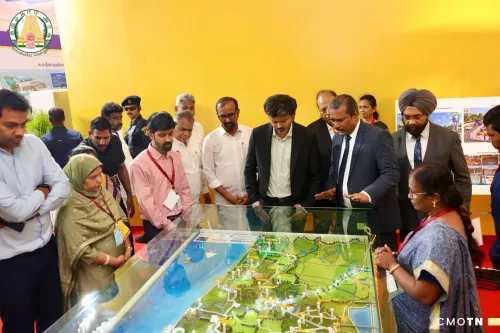
A city that has wrestled with both parching water scarcity and catastrophic monsoon floods got a significant infrastructure commitment on Wednesday, 14 October 2026, when Tamil Nadu Chief Minister C. Joseph Vijay laid the foundation stone for a Rs 3,108.55 crore Ring Main System at the Chennai Metropolitan Water Supply and Sewerage Board's pumping station in Sholinganallur — and then drove straight to Karapakkam to inspect the city's flood defences ahead of the Northeast Monsoon. The Chief Minister's Office of Tamil Nadu announced the twin moves in a post on X on Wednesday evening.
What the Rs 3,108 crore ring main will do for Chennai
The Ring Main System will be implemented through the Chennai Metropolitan Water Supply and Sewerage Board (CMWSSB) and cover localities within the Greater Chennai Corporation (GCC) limits. A ring main — a continuous loop of distribution pipes — is designed to equalise water pressure across a network, reduce dead-end supply failures, and ensure that even peripheral wards receive consistent flow. For a city where certain zones routinely face hours-long daily cuts while others are adequately served, the project directly targets that supply inequity.
The estimated outlay of Rs 3,108 crore and 55 lakh makes this one of the larger single water-infrastructure commitments in Chennai's recent history. CMWSSB has previously executed successive source-augmentation and distribution-improvement schemes, but a city-wide ring-based distribution upgrade of this scale signals a structural shift in approach — from patchwork augmentation to network-wide resilience.
Okkiyam Maduvu inspection and the Northeast Monsoon countdown
CM Vijay also personally inspected Okkiyam Maduvu, the major flood-retention waterbody in Karapakkam on Chennai's southeastern fringe, which functions as a critical buffer during heavy rainfall events. The site visit came with the Northeast Monsoon — Tamil Nadu's primary rainy season, running October through December — already on the doorstep. Chennai's vulnerability to monsoon flooding is long and well-documented: the 2015 floods triggered a generation of integrated stormwater drain projects and desilting drives that successive administrations have continued to build on.
The review covered flood-mitigation preparedness across multiple departments simultaneously — the Water Resources Department, the Highways Department, and the Greater Chennai Corporation. That multi-agency coordination, institutionalised after 2015, now operates as the city's standard monsoon-readiness protocol: pump stations assessed, drains desilted, retention bodies checked, and highway drainage cleared in a single coordinated sweep before the season peaks.
Chennai's recurring dual challenge: scarcity and surplus
The juxtaposition of Wednesday's events captures Chennai's peculiar urban water paradox — a metropolitan area that routinely faces drinking-water crises in summer and flood emergencies in winter. The Ring Main project addresses the scarcity half; the Okkiyam Maduvu inspection and department reviews address the surplus half. Tackling both on the same afternoon, with foundation stone and site visit combined, sends a deliberate signal of joined-up governance.
What comes next will matter as much as the symbolic start: tendering timelines for the ring main works, contractor selection, and whether pre-monsoon pump station readiness across all three departments holds through October and November will determine how much of Wednesday's promise translates into dry homes and steady taps.
Point of View
108 crore Ring Main commitment feeds into a longer arc of CMWSSB investment that successive Tamil Nadu governments have pursued, partly in response to chronic public frustration with uneven water distribution across the city. Anchoring the announcement at the operational Sholinganallur pumping station, rather than a ceremonial venue, and following it with a hands-on inspection of Okkiyam Maduvu, emphasises on-the-ground engagement over ribbon-cutting optics. The critical test for the administration will be execution velocity on the ring main project and whether the flood-mitigation coordination holds through Chennai's most weather-exposed months.
NationPress
14 Oct 2026
Frequently Asked Questions
What is the Chennai Ring Main System project?
The Ring Main System is a Rs 3,108.55 crore water distribution network project to be built by the Chennai Metropolitan Water Supply and Sewerage Board within Greater Chennai Corporation limits. A ring main creates a continuous pipe loop that equalises pressure and improves supply consistency across the city.
Who laid the foundation stone for Chennai's ring main water project?
Tamil Nadu Chief Minister C. Joseph Vijay laid the foundation stone on 14 October 2026 at the CMWSSB pumping station in Sholinganallur, Chennai.
What is Okkiyam Maduvu and why did the CM visit it?
Okkiyam Maduvu is a major flood-retention waterbody in Karapakkam on the southeastern edge of Chennai. CM Vijay inspected it personally as part of a review of Northeast Monsoon flood-mitigation preparedness.
Which departments are involved in Chennai's flood mitigation for the 2026 Northeast Monsoon?
The Water Resources Department, the Highways Department, and the Greater Chennai Corporation are the primary agencies coordinating flood-mitigation works ahead of the 2026 Northeast Monsoon season.
How much will the Chennai ring main water project cost?
The project is estimated at Rs 3,108 crore and 55 lakh (approximately Rs 3,108.55 crore), to be implemented through the Chennai Metropolitan Water Supply and Sewerage Board.