India-Egypt target $12 billion trade, launch FTA talks at ministerial JTC
Synopsis
India–Egypt bilateral trade has already surged 65 per cent year-on-year to $5.04 billion in just the first half of FY27 — and both governments now want to nearly double the annual run-rate to $12 billion, with a formal PTA or FTA process launched at the first-ever ministerial-level Joint Trade Committee. Egypt's Suez Canal gateway to Africa and Europe makes this more than a bilateral deal.
Key Takeaways
India and Egypt have set a bilateral trade target of $12 billion , up from $6.5 billion in FY26.
A Joint Working Group was established to explore Terms of Reference for a Preferential Trade Agreement (PTA) or Free Trade Agreement (FTA) .
Trade grew 65 per cent year-on-year to $5.04 billion during April–September 2026 .
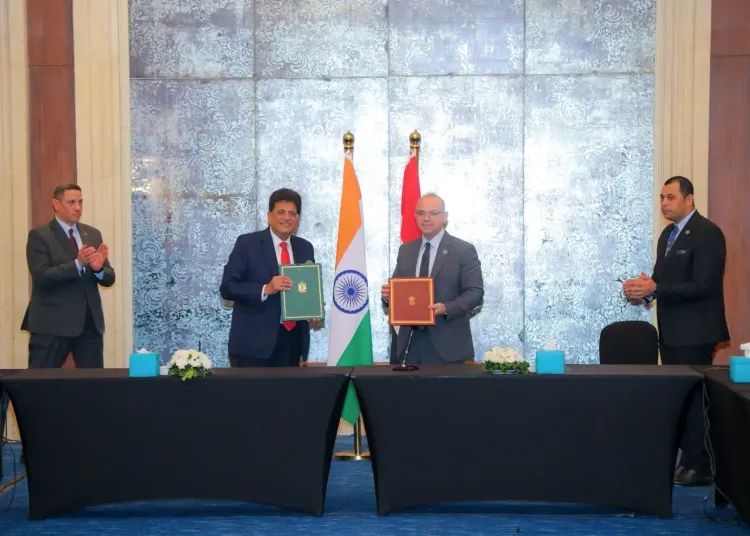
The seventh JTC session in Egypt's New Administrative Capital was the first to be held at the ministerial level, co-chaired by Piyush Goyal and Dr Mohamed Farid Saleh .
Priority sectors include pharmaceuticals , fertilisers , textiles , renewable energy , and engineering equipment .
The next JTC meeting is scheduled for New Delhi in 2028 or earlier.
India and Egypt have agreed to work towards raising bilateral trade to $12 billion and will set up a Joint Working Group to explore the terms for a Preferential Trade Agreement (PTA) or Free Trade Agreement (FTA), according to an official statement issued on Monday, 16 November 2026. The agreement was reached at the seventh session of the India–Egypt Joint Trade Committee (JTC) held in Egypt's New Administrative Capital.
The session was co-chaired by Union Commerce and Industry Minister Piyush Goyal and Egypt's Minister of Investment and Foreign Trade, Dr Mohamed Farid Saleh — marking the first time the bilateral institutional mechanism convened at the ministerial level, underscoring both governments' commitment to deepening the economic dimension of the India–Egypt Strategic Partnership.
Trade Numbers Behind the Push
The momentum is data-driven. India–Egypt bilateral trade rose 35 per cent to $6.5 billion in FY26. For the first half of the current fiscal year — April to September 2026 — trade surged 65 per cent year-on-year to $5.04 billion, reflecting accelerating commercial engagement and significant headroom for further diversification of the trade basket.
Notably, the $12 billion target would nearly double current annual trade levels, making the PTA or FTA framework a critical enabler if the goal is to be met within a realistic timeframe.
What the Joint Working Group Will Do
The newly established Joint Working Group will examine the Terms of Reference for a PTA or FTA aimed at improving market access for both sides and fostering investment linkages. The JTC discussions covered a broad agenda: addressing non-tariff barriers, streamlining customs procedures, strengthening standards and conformity assessments, and resolving practical regulatory issues such as product registrations.
Both sides also discussed building resilient supply chains, developing predictable trade pathways, and encouraging joint manufacturing and cross-border investment flows.
Priority Sectors and Strategic Complementarities
The two countries identified several high-potential sectors for enhanced trade and investment, including pharmaceuticals and medical devices, engineering and electrical equipment, fertilisers, textiles, renewable energy, and emerging technologies. Significant complementarities were also noted in industrial goods, energy, chemicals, and agricultural products.
Egypt's geographic advantage — its proximity to the Suez Canal and connectivity with African, Arab, and European markets — positions it as a strategic partner for export-oriented manufacturing and regional supply chains. India, in turn, offers Egyptian businesses a large consumer market, increasingly competitive infrastructure, and technology partnership opportunities.
Business Forum and Next Steps
The JTC session was preceded by bilateral ministerial discussions and accompanied by the India–Egypt Business Forum, which drew over 300 companies from both countries to strengthen private-sector engagement under the Strategic Partnership framework.
The next JTC meeting was agreed to be held in New Delhi in 2028, or earlier at a mutually convenient date. With a PTA or FTA framework now under active exploration and trade already growing at over 60 per cent year-on-year in the first half of FY27, the bilateral relationship appears poised for a structural upgrade in the coming years.
Point of View
But India's FTA track record is uneven: deals with the UAE and Australia moved quickly, while others have stalled for years at exactly this 'terms of reference' stage. Egypt's Suez pivot is strategically compelling as India courts an Africa-facing manufacturing corridor, but the proof will be in whether the Joint Working Group tables a draft text before 2028, not after. The business forum's 300-company turnout signals private-sector appetite; the government's job is now to convert that energy into enforceable rules.
NationPress
16 Nov 2026
Frequently Asked Questions
What is the India–Egypt $12 billion trade target?
India and Egypt have agreed to work towards raising their annual bilateral trade to $12 billion, nearly double the $6.5 billion recorded in FY26. The target was announced at the seventh session of the India–Egypt Joint Trade Committee in Egypt's New Administrative Capital on 16 November 2026.
What is the India–Egypt Joint Working Group on trade?
The Joint Working Group is a newly established bilateral body tasked with exploring the Terms of Reference for a Preferential Trade Agreement (PTA) or Free Trade Agreement (FTA) between India and Egypt. Its mandate includes improving market access, fostering investment linkages, and facilitating stronger bilateral commercial ties.
How fast is India–Egypt trade growing?
India–Egypt bilateral trade rose 35 per cent to $6.5 billion in FY26. In the first half of FY27 (April–September 2026), trade grew 65 per cent year-on-year to $5.04 billion, suggesting the full-year figure could comfortably surpass the previous year's total.
Which sectors are prioritised in India–Egypt trade talks?
Priority sectors identified during the JTC discussions include pharmaceuticals and medical devices, engineering and electrical equipment, fertilisers, textiles, renewable energy, and emerging technologies. Complementarities were also noted in industrial goods, chemicals, energy, and agricultural products.
When is the next India–Egypt Joint Trade Committee meeting?
The next JTC meeting is agreed to be held in New Delhi in 2028, or earlier at a mutually convenient date. The 2026 session was notable as the first to be convened at the ministerial level.