India EMS market to cross $150 billion by FY30: KPMG report

Synopsis
India's EMS sector has grown fourfold in five years, but a new KPMG report warns that scale alone won't unlock the sector's $150 billion potential by FY30. With 80–95% of critical components still imported and design capabilities thin, India risks being locked into low-margin assembly even as a trillion-dollar global market reshapes around it.
Key Takeaways
India's EMS market could exceed $150 billion by FY30 , up from $40–45 billion in FY25 , per KPMG in India .
India holds just 5–6% of the global EMS market, estimated at $640–650 billion in 2025 and projected to cross $1 trillion by the early 2030s .
Critical component import dependency stands at 80–95% , limiting domestic value addition and margins.
India has received roughly $19.5 billion in cumulative policy incentives to support the electronics sector.
The report calls for a shift from high-volume assembly to design-led, system-level capabilities across engineering, supply chains, and product development.
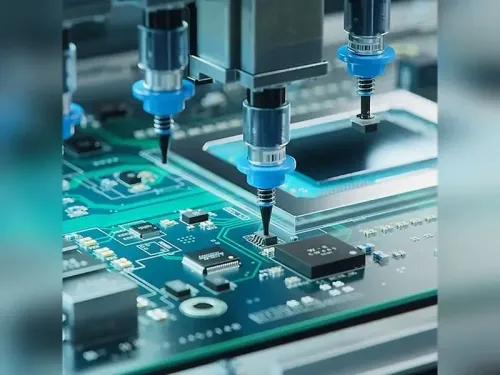
India's electronics manufacturing services (EMS) market could surpass $150 billion by FY30, according to a report released on Monday, 8 June by KPMG in India. The sector, which has expanded nearly fourfold in five years, now stands at a critical juncture — scale has been built, but deeper value-chain integration remains elusive.
Rapid Growth, but a 'Scale Without Depth' Problem
The KPMG report estimates India's EMS market grew from roughly $10–12 billion in FY20 to $40–45 billion in FY25, fuelled by domestic demand, government policy support, and the global China+1 supply-chain diversification strategy. Yet the consultancy flags a structural paradox: while India dominates high-volume assembly — particularly in mobile phones and consumer electronics — its footprint in higher-value segments such as design, component manufacturing, and intellectual property (IP) ownership remains thin.
'Amid a once-in-a-generation rewiring of global electronics supply chains, driven by geopolitics, resilience priorities and rising technological complexity, India's EMS market is at a critical inflection point — where scale has been built, but value chain depth remains limited,' the report stated.
India's Share in a Trillion-Dollar Global Market
KPMG pegs the global EMS market at $640–650 billion in 2025, with projections that it could exceed $1 trillion by the early 2030s, driven by connectivity, electrification, and original equipment manufacturers (OEMs) outsourcing more production. India currently accounts for just 5–6 per cent of global EMS manufacturing, signalling significant headroom for expansion if structural constraints are addressed.
Notably, India has received roughly $19.5 billion in cumulative policy incentives to support its electronics sector — a figure that underscores the Centre's commitment but also raises questions about sustainability as those incentives begin to taper.
Structural Constraints Holding Back Value Addition
The report identifies import dependency as the sector's most persistent bottleneck, with critical components sourced from abroad at a rate of 80–95 per cent across key categories. This limits domestic value addition and compresses margins for Indian EMS players. Analysts cited in the report argue that India must pivot from assembly-led growth to design-led and system-level capabilities, making engineering depth, supply-chain sophistication, and product development core strategic priorities.
Rohan Rao, Partner, Automotive and Lead, Electric Mobility, KPMG in India, said: 'India's EMS sector has reached a pivotal moment with firm foundations of scale, but the next phase of growth will be defined by depth. Realising India's potential will require sustained investment in component ecosystems, engineering depth, and supply chain sophistication to unlock higher value participation in global electronics manufacturing.'
What Needs to Happen Next
The report calls for coordinated action across government, EMS players, and global OEMs over the next five to ten years. Key priorities include building domestic component ecosystems, strengthening workforce capabilities, investing in engineering and design, and deepening integration across the value chain. The window is narrow: as policy incentives taper, organic capability-building must accelerate to sustain growth momentum.
With global supply chains continuing to shift away from single-source dependence, India's ability to move up the electronics value chain in the next three to five years will determine whether it captures a transformative share of a trillion-dollar market — or remains a high-volume, low-margin assembler.
Point of View
The value retained onshore remains thin. The next phase will not be won with more incentives but with unglamorous, long-cycle investments in component manufacturing, semiconductor packaging, and engineering talent — areas where India has repeatedly announced intent without matching execution. The window is real, but so is the risk of being outpaced by Vietnam and Mexico, which are also aggressively courting OEM diversification.
NationPress
22 Sept 2026
Frequently Asked Questions
What is India's electronics manufacturing services (EMS) market size?
India's EMS market stood at approximately $40–45 billion in FY25, having grown from $10–12 billion in FY20, according to a KPMG in India report. It could exceed $150 billion by FY30 if structural constraints are addressed.
Why is India's EMS sector described as being at an inflection point?
KPMG describes India's EMS sector as facing a 'scale without depth' paradox — it has built high-volume assembly capacity, particularly in mobile and consumer electronics, but lacks meaningful presence in higher-value areas like design, component manufacturing, and IP ownership. Bridging that gap is now the central challenge.
What is India's share of the global EMS market?
India accounts for roughly 5–6% of global EMS manufacturing. The global market is estimated at $640–650 billion in 2025 and is projected to cross $1 trillion by the early 2030s, giving India significant room to expand its share.
What structural challenges does India's EMS sector face?
The most critical challenge is import dependency, with 80–95% of key components sourced from abroad, which limits domestic value addition and compresses margins. The report also flags gaps in engineering depth, design capabilities, and supply-chain sophistication.
What policy support has India provided to the EMS sector?
India has extended roughly $19.5 billion in cumulative policy incentives to support electronics manufacturing. However, as these incentives taper, the sector will need to build organic capabilities in components, engineering, and design to sustain growth.