India set to become world's 3rd-largest economy and global AI hub: SAP report

Synopsis
SAP's latest report reframes India not as an emerging market but as the world's next great technology-building hub — with over 80% of the company's AI agents already made in India, a $4.15 trillion economy climbing toward $7 trillion by 2030, and 2.5 million STEM graduates a year fuelling the engine. The third-largest-economy crown may be closer than most forecasts suggest.
Key Takeaways
India is projected to cross the $5 trillion GDP milestone in the near term and become the world's third-largest economy , according to a SAP report dated 16 November 2026 .
India's economy, currently valued at nearly $4.15 trillion , is forecast to reach $6–7 trillion by the end of the decade.
More than 80 per cent of SAP's AI agents are built in India, which is also one of its fastest-growing markets.
India produces over 2.5 million STEM graduates annually and has more than one billion citizens under 35 .
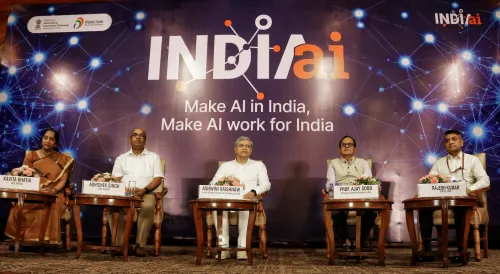
The IndiaAI Mission , launched in March 2024 with a budget of approximately $1.1 billion , supports AI research, compute infrastructure, and skills development.
Multinationals are recalibrating India from a back-office base to a global innovation and demand hub .
India is on track to cross the $5 trillion economic milestone in the near term and emerge as the world's third-largest economy, while simultaneously positioning itself as a global centre for technology, innovation, and artificial intelligence, according to a report released on Monday, 16 November 2026. The findings, published by enterprise software major SAP, signal a fundamental reframing of India's role in the global economic order.
India at the Core of SAP's AI Strategy
SAP said it now views India not merely as a large domestic market but as a place where enterprise technology is built, tested, and scaled for worldwide impact. Notably, more than 80 per cent of SAP's AI agents are built in India, and the country ranks among the company's fastest-growing markets globally.
India's large-scale data generation, a deep developer ecosystem, growing investments in AI technologies, and an evolving regulatory framework have collectively helped the country shape how AI and AI agents are built, deployed, and scaled at a global level, the report stated.
Economic Scale and Structural Drivers
India's economy, currently valued at nearly $4.15 trillion, is expected to reach between $6 trillion and $7 trillion by the end of the decade. The report emphasised that the factors behind India's rise are structural rather than cyclical — rooted in economic scale, deep technology talent, and digital infrastructure built for mass adoption.
Several structural advantages reinforce this trajectory: a domestic market of 1.4 billion people, rising affluence, and rapid urbanisation that is driving demand across infrastructure, housing, transportation, financial services, healthcare, and consumer products. With over one billion citizens under 35 and more than 2.5 million STEM graduates produced each year, India holds one of the world's deepest reservoirs of technology talent.
Government Policy Reinforcing Momentum
Policy support has played a significant role. The report highlighted tax reforms, liberalised foreign direct investment rules, production-linked incentive (PLI) schemes, and sustained infrastructure spending on ports, highways, logistics corridors, and renewable energy as key enablers of India's acceleration.
The IndiaAI Mission, launched in March 2024 with a budget of approximately $1.1 billion, is specifically designed to support AI research, compute infrastructure, and skills development, enabling India to build — rather than merely consume — AI systems.
From Back-Office to Global Innovation Hub
The report noted a decisive shift in how multinational companies perceive India. Firms that once treated the country as a back-office or low-cost manufacturing base are now recalibrating their strategies, positioning India as a demand market, innovation hub, and source of global momentum.
India's digital transformation has created an environment where digital products can reach hundreds of millions of users rapidly, effectively giving companies a vast, real-world laboratory for testing new technologies and business models. This combination of scale, talent, and policy alignment has shifted India from a market companies serve or source from into one where global technology strategy is designed and scaled.
What Comes Next
As India advances toward its $5 trillion near-term target and a projected $6–7 trillion economy by 2030, the country's ability to translate structural advantages into sustainable, broad-based growth will be closely watched by global investors, technology companies, and policymakers alike. The pace of AI adoption, regulatory clarity, and infrastructure execution will be the critical variables determining whether India can consolidate its emerging position at the apex of the global technology order.
Point of View
Not a think-tank. When a Fortune 500 enterprise software company says 80 per cent of its AI agents are built in India, that is a revealed preference, not a projection. Yet the report sidesteps the harder question: whether India's AI and innovation momentum is concentrated in a thin export-oriented layer or is genuinely diffusing into the broader economy. A $6–7 trillion GDP figure by 2030 is achievable on paper, but India's per-capita income would still rank it among lower-middle-income nations. The third-largest-economy headline, while accurate in aggregate, risks obscuring the structural inequality that could ultimately cap domestic demand — the very demand that SAP and its peers are counting on.
NationPress
16 Nov 2026
Frequently Asked Questions
When will India become the world's third-largest economy?
According to the SAP report released on 16 November 2026, India is on track to cross the $5 trillion milestone in the near term and become the third-largest economy globally. Its GDP, currently at nearly $4.15 trillion, is projected to reach $6–7 trillion by the end of the decade.
Why is India considered a global AI hub?
India's combination of large-scale data generation, a deep developer ecosystem, growing AI investments, and an evolving regulatory framework has positioned it as a country that shapes how AI is built and scaled globally. SAP noted that more than 80 per cent of its AI agents are developed in India.
What is the IndiaAI Mission and how does it support this growth?
The IndiaAI Mission is a government initiative launched in March 2024 with a budget of approximately $1.1 billion, aimed at supporting AI research, compute infrastructure, and skills development. It is designed to enable India to build its own AI systems rather than depend on foreign technology.
What structural factors are driving India's economic rise?
The SAP report identified economic scale, a population of 1.4 billion with rising affluence, rapid urbanisation, over 2.5 million STEM graduates annually, and government policies including PLI schemes and infrastructure investment as the core structural drivers of India's growth.
How has India's role changed for multinational companies?
Companies that previously viewed India as a back-office or low-cost manufacturing base are now repositioning it as a demand market and global innovation hub. India's digital infrastructure allows new products to reach hundreds of millions of users quickly, making it a real-world laboratory for technology and business model testing.