India's renewable energy growth avoids ₹9.4 lakh crore in fuel import costs since 2011: IEA

Synopsis
India's bet on renewables is paying off in hard rupees — ₹9.4 lakh crore in avoided fuel import costs since 2011, per the IEA. With annual savings set to exceed the entire FY25 import bill for coal and gas by 2030, and India meeting its 2030 clean capacity target five years early, this is no longer just a climate story. It is a fiscal and strategic one.
Key Takeaways
India avoided over ₹9.4 lakh crore in coal and gas import costs between 2011 and 2025 , according to an IEA report.
India added 168 GW of solar and 38 GW of wind capacity between March 2014 and September 2026 ; total renewable capacity crossed 300 GW in 2026 .
Cumulative import savings could reach ₹22.6 lakh crore by 2030 ; annual savings projected at ₹3.3 lakh crore — exceeding India's full FY25 coal and gas import bill.
Solar tariffs in 2025 were around 40% below the average cost of coal-based electricity, driven by competitive bidding.
India achieved 50% non-fossil installed electricity capacity in 2025 , meeting its 2030 target five years early .
India is ranked the world's second-fastest-growing renewable market and second-largest solar panel manufacturer .
India's rapid expansion of renewable energy capacity has helped the country avoid more than ₹9.4 lakh crore in coal and natural gas import costs between 2011 and 2025, according to a report released by the International Energy Agency (IEA) on Wednesday, 11 November 2026. The findings underscore how India's clean energy push is delivering not just environmental but significant fiscal dividends.
Scale of India's Renewable Capacity Addition
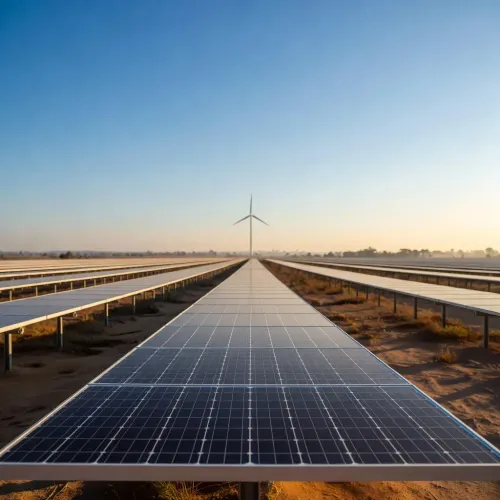
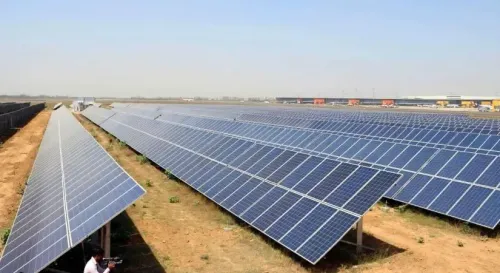
According to the IEA report, India added 168 GW of solar power capacity and 38 GW of wind power capacity between March 2014 and September 2026. Bioenergy capacity reached nearly 12 GW by September 2026. India's total renewable power capacity has nearly quadrupled over the past decade, crossing 300 GW in 2026.
The report identified India as the world's second-fastest-growing renewable energy market and the second-largest manufacturer of solar panels globally — a position that reflects both domestic demand and aggressive industrial policy.
What India Saved — and What It Stands to Save
The IEA estimated that without the renewable capacity added since 2010, India would have needed approximately 110 million tonnes of additional imported coal in 2025 alone. Looking ahead, cumulative coal and gas import savings could approach ₹22.6 lakh crore by 2030, assuming international fuel prices remain broadly in line with 2024-25 averages.
Annual savings could reach around ₹3.3 lakh crore by 2030 — a figure that reportedly exceeds India's entire spending on non-coking coal and natural gas imports in FY25. This positions renewable energy not merely as a climate strategy but as a structural hedge against volatile global fuel markets.
Key Policy Drivers Behind the Growth
The IEA credited India's progress to sustained policy support, ambitious goals, and long-term planning. Competitive bidding processes have helped India achieve some of the world's lowest solar power costs; according to the report, tariffs for solar projects commissioned in 2025 were around 40% below the average cost of coal-based electricity.
The government's PM-KUSUM scheme has extended renewable benefits to the agriculture sector, supporting solar-powered irrigation pumps and farm electricity supply. Meanwhile, Production Linked Incentive (PLI) schemes and policies encouraging domestically manufactured equipment have attracted significant investment in India's solar manufacturing ecosystem.
India Meets Its 2030 Target Five Years Early
Notably, India achieved 50% of its installed electricity capacity from non-fossil sources in 2025 — meeting its 2030 target a full five years ahead of schedule. This milestone is among the most striking in the report and signals that India's energy transition is tracking faster than official projections had anticipated.
This comes amid continued global pressure on emerging economies to accelerate decarbonisation, and India's performance is likely to feature prominently in multilateral climate discussions. With annual savings projected to surpass current import bills by the decade's end, the economic case for sustaining — and deepening — the renewable push appears compelling.
Point of View
It is a real reduction in current account pressure. What the headline figure also obscures is speed: hitting 50% non-fossil capacity five years ahead of schedule is rare in a country of India's energy scale. The challenge now is whether transmission infrastructure, grid balancing, and storage investment keep pace with generation capacity — because adding gigawatts without solving intermittency and evacuation bottlenecks is where past clean energy transitions have stalled. The ₹22.6 lakh crore savings projection by 2030 is achievable, but only if the second half of the build-out is as well-executed as the first.
NationPress
11 Nov 2026
Frequently Asked Questions
How much did India save on fuel imports through renewable energy?
India avoided over ₹9.4 lakh crore in coal and natural gas import costs between 2011 and 2025, according to an IEA report released on 11 November 2026. Cumulative savings could rise to approximately ₹22.6 lakh crore by 2030, assuming fuel prices stay near 2024-25 averages.
How much renewable energy capacity has India added?
India added 168 GW of solar and 38 GW of wind power capacity between March 2014 and September 2026, with bioenergy reaching nearly 12 GW by September 2026. Total renewable capacity crossed 300 GW in 2026, nearly quadrupling over the past decade.
Did India meet its 2030 clean energy target?
Yes. India achieved 50% of its installed electricity capacity from non-fossil sources in 2025 — meeting its 2030 target five years ahead of schedule. The IEA credited this to sustained policy support, competitive bidding, and long-term planning.
Why are India's solar tariffs so low?
Competitive bidding processes have driven solar tariffs in India to some of the world's lowest levels. According to the IEA, tariffs for solar projects commissioned in 2025 were around 40% below the average cost of coal-based electricity.
What government schemes have supported India's renewable energy growth?
The PM-KUSUM scheme has extended solar benefits to agriculture through solar-powered irrigation pumps and farm electricity supply. Production Linked Incentive (PLI) schemes and domestic manufacturing policies have also attracted investment in India's solar panel manufacturing sector, helping it become the world's second-largest producer.