₹6,800 crore in unclaimed deposits returned to 29 lakh claimants in 6 months
Synopsis
In six months, India's public sector banks returned ₹6,800 crore in dormant deposits to 29 lakh claimants — while simultaneously posting their highest-ever annual net profit of ₹1.98 lakh crore and driving GNPA to a historic low of 1.93%. The numbers suggest a banking sector that has turned a corner, but the real test is whether the citizen outreach on unclaimed assets can scale further.
Key Takeaways
Over ₹6,800 crore in unclaimed bank deposits restituted to nearly 29 lakh claimants in the past six months .
PSBs recorded their highest-ever annual net profit of approximately ₹1.98 lakh crore in FY 2025–26 .
Aggregate PSB business reached ₹283.3 lakh crore as on 31 March 2026 .
GNPA fell to a historic low of 1.93% ; NNPA declined to 0.39% .
Revamped DFS website launched in 23 regional languages with accessibility features for visually impaired users.
Banks advised to support borrowers under ECLGS 5.0 and maintain preparedness for Middle East crisis spillover.
Over ₹6,800 crore in unclaimed bank deposits has been restituted to nearly 29 lakh claimants across India in the past six months, the Finance Ministry announced on Friday, 29 May 2026, as part of an intensified nationwide drive to help citizens recover dormant financial assets. The development marks a significant acceleration in the government's campaign to clear the backlog of unclaimed funds held with public sector banks.
Review Meeting and Key Announcements
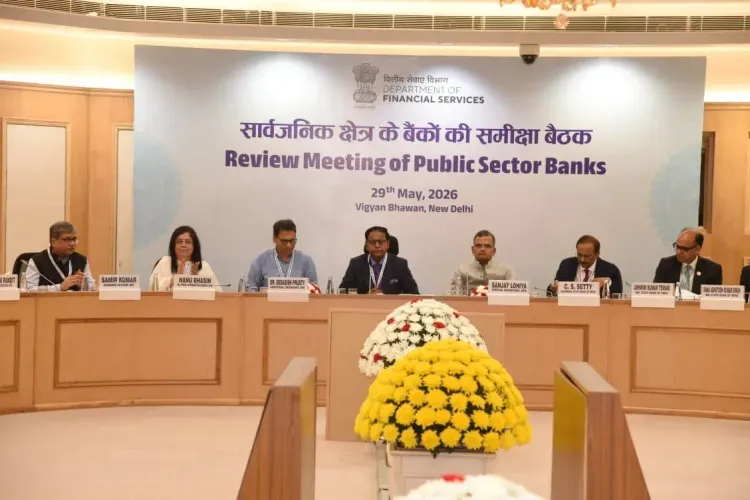
M. Nagaraju, Secretary of the Department of Financial Services (DFS), chaired a comprehensive review meeting of public sector banks (PSBs) to assess performance and progress across key operational, financial, and strategic priorities for FY 2025–26. The meeting was attended by the Special Secretary, DFS, senior officials, the State Bank of India's Chairman, and the Managing Directors, Chief Executive Officers, and Executive Directors of PSBs.
During the meeting, a coffee table book titled 'Your Money, Your Right' was unveiled. The publication documents the nationwide campaign to empower citizens to identify and reclaim unclaimed financial assets, highlighting collaborative efforts among banks, financial institutions, regulators, and other stakeholders in facilitating tracing, claim settlement, and restitution.
The revamped website of the Department of Financial Services was also launched — designed with a citizen-centric approach, the portal is available in 23 regional languages and incorporates accessibility features for persons with visual impairments, reinforcing the government's commitment to inclusive digital service delivery.
PSBs Post Record Profits in FY 2025–26
The review highlighted that PSBs delivered strong financial performance in FY 2025–26. Aggregate business of PSBs reached approximately ₹283.3 lakh crore as on 31 March 2026, while aggregate net profit rose to around ₹1.98 lakh crore — the highest-ever annual net profit in the history of public sector banking in India.
Asset quality also improved markedly. Gross Non-Performing Assets (GNPA) fell to a historic low of 1.93%, while Net Non-Performing Assets (NNPA) declined to 0.39%, reflecting continued balance-sheet strengthening and prudent risk management across the sector.
Financial Inclusion and Digital Lending Progress
Progress under major financial inclusion initiatives — including Pradhan Mantri Jan Dhan Yojana, social security schemes, Pradhan Mantri Mudra Yojana, PM Vishwakarma, and digital lending programmes — was reviewed. PSBs continue to play a central role in expanding financial access and strengthening last-mile banking delivery across the country.
The status of end-to-end digital lending journeys for small-value loans and welfare-linked schemes was also assessed. Banks highlighted paperless processing through e-KYC and digital documentation, straight-through processing (STP), and integration with government platforms to improve accessibility and customer experience.
Advisories and Global Risk Preparedness
Banks were advised to provide proactive, need-based support to eligible borrowers under ECLGS 5.0, strengthen grievance redressal mechanisms, improve operational efficiency, and explore new business opportunities to sustain profitability. Deliberations also covered enhancement of cyber security frameworks and improved credit access for MSMEs.
Notably, banks were also advised to maintain preparedness and adaptability in response to the ongoing crisis in the Middle East and the evolving global situation — a signal that the Finance Ministry is factoring in external macro risks into PSB operational planning. With record profits, historic-low NPAs, and a live unclaimed-deposits drive, India's public sector banking landscape is entering a new phase — though execution on citizen outreach and MSME credit will determine how durable these gains prove.
Point of View
800 crore restitution figure is meaningful, but it must be read against the total stock of unclaimed deposits parked with the RBI's Depositor Education and Awareness Fund — which runs into tens of thousands of crores. Six months of accelerated outreach returning ₹6,800 crore suggests the drive is working, but also underscores how large the unresolved pool remains. Meanwhile, the record ₹1.98 lakh crore PSB profit and 1.93% GNPA deserve scrutiny: much of the NPA cleanup was driven by write-offs and recoveries from the previous bad-loan cycle, not necessarily by a structural improvement in credit underwriting. The real test for PSBs now is whether they can grow MSME and retail credit without recreating the asset-quality problems of the 2010s.
NationPress
20 Sept 2026
Frequently Asked Questions
How much unclaimed bank deposit money has been returned to claimants?
Over ₹6,800 crore in unclaimed bank deposits has been restituted to nearly 29 lakh claimants across India in the past six months, according to the Finance Ministry's announcement on 29 May 2026. The restitution is part of an intensified nationwide campaign by public sector banks and regulators.
What is the 'Your Money, Your Right' initiative?
'Your Money, Your Right' is a coffee table book unveiled by the Department of Financial Services that documents the nationwide campaign to help citizens identify and reclaim unclaimed financial assets. It highlights collaborative efforts by banks, financial institutions, and regulators in facilitating claim settlement and restitution.
What was the net profit of public sector banks in FY 2025–26?
Public sector banks recorded an aggregate net profit of approximately ₹1.98 lakh crore in FY 2025–26 — the highest-ever annual net profit in the history of PSBs in India. Aggregate business reached ₹283.3 lakh crore as on 31 March 2026.
What is the current NPA level of Indian public sector banks?
Gross Non-Performing Assets (GNPA) of PSBs fell to a historic low of 1.93% in FY 2025–26, while Net Non-Performing Assets (NNPA) declined to 0.39%. The Finance Ministry attributed this to continued balance-sheet strengthening and prudent risk management.
How can citizens reclaim their unclaimed bank deposits?
Citizens can use the revamped Department of Financial Services website, which is available in 23 regional languages and includes accessibility features for visually impaired users, to trace and initiate claims on unclaimed financial assets. Public sector banks are also running outreach programmes as part of the nationwide restitution drive.