India's GDP hits 7.8% amid global storm, outpaces G7 and China
Synopsis
In the worst global economic weather in a generation — steep US tariffs, an oil shock, and Hormuz disruption — India did not just survive. It accelerated. A 7.8% GDP print, twice China's pace and nearly four times America's, with manufacturing, services, consumption, and investment all surging simultaneously, makes this the most emphatic data point in India's decade-long economic transformation.
Key Takeaways
India's GDP grew 7.8 per cent in the latest quarter, up from 6.9 per cent a year earlier, beating the RBI's projection of 7 per cent .
India outpaced every major economy: China (4.3%) , USA (2.1%) , UK (1.2%) , Germany (1%) , and Japan (0.5%) .
Manufacturing grew 9.2% , services 10% , consumption 7.1% , and investment 11.9% .
Gross foreign investment inflows hit $30.7 billion — the highest in at least 15 years of RBI records; net inflows rose 64% .
India is now the fourth largest economy in the world; 25 crore Indians have exited multidimensional poverty in twelve years.
The RBI projects full-year growth at 6.7% , with analysts noting upside risk given this quarter's performance.
India's economy expanded at 7.8 per cent in the most recent quarter, surpassing the Reserve Bank of India's (RBI) own projection of 7 per cent and outpacing every major economy on earth — including China (4.3%), the United States (2.1%), Britain (1.2%), Germany (1%), and Japan (0.5%) — during what analysts describe as one of the most punishing global economic environments in a generation. The growth figure, released on 2 September, marks an acceleration from 6.9 per cent recorded a year earlier.
The Headwinds India Faced
The past thirteen months subjected the global economy to a cascade of simultaneous shocks: the steepest American tariff barriers faced by any major trading nation, a significant oil price shock, disruption at the Strait of Hormuz, and a worldwide supply chain squeeze. For India, each of these pressures was disproportionately severe. India imports nearly 90 per cent of its crude oil, making it acutely vulnerable to both price spikes and shipping lane disruptions. The Hormuz chokepoint sits astride the very sea lanes that carry India's energy imports and export cargo. By most conventional measures, the external environment was stacked against India more heavily than against any other large economy.
Every Engine Firing: The Sectoral Breakdown
The headline number is underpinned by broad-based sectoral strength. Manufacturing grew 9.2 per cent, services expanded 10 per cent, consumption rose 7.1 per cent, and the investment sector led all components with growth of 11.9 per cent. For decades, a conventional argument held that India must choose between manufacturing-led and services-led development. This quarter, both sectors grew faster than most economies manage in their best years. Foreign capital has taken note: gross foreign investment inflows reached $30.7 billion — the strongest in at least fifteen years of RBI records — while net inflows surged 64 per cent. Gross inflows indicate interest; net inflows indicate sustained conviction. The distinction matters.
Twelve Years: From Fragile Five to Fourth Largest Economy
The context is worth recalling. In 1991, a single oil shock drained India's foreign exchange reserves so severely that the country airlifted gold to London as collateral. As recently as 2013, global financial institutions categorised India among the so-called 'Fragile Five' — economies deemed most vulnerable to capital flight. That designation is now history. India is today the fourth largest economy in the world and is closing the gap on the third position. According to government data, 25 crore Indians have risen out of multidimensional poverty in this period. Inflation, which was near double digits when the current administration took office, held at 4.45 per cent through this year's oil shock. Foreign exchange reserves have more than doubled. Close to two-thirds of all foreign investment attracted since liberalisation in 1991 has arrived in the past twelve years. Nearly half of all real-time digital payments globally are processed in India.
Policy Decisions Behind the Numbers
Analysts and the article's author — a Senior Advocate practising in the Supreme Court of India — attribute the resilience to a decade of structural policy choices rather than cyclical fortune. When the tariff shock hit, the government cut and simplified the Goods and Services Tax (GST), directing purchasing power back to Indian consumers at the precise moment export demand was under threat. Capital expenditure on roads, rail, and ports was maintained rather than curtailed. New trade agreements with Britain and Europe were advanced as one major trade corridor narrowed, and exports reportedly recorded a substantial rise in July. The author argues these crisis responses rested on a decade of prior construction: the Insolvency and Bankruptcy Code strengthened the banking system; the GST unified dozens of state tax regimes into a single national market; the Jan Dhan–Aadhaar–Mobile trinity extended financial inclusion and laid the infrastructure on which UPI now operates; the Make in India and Production-Linked Incentive (PLI) schemes seeded manufacturing capacity; and highway, freight corridor, and port investments expanded logistics throughput. More than 1,500 obsolete laws have reportedly been repealed and over 40,000 compliances removed under the current administration.
The Political Dimension and What Comes Next
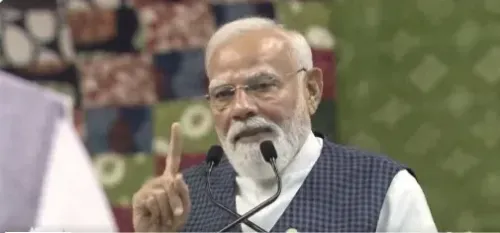
The growth data has reignited a sharp political exchange. The article's author notes that Congress leader Rahul Gandhi had declared India's economy 'dead' and, more recently, predicted an 'economic tsunami' worse than any crisis Indians had seen. The author characterises these as predictions that were twice made and twice disproved by the data. Prime Minister Narendra Modi, in his response to the GDP figures, congratulated citizens and described the number as a reflection of 'our collective strength', while calling on 140 crore Indians to sustain the pace, deepen self-reliance, and build toward a Viksit Bharat by 2047 — India's centenary of independence. The RBI projects full-year growth at 6.7 per cent; on the basis of this quarter's performance, the author argues the risk to that forecast is firmly to the upside. This is the sixth consecutive year in which India has been the fastest-growing major economy since the post-Covid recovery began.
Point of View
Oil, and supply-chain shocks is genuinely remarkable — but the article, authored by a legal professional rather than an economist, reads more as a political brief than independent analysis. The attribution of every positive outcome to Prime Minister Modi's leadership and the pointed attack on Rahul Gandhi belong to the op-ed tradition, not neutral economic assessment. What the data does objectively confirm is that India's structural reforms of the past decade — GST unification, IBC, PLI, digital public infrastructure — have created real shock-absorbers. The harder question, largely unasked here, is whether 7.8% growth is translating proportionally into quality employment, wage growth, and reduced inequality — metrics that GDP alone cannot capture. The RBI's own full-year projection of 6.7% suggests institutional caution about sustaining this pace.
NationPress
17 Oct 2026
Frequently Asked Questions
What is India's latest GDP growth rate?
India's GDP grew at 7.8 per cent in the most recent quarter, up from 6.9 per cent a year earlier and ahead of the RBI's projection of 7 per cent. The figure was released on 2 September and makes India the fastest-growing major economy in the world for the period.
How does India's GDP growth compare to other major economies?
India's 7.8% growth is nearly twice China's 4.3% and close to four times the United States' 2.1% for the same period. Germany recorded 1%, Japan 0.5%, and Britain 1.2%, making India's performance the highest among all major economies tracked.
Which sectors drove India's 7.8% GDP growth?
All four major components expanded strongly: investment grew 11.9%, services 10%, manufacturing 9.2%, and consumption 7.1%. The simultaneous strength across both manufacturing and services is notable, as the two sectors have historically grown at uneven rates in India.
What is the significance of India becoming the fourth largest economy?
India has overtaken several advanced economies to become the world's fourth largest by GDP, a position that would have been considered unlikely as recently as 2013, when it was grouped among the 'Fragile Five' most vulnerable economies. The country is reportedly closing the gap on the third-place economy.
What does the RBI project for India's full-year GDP growth?
The Reserve Bank of India has projected full-year GDP growth at 6.7 per cent. However, given that the latest quarterly figure of 7.8% significantly exceeded the RBI's own quarterly forecast of 7%, analysts suggest the risk to the full-year projection is skewed to the upside.