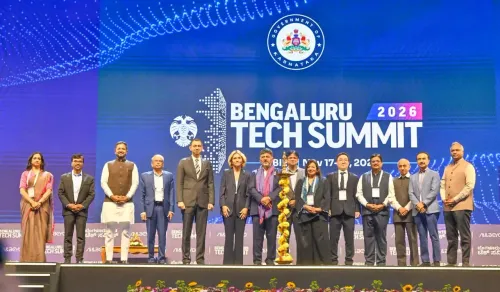
India's AI and semiconductor manufacturing leap: Bengaluru Tech Summit signals strategic shift

Synopsis
The Bengaluru Tech Summit has drawn a line in the sand: India wants to build chips, not just design them. With over ₹23,000 crore in global commitments, Karnataka's combination of AI talent and policy support makes this the most credible attempt yet to shift India from semiconductor consumer to semiconductor maker — with strategic, economic, and geopolitical stakes attached.
Key Takeaways
The Bengaluru Tech Summit signalled India's strategic shift from software services to AI and semiconductor manufacturing .
Shivakumar positioned the state as a global hub, noting Bengaluru hosts nearly half of India's AI and ML talent .
Global firms have committed over ₹23,000 crore in semiconductor R&D and manufacturing across Bengaluru and Mysuru .
Karnataka is home to more than 100 fabless chip companies and contributes one-fifth of India's electronics exports.
Four electronics manufacturing clusters from Dharwad to Mysuru are being prepared to support the expansion.
Experts warn that bridging design-to-fabrication requires consistent policy, power, and water infrastructure — areas that have historically challenged Indian semiconductor ambitions.
India's Bengaluru Tech Summit this week delivered a pointed message: the country is no longer satisfied being the world's back office for software and chip design. Artificial intelligence and semiconductor manufacturing dominated the summit's agenda, marking a deliberate pivot from services-led growth toward building the physical and intellectual infrastructure of the next technological era.
Karnataka Positions Itself as Global Tech Hub
Karnataka Chief Minister D.K. Shivakumar used the summit's inauguration to present the state as an emerging global centre for AI, deep technology, and semiconductor manufacturing. Bengaluru already hosts nearly half of India's AI and machine-learning talent, and the state is home to more than 100 fabless chip companies. Karnataka accounts for three-fifths of the engineers employed in India's semiconductor capability centres and contributes roughly one-fifth of the country's electronics exports.
Global companies have committed over ₹23,000 crore in semiconductor research, development, and manufacturing facilities across Bengaluru and Mysuru. Four electronics manufacturing clusters, stretching from Dharwad to Mysuru, are being readied to support this rapid expansion.
Why Semiconductors Are Now a Strategic Imperative
Semiconductors are the substrate on which modern AI operates. Training large-scale models, deploying inference systems, powering autonomous platforms, and securing critical infrastructure all depend on advanced chips. For decades, India excelled at chip design and software services while remaining heavily reliant on imports for fabrication and advanced packaging.
As AI evolves into a general-purpose technology with military, economic, and societal consequences, dependence on foreign fabrication facilities is no longer merely a commercial concern — it is a strategic vulnerability. The Bengaluru Tech Summit's emphasis on domestic manufacturing therefore represents a maturation in India's technology policy, aligning with the national push under the India Semiconductor Mission and production-linked incentive (PLI) frameworks.
High-Multiplier Effects on Jobs and Ecosystems
Karnataka's existing design strengths give it a head start in moving toward actual fabrication and packaging. Analysts note that this transition can generate high-multiplier effects — skilled employment, supplier ecosystems, and the capacity to iterate rapidly on AI-specific hardware such as edge processors, neuromorphic chips, and specialised accelerators. The state's combination of engineering talent and policy-backed infrastructure makes it one of the more credible candidates for this transition within India.
Broader Economic and Trade Implications
For India's wider economy, a credible semiconductor and electronics manufacturing base could help rebalance the country's growth story. Software and IT services have long driven export earnings and middle-class expansion, but manufacturing has lagged relative to comparable emerging economies. A stronger electronics base can absorb more engineering graduates, reduce current-account pressure from electronics imports, and open higher-value export channels.
It also reinforces India's positioning as a preferred 'China-plus-one' destination at a moment when multinational firms are actively diversifying production away from a single geography. This comes amid accelerating global supply-chain restructuring, in which India is competing with Vietnam, Mexico, and Malaysia for a larger share of advanced manufacturing.
What Comes Next
The momentum from the Bengaluru Tech Summit will be tested by execution — particularly whether the four planned electronics manufacturing clusters attract anchor investors and whether the ₹23,000 crore in commitments translates into operational facilities within the projected timelines. Industry observers note that bridging the gap from chip design to fabrication requires sustained policy consistency, power infrastructure, and water supply guarantees that have historically challenged large semiconductor fabs in India.
Point of View
But the Bengaluru Tech Summit is notable for its specificity — named clusters, committed capital, and a state government with demonstrable engineering depth behind the pitch. The ₹23,000 crore in commitments is real money, but the gap between commitment and operational fab is where previous waves of enthusiasm have faded. The 'China-plus-one' window is not permanently open: Vietnam and Malaysia are moving faster on some fronts. India's edge is its design talent and domestic market scale — but neither substitutes for the unglamorous infrastructure of reliable power, water, and logistics that advanced semiconductor fabs demand. The summit was a credible signal; the execution timeline will be the real verdict.
NationPress
20 Nov 2026
Frequently Asked Questions
What was the focus of the Bengaluru Tech Summit 2024?
The Bengaluru Tech Summit this week centred on artificial intelligence and semiconductor manufacturing, marking a strategic shift in India's technology agenda from software services toward physical chip production and AI infrastructure. Karnataka CM D.K. Shivakumar used the event to position the state as an emerging global hub for deep tech and semiconductor manufacturing.
How much have global companies invested in Karnataka's semiconductor sector?
Global companies have committed over ₹23,000 crore in semiconductor research, development, and manufacturing facilities across Bengaluru and Mysuru. Four electronics manufacturing clusters from Dharwad to Mysuru are being developed to support this expansion.
Why is semiconductor manufacturing strategically important for India?
As AI becomes a general-purpose technology with military and economic consequences, reliance on foreign chip fabrication is a strategic risk, not just a commercial one. India currently excels at chip design but imports most of its fabricated chips, making domestic manufacturing capacity a national security and economic priority.
What is India's existing semiconductor and AI strength in Karnataka?
Bengaluru hosts nearly half of India's AI and machine-learning talent. The state is home to more than 100 fabless chip companies, accounts for three-fifths of engineers in India's semiconductor capability centres, and contributes roughly one-fifth of the country's electronics exports.
How does this push relate to India's 'China-plus-one' opportunity?
Multinational firms actively diversifying production away from China are evaluating India as an alternative manufacturing base. A credible semiconductor and electronics ecosystem would strengthen India's case as a preferred 'China-plus-one' destination, opening higher-value export opportunities and reducing current-account pressure from electronics imports.