India's economy resilient amid global uncertainty, says DEA Secretary at RBI SAMVAD 2026

Synopsis
At RBI SAMVAD 2026, India's DEA Secretary declared the country's macroeconomic foundations are holding firm even as global crises accelerate. Experts from the IMF, Invesco, and Bhutan's central bank warned that financial shocks are arriving faster and with greater intensity — and that AI agents, climate risk, and geopolitical fragmentation are the next frontiers policymakers must build defences against.
Key Takeaways
Anuradha Thakur , DEA Secretary, said India's fiscal trajectory and flexible inflation targeting provide macroeconomic stability against global headwinds, speaking at RBI SAMVAD 2026 on 20 October 2026 .
RBI Deputy Governor Poonam Gupta noted the policy focus has shifted from individual institutions to the financial system as a whole, including non-banks.
Global panellists — from the IMF , IRDAI , Invesco , and Bhutan's central bank — warned that financial crises are arriving faster and with greater intensity.
Key risks flagged: climate change , rising role of fintechs and non-bank intermediaries , geopolitical fragmentation, AI agent deployment , and cross-border data-sharing gaps.
SAMVAD 2026 was inaugurated by RBI Governor Sanjay Malhotra ; Finance Minister Nirmala Sitharaman delivered the keynote address on 19 October .
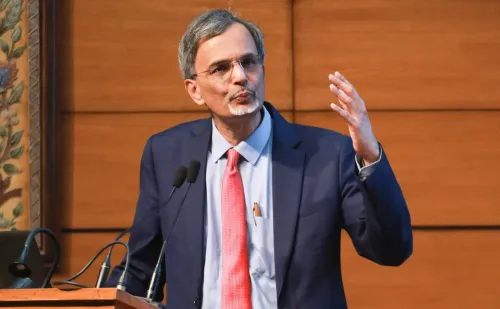
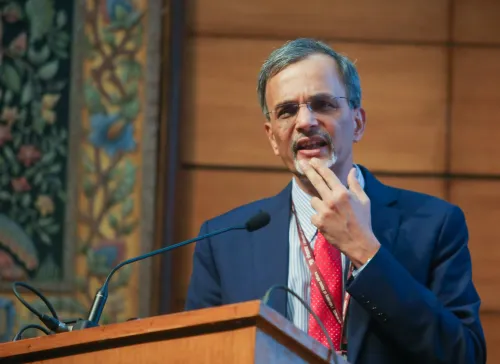
Anuradha Thakur, Secretary of the Department of Economic Affairs (DEA), on Tuesday, 20 October 2026, declared that India stands as a compelling model of macroeconomic resilience, citing its credible fiscal trajectory and anchored inflation expectations as key buffers against a turbulent global backdrop. Her remarks came during a special address on 'Financial Stability' at RBI SAMVAD 2026, the central bank's flagship international seminar for central banks, being held in New Delhi.
'India faces the present challenging global scenario from a position of macroeconomic stability,' Thakur said, underscoring that the country's flexible inflation targeting framework has been instrumental in keeping inflationary expectations in check.
RBI Deputy Governor Sets the Stage
RBI Deputy Governor Poonam Gupta, setting the context for the panel discussion, noted that financial stability has evolved into a standalone policy objective — no longer a byproduct of monetary management. She pointed out that the policy lens has broadened from monitoring individual institutions to scrutinising the financial system as a whole, encompassing not just banks but also non-bank financial intermediaries.
Global Experts Sound Alerts on Emerging Risks
A high-profile panel featuring Ajay Seth, Chairman of the Insurance Regulatory and Development Authority of India (IRDAI); Yangchen Tshogyel, Governor of the Royal Monetary Authority of Bhutan; Athanasios Vamvakidis of the International Monetary Fund (IMF); and Paul Jackson of Invesco converged on a sobering message: financial crises are arriving faster and hitting harder than before.
The panellists cautioned that lessons from past episodes of financial reengineering must not be discarded even as innovation is encouraged. They flagged a cluster of systemic risks demanding urgent attention — including the accelerating impacts of climate change, the expanding role of non-bank financial intermediaries and fintech platforms, and the growing fragmentation of global geopolitics. Notably, they also raised concerns about gaps in cross-border data sharing and the risks introduced by the increasing deployment of AI agents in financial services.
The panellists stressed that resilience must be built not merely within bank balance sheets, but across corporate and household balance sheets as well — a broader conception of financial stability than has traditionally guided policymaking.
About RBI SAMVAD 2026
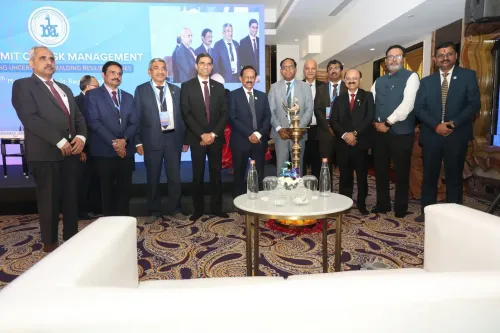
SAMVAD 2026 was inaugurated on Monday, 19 October by RBI Governor Sanjay Malhotra, who delivered the welcome address. Union Finance and Corporate Affairs Minister Nirmala Sitharaman delivered the keynote address. The two-day event brings together central bank governors, senior policymakers, representatives from international organisations, and subject-matter experts from across the world to examine emerging challenges and opportunities facing the global financial system.
Why This Moment Matters
The timing of SAMVAD 2026 is significant. Global central banks are navigating a rare combination of sticky inflation, elevated public debt, and geopolitical fragmentation — conditions that stress-test even the most robust financial architectures. India's positioning as a stable anchor in this environment is as much a diplomatic signal as an economic assessment. The emphasis on non-bank risks and AI-driven vulnerabilities signals that the next frontier of financial regulation is already taking shape.
Point of View
Non-bank intermediary expansion, and geopolitical fragmentation represents a qualitatively new threat landscape that existing regulatory frameworks were not designed for. India's own fintech and shadow-banking sectors have grown rapidly, and the RBI's broadened system-wide lens is the right instinct — but intention and architecture are not the same thing. The real test will come when the next shock arrives faster than the last.
NationPress
20 Oct 2026
Frequently Asked Questions
What is RBI SAMVAD 2026?
RBI SAMVAD 2026 is a two-day international seminar hosted by the Reserve Bank of India, inaugurated on 19 October 2026 by RBI Governor Sanjay Malhotra, with Finance Minister Nirmala Sitharaman delivering the keynote. It brings together central bank governors, senior policymakers, and international experts to discuss challenges facing the global financial system.
What did DEA Secretary Anuradha Thakur say about India's economy?
Thakur said India's strong macroeconomic foundation — including a credible fiscal trajectory and a flexible inflation-targeting framework — has anchored inflationary expectations and positioned the country to face global uncertainties from a position of stability. She described India as a compelling example of economic resilience.
What risks did global experts highlight at SAMVAD 2026?
Panellists from the IMF, Invesco, IRDAI, and the Royal Monetary Authority of Bhutan warned that financial crises are now more frequent and intense. Key risks cited included climate change, the growing role of non-bank financial intermediaries and fintechs, geopolitical fragmentation, cross-border data-sharing gaps, and the increasing use of AI agents in financial services.
Why has financial stability become a standalone policy objective?
RBI Deputy Governor Poonam Gupta noted that the traditional focus on individual institution health is no longer sufficient — the 2008 global financial crisis and subsequent shocks demonstrated that systemic risks can build up outside conventional banking. Policy frameworks now track the entire financial system, including non-banks and fintech platforms.
Who were the key speakers at RBI SAMVAD 2026?
Key speakers included RBI Governor Sanjay Malhotra, Finance Minister Nirmala Sitharaman, DEA Secretary Anuradha Thakur, and RBI Deputy Governor Poonam Gupta. The panel featured Ajay Seth of IRDAI, Yangchen Tshogyel of Bhutan's Royal Monetary Authority, Athanasios Vamvakidis of the IMF, and Paul Jackson of Invesco.