India's first amorphous silicon solar cell: IACS Kolkata leads Atmanirbhar push

Synopsis
India has fabricated its first amorphous silicon solar cell using an indigenously built PECVD system at IACS Kolkata — a quiet but consequential step in the country's push for homegrown clean-energy technology. The simultaneous launch of the RETINA incubation centre signals that IACS is no longer just a research institution; it is being repositioned as a launchpad for deep-tech startups.
Key Takeaways
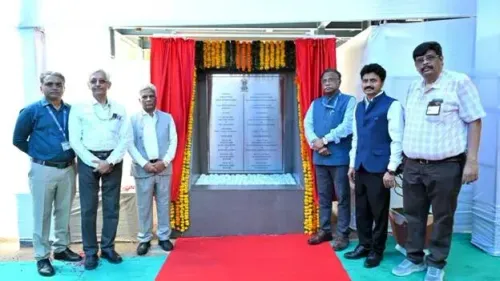
Jitendra Singh inaugurated an indigenously developed PECVD system at IACS Kolkata on 26 May 2025 .
The system enables fabrication of India's first amorphous silicon solar cell , developed by Prof.
The RETINA incubation centre was also launched to bridge research and entrepreneurship at IACS.
The minister linked both developments to the Atmanirbhar Bharat and Viksit Bharat 2047 national visions.
IACS research spans quantum materials , cancer biology , nanotechnology , AI and sustainable energy materials .
Union Minister of State for Science and Technology Dr. Jitendra Singh on Tuesday, 26 May inaugurated an indigenously developed Plasma Enhanced Chemical Vapor Deposition (PECVD) system at the Indian Association for the Cultivation of Science (IACS) campus in Kolkata, marking a significant milestone in India's clean-energy research. The system was purpose-built for the fabrication of India's first amorphous silicon solar cell, according to an official statement from the Ministry of Science and Technology.
What Was Inaugurated
The PECVD system, developed by Prof. Ashok Kumar Barua of IACS, represents the country's first indigenously engineered platform for amorphous silicon solar-cell fabrication. Dr. Singh described it as a pioneering contribution that marks 'an important chapter in India's renewable-energy journey.' Alongside the system, the minister also launched RETINA — the institute's new incubation centre, whose full name expands to Research Entrepreneurship for Translation, Innovation and Navigation.
The Atmanirbhar Bharat Connection
Addressing the gathering, Dr. Singh said the indigenous development of advanced solar-cell fabrication technology embodied the spirit of scientific self-reliance that India is accelerating under the vision of Atmanirbhar Bharat. He emphasised that the country's scientific institutions are increasingly moving beyond fundamental research to integrate startup culture, entrepreneurship and societal applications into their core mandate.
RETINA and the Research-to-Market Push
The launch of the RETINA incubation centre signals IACS's intent to bridge the gap between laboratory discovery and commercial deployment. Dr. Singh highlighted that the future of Indian science lies in converting research breakthroughs into affordable and scalable technologies capable of addressing national priorities — spanning healthcare, clean energy, advanced materials and sustainable development.
IACS's Broader Research Portfolio
The minister acknowledged IACS's contributions across a wide range of frontier domains, including quantum materials, nanotechnology, artificial intelligence, battery materials, cancer biology and environmental technologies. He specifically referenced ongoing work at the institute in areas such as Duchenne Muscular Dystrophy treatment research, toxic waste remediation, photodetectors, biosensors and sustainable energy materials.
Viksit Bharat 2047 Vision
Dr. Singh positioned these developments within the broader national goal of Viksit Bharat 2047, stating that innovation, academia, industry and startups must converge to place India among the world's leading knowledge economies. He also commended IACS for its outreach programmes targeting school students, women and rural communities — efforts aimed at broadening scientific participation across society. The next phase will likely see RETINA facilitate industry partnerships to commercialise IACS's clean-energy and materials research.
Point of View
Not merely symbolic. The real question is whether the RETINA incubation centre can translate Prof. Barua's PECVD work into a scalable manufacturing pathway, or whether it remains a laboratory achievement. Amorphous silicon solar cells are cost-effective but lower in efficiency than crystalline alternatives; the commercial viability case will need to be made explicitly. Without a clear industry-adoption roadmap, this risks being celebrated as a milestone and then quietly shelved — a pattern Indian deep-tech research has seen before.
NationPress
19 Sept 2026
Frequently Asked Questions
What is India's first amorphous silicon solar cell and where was it developed?
India's first amorphous silicon solar cell was developed at the Indian Association for the Cultivation of Science (IACS) in Kolkata, using an indigenously built Plasma Enhanced Chemical Vapor Deposition (PECVD) system created by Prof. Ashok Kumar Barua. The system was inaugurated on 26 May 2025 by Union MoS Dr. Jitendra Singh.
What is the RETINA incubation centre at IACS?
RETINA stands for Research Entrepreneurship for Translation, Innovation and Navigation — a newly launched incubation centre at IACS Kolkata designed to convert fundamental research into startups and market-ready technologies. It was inaugurated alongside the PECVD system on 26 May 2025.
How does this development relate to Atmanirbhar Bharat?
Dr. Jitendra Singh described the indigenous fabrication of advanced solar-cell technology as embodying the spirit of Atmanirbhar Bharat, India's self-reliance initiative. The PECVD system was designed, built and deployed entirely within India, reducing dependence on imported clean-energy manufacturing equipment.
What other research areas is IACS known for?
IACS Kolkata conducts research across quantum materials, nanotechnology, artificial intelligence, battery materials, cancer biology and environmental technologies. Recent work includes Duchenne Muscular Dystrophy treatment research, toxic waste remediation, photodetectors, biosensors and sustainable energy materials.
What is the significance of amorphous silicon solar cells for India?
Amorphous silicon solar cells are a cost-effective thin-film photovoltaic technology suitable for a range of applications. Developing indigenous fabrication capability reduces India's reliance on imported solar components, which is critical given the country's target to scale up renewable-energy capacity under its climate commitments.