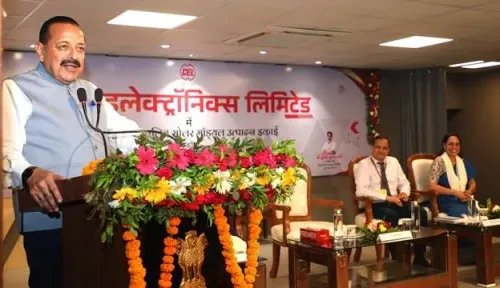
Dr. Jitendra Singh Inaugurates India's First Indigenous PECVD Solar Cell Setup at IACS Kolkata

Synopsis
Union Science and Technology Minister Dr. Jitendra Singh inaugurated India's first indigenous PECVD setup for amorphous silicon solar cell fabrication at IACS Kolkata on May 26, 2026, advancing India's self-reliance in clean energy technology.
Key Takeaways
Union Science and Technology Minister Dr.
Jitendra Singh inaugurated the PECVD Setup at IACS, Kolkata on May 26, 2026 .
The setup is India's first-ever indigenous facility for the fabrication of amorphous silicon (a-Si) solar cells.
IACS Director Professor Kalobaran Maiti and senior officials were present at the inauguration.
The initiative is positioned as a step toward strengthening India's self-reliance in advanced solar energy research and clean technology .
IACS , established in 1876 , is one of India's oldest fundamental sciences research institutions, based in Kolkata.
The development aligns with India's broader policy frameworks including the Jawaharlal Nehru National Solar Mission and the Make in India initiative.
Union Science and Technology Minister Dr. Jitendra Singh on Tuesday, May 26, 2026, inaugurated India's first-ever indigenous PECVD (Plasma-Enhanced Chemical Vapour Deposition) Setup for the fabrication of amorphous silicon (a-Si) solar cells at the Indian Association for the Cultivation of Science (IACS) in Kolkata, marking a significant milestone in the country's push for self-reliance in advanced solar energy research.
Context
The inauguration took place in the presence of IACS Director Professor Kalobaran Maiti, senior officials, and distinguished dignitaries. The PECVD setup is described as the first of its kind to be indigenously developed in India for the fabrication of a-Si solar cells — a thin-film photovoltaic technology with applications in low-cost, flexible solar devices.
Dr. Singh stated that 'the initiative marks an important step towards strengthening India's self-reliance in advanced solar energy research, innovation and clean technology development.' The development signals a shift from dependence on imported photovoltaic components to building domestic fabrication capability within a premier public research institution.
Policy Backdrop
The inauguration sits within a long-running policy arc. India's Jawaharlal Nehru National Solar Mission, launched in 2010, set the foundational framework for accelerating domestic solar technology development. The Make in India initiative, launched in 2014, further reinforced the push for indigenous manufacturing capabilities, including in the renewable energy equipment sector.
IACS, established in 1876, is one of India's oldest and most prestigious fundamental sciences research institutions. Its focus on condensed matter physics and materials research makes it a natural home for advanced photovoltaic fabrication work. Successive governments have linked science and technology investments at institutes like IACS to national targets for non-fossil fuel energy capacity and India's broader climate commitments.
India has pursued greater self-reliance in solar photovoltaic technologies through public research institutions, aiming to reduce dependence on imported cells and modules — a strategic concern given the dominance of foreign suppliers in the current solar supply chain.
Stakeholders and Impact
The primary beneficiaries of this development are India's solar research community and the broader renewable energy industry. An indigenous PECVD fabrication capability at a national institution like IACS opens pathways for academic researchers to develop, test, and refine a-Si solar cell technologies without reliance on foreign infrastructure.
For the renewable energy sector, the establishment of such a facility could, over time, contribute to the knowledge base required to scale domestic thin-film solar manufacturing. Industry stakeholders engaged in production-linked incentive schemes for solar manufacturing may also find alignment with the research outputs generated at IACS.
What's Next
The inauguration is expected to prompt further scrutiny of whether similar indigenous fabrication facilities will be established at other national laboratories across India. Observers will watch for announcements linking IACS research outputs to commercial or industrial solar manufacturing programmes.
The integration of such research capabilities with existing government schemes for solar energy production could be a key next step, as India works toward its ambitious renewable energy targets and seeks to build a resilient, domestically anchored solar technology ecosystem.
Frequently Asked Questions
What is the PECVD setup inaugurated at IACS Kolkata?
The PECVD (Plasma-Enhanced Chemical Vapour Deposition) setup inaugurated at IACS Kolkata is India's first-ever indigenous facility for the fabrication of amorphous silicon (a-Si) solar cells, a type of thin-film photovoltaic technology.
Who inaugurated the PECVD solar cell setup at IACS?
Union Science and Technology Minister Dr. Jitendra Singh inaugurated the PECVD setup at the Indian Association for the Cultivation of Science (IACS) in Kolkata on May 26, 2026.
What is IACS and where is it located?
The Indian Association for the Cultivation of Science (IACS) is one of India's oldest and most prestigious scientific research institutions, established in 1876 and located in Kolkata.
Why is indigenous solar cell fabrication important for India?
India has historically depended on imported solar photovoltaic cells and modules. Developing indigenous fabrication capabilities reduces this dependence, strengthens energy security, and supports national goals for renewable energy and climate commitments.
How does this relate to Make in India and India's solar mission?
The PECVD setup aligns with both the Jawaharlal Nehru National Solar Mission launched in 2010 and the Make in India initiative launched in 2014, both of which promote domestic development and manufacturing in the solar energy sector.