Green urea plants: Govt holds Pre-EOI meet, ₹19,744 crore push outlined
Synopsis
India's push to build green urea plants moved from policy to procurement this week — with a high-level Pre-EOI meeting in Noida drawing NTPC, SECI, electrolyser makers, and fertilizer majors. The government's ₹19,744 crore infrastructure commitment and SECI's price-parity mechanism signal a serious attempt to make green ammonia competitive, not just aspirational.
Key Takeaways
The Department of Fertilizers held a Pre-EOI meeting at PDIL headquarters, Noida on 26 June 2025 to advance green urea plant plans.
An Invitation for Expression of Interest for green urea plants was issued earlier in the same week.
The government has committed ₹19,744 crore from the Ministry of New and Renewable Energy to support green energy infrastructure.
SECI will procure green ammonia and supply it to fertilizer companies at grey ammonia market prices, bridging the cost gap.
A procurement target of 7.24 lakh metric tonne per annum of green ammonia will be allocated via e-Reverse Auction .
The 150 TPD pilot plant at Pudimadaka, Andhra Pradesh , developed by NETRA (NTPC) , serves as the technical benchmark.
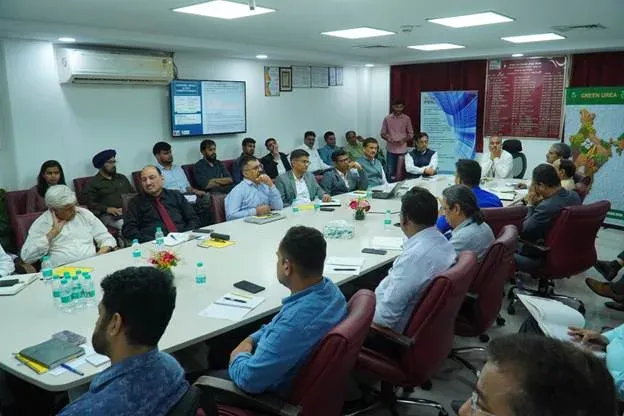
The Department of Fertilizers convened a high-level Pre-Expression of Interest (Pre-EOI) meeting at PDIL headquarters in Noida on 26 June 2025 to accelerate India's push for green urea plants, with the government detailing a coordinated financial and institutional framework to make green ammonia commercially viable. The meeting followed an Invitation for Expression of Interest issued earlier in the week for establishing green urea manufacturing capacity across India.
Who Attended and Why It Matters
The meeting drew wide participation from both public and private stakeholders, including NTPC, the Solar Energy Corporation of India (SECI), technology suppliers for ammonia-urea, major Indian fertilizer companies, and manufacturers of electrolysers, green hydrogen, and green ammonia. According to the official statement from the Ministry of Chemicals and Fertilizers, the strong turnout — both online and offline — signals robust industry appetite for what the ministry described as a shift toward sustainable agriculture, carbon neutrality, and technological self-reliance.
Financial Support and Cost-Parity Mechanism
A key challenge acknowledged at the meeting is that green ammonia currently costs significantly more to produce than conventional grey ammonia, making green urea uncompetitive without government intervention. To bridge this gap, the government outlined ₹19,744 crore in support from the Ministry of New and Renewable Energy to accelerate critical green energy infrastructure.
SECI has already tendered for purchasing green ammonia from producers and will supply it to domestic fertilizer companies at standard market-linked grey ammonia prices — effectively absorbing the cost differential. A direct financial incentive scheme under the NGHM (Green Ammonia Mode 2A) programme was also detailed to encourage private sector participation.
Procurement Targets and Auction Framework
A total procurement target of 7.24 lakh metric tonne per annum of green ammonia has been set, to be allocated through a transparent, competitive e-Reverse Auction managed by SECI. The Department of Fertilizers will establish the institutional and market-parity framework to integrate green ammonia seamlessly into the national fertilizer manufacturing chain.
The Pudimadaka Pilot as a Blueprint
Technical discussions centred on the 150 TPD Green Urea pilot plant at Pudimadaka, Andhra Pradesh — developed by NETRA, the R&D wing of NTPC — as a benchmark for scaling. The facility demonstrated integration of advanced Carbon Capture and Utilization (CCUS) systems with water electrolysis, and also supports the use of carbonated fly ash, food-grade materials, and synthetic fuels.
What Comes Next
With the Pre-EOI stage complete, formal expressions of interest from prospective players across the green ammonia value chain are expected to follow. The framework being built — combining SECI's procurement role, NGHM incentives, and the PDIL-led institutional process — represents the government's attempt to de-risk early movers and build a domestic green fertilizer supply chain from the ground up.
Point of View
The e-Reverse Auction process is untested at this scale, and the 7.24 lakh MT/year target is ambitious for a sector that currently has negligible domestic green ammonia output. The Pudimadaka pilot is a proof-of-concept, not a template that scales overnight. If SECI's procurement pipeline moves as fast as the Pre-EOI enthusiasm suggests, India could meaningfully decarbonise its fertilizer sector by the end of the decade — but the gap between a well-attended meeting and a commissioned plant has tripped up Indian industrial policy before.
NationPress
25 Sept 2026
Frequently Asked Questions
What is India's green urea plant initiative?
It is a government-led effort to establish green urea manufacturing facilities in India using green ammonia — produced from renewable energy — instead of fossil-fuel-derived grey ammonia. The Department of Fertilizers issued an Expression of Interest invitation in late June 2025 to attract public and private players across the value chain.
Why does green urea need government support to be viable?
Green ammonia currently costs more to produce than conventional grey ammonia, making green urea uncompetitive in the open market. To address this, SECI will purchase green ammonia from producers and supply it to fertilizer companies at standard grey ammonia prices, with the cost difference covered through government support including a ₹19,744 crore infrastructure commitment.
What is the green ammonia procurement target?
The government has set a procurement target of 7.24 lakh metric tonne per annum of green ammonia, to be allocated through a transparent, competitive e-Reverse Auction managed by SECI under the NGHM Green Ammonia Mode 2A scheme.
What role does the Pudimadaka plant play?
The 150 TPD Green Urea pilot plant at Pudimadaka, Andhra Pradesh — developed by NETRA, NTPC's R&D wing — serves as the technical benchmark for the larger initiative. It demonstrated integration of Carbon Capture and Utilization systems with water electrolysis and the use of carbonated fly ash and synthetic fuels.
Which organisations participated in the Pre-EOI meeting?
Participants included NTPC, the Solar Energy Corporation of India, technology suppliers for ammonia-urea processes, major Indian fertilizer companies, and manufacturers of electrolysers, green hydrogen, and green ammonia — covering the full green urea value chain.