India's higher education enrolment hits 4.50 crore in 2023–24, female participation leads surge
Synopsis
India's higher education headcount has crossed 4.50 crore — a 31.5% jump in a decade — but the real headline is gender: women now outenrol men on a parity-adjusted basis, with the GPI hitting 1.08. OBC participation has surged to 40.1%. The NEP 2020 target of 50% GER by 2035 still requires near-doubling the current ratio, making the next decade the harder climb.
Key Takeaways
Higher education enrolment rose 31.5 per cent from 3.42 crore in 2014–15 to 4.50 crore in 2023–24 .
The Gross Enrolment Ratio (GER) reached 30 per cent in 2023–24 , against a NEP 2020 target of 50 per cent by 2035 .
Female enrolment grew 42.2 per cent to 2.24 crore ; the Gender Parity Index rose to 1.08 , crossing parity.
OBC participation recorded the largest social-category gain, rising from 32.8 per cent to 40.1 per cent .
Universities increased 69.6 per cent — from 760 to 1,289 — over the decade.
STEM enrolment grew a more modest 11.5 per cent , from 91.5 lakh to 1.02 crore .
Higher education enrolment in India reached 4.50 crore students in 2023–24, up 31.5 per cent from 3.42 crore in 2014–15, according to an official factsheet released on 30 August. The decade-long expansion reflects widening access across gender, caste, and disciplinary lines, with female enrolment outpacing the overall growth rate.
Gross Enrolment Ratio on a Steady Climb
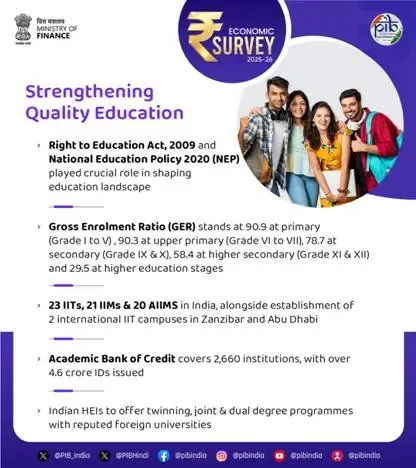
The Gross Enrolment Ratio (GER) in higher education rose from 23.7 per cent in 2014–15 to 29.5 per cent in 2022–23, and edged further to 30 per cent in 2023–24. The National Education Policy (NEP) 2020 has set a target of raising the GER to 50 per cent by 2035 — meaning India must still nearly double its current ratio over the next decade. The data comes from the All India Survey on Higher Education (AISHE), conducted annually by the Ministry of Education, which tracks Higher Education Institutions (HEIs) across the country.
Institutional Expansion Across Universities and Colleges
India's higher education infrastructure has grown substantially over the period. The number of universities surged 69.6 per cent — from 760 in 2014–15 to 1,289 in 2023–24. The number of colleges rose 25.3 per cent, from 38,498 to 48,246, while standalone institutions climbed roughly 24 per cent, from 12,276 to 15,221. This infrastructure push has been central to accommodating the rising student population.
Female Enrolment Surges, Gender Parity Index Crosses 1.0
Female enrolment grew 42.2 per cent over the decade — from 1.57 crore in 2014–15 to 2.24 crore in 2023–24 — outpacing total enrolment growth of 31.5 per cent. Critically, the Gender Parity Index (GPI) crossed parity, rising from 0.92 to 1.08, indicating that women now enrol at a higher rate than men relative to their share of the eligible population. The GPI for Scheduled Caste (SC) students improved from 0.91 to 1.11, and for Scheduled Tribe (ST) students from 0.81 to 1.08 during the same period — a notable equity gain across historically underrepresented groups.
SC, ST, and OBC Participation Rises Across the Decade
The share of SC enrolment in total higher education rose from 13.44 per cent in 2014–15 to 15.5 per cent in 2023–24. ST enrolment share increased from 4.8 per cent to 6.4 per cent. OBC participation recorded the steepest rise among all social categories, climbing from 32.8 per cent to 40.1 per cent. This comes amid a broader policy push to widen reservation-backed access and expand scholarship coverage for marginalised communities.
STEM Enrolment Grows, but at a Slower Pace
Enrolment in Science, Technology, Engineering, and Mathematics (STEM) disciplines rose from 91.5 lakh in 2014–15 to 1.02 crore in 2023–24, an increase of approximately 11.5 per cent. While positive, this growth lags the overall enrolment expansion of 31.5 per cent, suggesting that humanities, social sciences, and commerce continue to absorb a larger share of new students. As India positions itself as a global technology hub, bridging this gap will be a key policy priority in the years ahead.
Point of View
Or are parity gains concentrated in under-resourced colleges and non-STEM streams? STEM enrolment grew just 11.5 per cent against an overall 31.5 per cent, suggesting the skills pipeline India needs for its technology ambitions is not keeping pace with raw headcount. The OBC surge to 40.1 per cent is politically significant but demands scrutiny of completion and employment outcomes — enrolment numbers alone do not capture whether students are graduating or finding work. With the NEP 2020 GER target of 50 per cent still 20 percentage points away, the easy gains from infrastructure expansion may already be exhausted; the harder task of retaining students and improving outcomes lies ahead.
NationPress
14 Oct 2026
Frequently Asked Questions
What is the current higher education enrolment in India?
India's higher education enrolment stood at 4.50 crore students in 2023–24 , up 31.5 per cent from 3.42 crore in 2014–15, according to official AISHE data released on 30 August.
What is India's Gross Enrolment Ratio in higher education?
The Gross Enrolment Ratio (GER) in higher education reached 30 per cent in 2023–24, rising from 23.7 per cent in 2014–15. The NEP 2020 targets a GER of 50 per cent by 2035.
How has female enrolment in higher education changed?
Female enrolment grew 42.2 per cent over the decade, from 1.57 crore in 2014–15 to 2.24 crore in 2023–24, outpacing overall enrolment growth. The Gender Parity Index rose to 1.08, meaning women now enrol at a higher rate than men on a parity-adjusted basis.
Which social category recorded the biggest rise in higher education enrolment?
OBC students recorded the largest increase in enrolment share among all social categories, rising from 32.8 per cent in 2014–15 to 40.1 per cent in 2023–24. SC and ST shares also improved over the same period.
How many universities and colleges does India have in 2023–24?
India had 1,289 universities and 48,246 colleges in 2023–24, representing growth of 69.6 per cent and 25.3 per cent respectively since 2014–15, according to the AISHE report.