Indian scientists develop ammonia gas sensor that works at room temperature
Synopsis
Scientists at CeNS Bengaluru have built an ammonia sensor that detects the toxic gas at just 319 parts per billion — at room temperature, with no external power source needed. It bends, folds, and fits into a smart band or e-textile, and auto-classifies air quality into safe, warning, and danger zones. This is India's most wearable industrial safety sensor yet.
Key Takeaways
CeNS Bengaluru , under the Department of Science and Technology , developed the ammonia-sensing platform, announced on 14 July .
The sensor detects ammonia at concentrations as low as 319 parts per billion , well below occupational safety limits.
Built on a vanadium oxide-vanadium sulfide (VOx/VS2) heterostructure , it operates at room temperature without external activation.
Flexible versions fabricated on polymer, paper, and textile substrates retain sensing capability under bending, twisting, and folding.
Prototype applications include smart bands , smart-home warning systems , and electronic textile platforms .
The sensor demonstrated long-term reliability exceeding ten weeks with stable, selective performance across a broad concentration range.
Indian scientists at the Centre for Nano and Soft Matter Sciences (CeNS), Bengaluru, have developed an advanced ammonia-sensing platform capable of detecting harmful ammonia at concentrations as low as 319 parts per billion — well below occupational safety limits — while operating at room temperature, according to an official statement released on Tuesday, 14 July. The breakthrough, developed under the Department of Science and Technology (DST), could transform safety monitoring in industrial, agricultural, and domestic environments.
How the Sensor Works
The device is built on a hybrid vanadium oxide-vanadium sulfide (VOx/VS2) heterostructure, engineered through a controlled surface transformation process. This design creates abundant active sites for ammonia adsorption while simultaneously enhancing charge transport within the sensing layer.
The synergistic effect significantly boosts detection performance, enabling rapid and highly selective identification of ammonia under ambient conditions — without the elevated temperatures or external activation sources that most conventional gas sensors require. This reduces energy consumption and simplifies deployment considerably.
Flexible and Wearable Versions
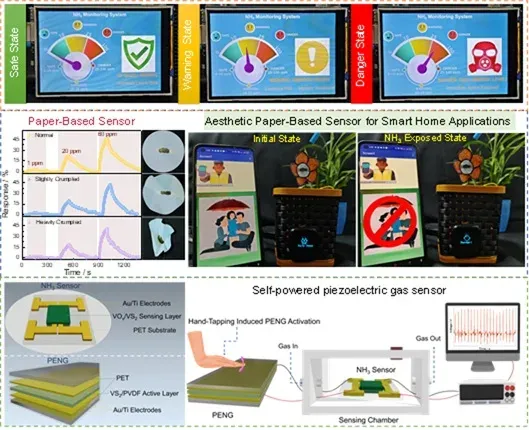
Researchers successfully fabricated flexible and wearable versions of the sensor on polymer, paper, and textile substrates. These lightweight devices retained their sensing capability even under bending, twisting, and folding conditions, demonstrating suitability for next-generation wearable electronics.
Prototype applications developed include smart bands, smart-home warning systems, and electronic textile platforms — all aimed at personal safety monitoring and intelligent environmental sensing.
Performance and Reliability
The sensor demonstrated excellent selectivity against other common gases, stable operation over repeated sensing cycles, and long-term reliability exceeding ten weeks. It performed effectively across a broad concentration range, making it suitable for diverse deployment scenarios.
A portable threshold-triggered monitoring system was also developed to issue immediate alerts when ammonia concentrations exceed predefined safety levels. The system automatically classifies environmental conditions into safe, warning, and danger zones, enabling rapid response without requiring technical expertise from the user.
Why Ammonia Detection Matters
Ammonia is widely used in fertiliser production, refrigeration, chemical manufacturing, and agriculture. However, exposure can cause severe irritation of the eyes, skin, and respiratory system, while prolonged exposure may lead to serious health complications.
This is the challenge the CeNS team set out to address. Such sensing devices can be deployed in industrial facilities, storage units, laboratories, and agricultural environments where ammonia leakage poses a significant risk, the official statement noted.
Broader Implications
The development marks a significant step for India's materials science and nanotechnology research ecosystem. By combining flexibility, room-temperature operation, and wearability, the CeNS sensor moves beyond laboratory proof-of-concept toward practical, scalable safety solutions. Wider commercialisation and field deployment timelines have not yet been announced.
Point of View
Even when the underlying science is competitive. The CeNS device is technically impressive — room-temperature operation on a flexible substrate at sub-320 ppb sensitivity is a meaningful combination — but the real test is whether DST's technology transfer pipeline can move this from prototype to factory floor. Ammonia leaks in cold-storage and fertiliser plants kill and injure workers every year in India, often because fixed industrial sensors are expensive and sparingly deployed. A low-cost wearable that auto-classifies danger zones could genuinely change that calculus, but only if a credible manufacturing and distribution pathway is established alongside the research publication.
NationPress
13 Oct 2026
Frequently Asked Questions
What has CeNS Bengaluru developed in ammonia sensing?
Scientists at the Centre for Nano and Soft Matter Sciences (CeNS), Bengaluru, have developed an advanced ammonia-sensing platform based on a vanadium oxide-vanadium sulfide heterostructure. It detects ammonia at concentrations as low as 319 parts per billion while operating at room temperature, without requiring external heating or activation.
Why is ammonia detection important for safety?
Ammonia is widely used in fertiliser production, refrigeration, chemical manufacturing, and agriculture, but exposure can cause severe irritation of the eyes, skin, and respiratory system. Prolonged exposure may lead to serious health complications, making early, accurate detection critical in industrial and agricultural settings.
How does this sensor differ from conventional gas sensors?
Unlike most conventional gas sensors that require elevated temperatures or external activation sources, the CeNS sensor operates efficiently at room temperature. This reduces energy consumption and simplifies deployment, making it more practical for continuous wearable or smart-home use.
What are the practical applications of this sensor?
Prototype applications include smart bands for personal safety, smart-home warning systems, and electronic textile platforms. The sensor can also be deployed in industrial facilities, storage units, laboratories, and agricultural environments where ammonia leakage poses a risk.
How reliable is the new ammonia sensor over time?
The sensor demonstrated long-term reliability exceeding ten weeks, with stable operation over repeated sensing cycles and effective performance across a broad concentration range. It also showed excellent selectivity against other common gases, reducing false alarms.