India's social protection coverage triples in a decade: SDG data 2026

Synopsis
India's official SDG scorecard for 2026 shows social protection coverage tripling in a decade and renewable energy capacity nearly tripling per capita — but the data also quietly flags how far the country still needs to travel before the 2030 deadline arrives.
Key Takeaways
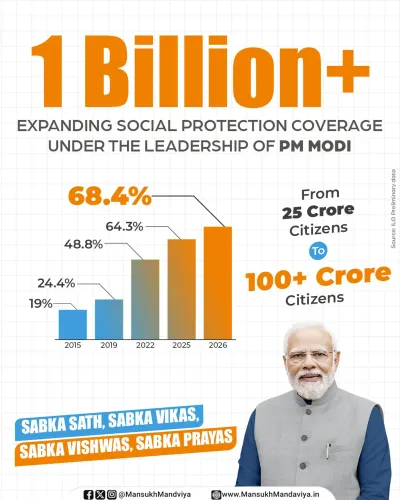
Social protection coverage rose from 22% in 2016 to 65.3% in 2026, per MoSPI data released on 29 June 2026 .
Installed renewable energy capacity nearly tripled from 64.04 watts per capita to 193.36 watts per capita over a decade.
Unemployment fell from 6.1% in 2017–18 to 3.1% in 2025; female professional workers crossed parity at 51.3% .
Maternal Mortality Ratio dropped from 122 to 87 per 1 lakh live births between 2015–17 and 2022–24.
Internet subscriptions surged from 302.36 million (2015) to 969.10 million (2025).
The National Indicator Framework 2026 covers 277 SDG indicators across all 17 Sustainable Development Goals .
India has recorded measurable advances across multiple Sustainable Development Goal (SDG) indicators over the past decade, with social protection coverage rising nearly threefold and installed renewable energy capacity per capita almost tripling, according to data released by the Ministry of Statistics and Programme Implementation (MoSPI) on Monday, 29 June 2026. The figures were published as part of the National Indicator Framework (NIF) 2026, unveiled on Statistics Day.
Social Protection and Employment Gains
The proportion of India's population covered by social protection systems climbed from 22% in 2016 to 65.3% in 2026 — a gain of more than 43 percentage points in ten years. The unemployment rate also narrowed sharply, falling from 6.1% in 2017–18 to 3.1% in 2025, according to the official data. In a notable gender shift, the ratio of female to male workers employed as Professionals and Technical Workers crossed parity, rising from 48.7% in 2023–24 to 51.3% in 2025.
Renewable Energy and Environmental Indicators
Installed renewable energy generating capacity nearly tripled from 64.04 watts per capita in 2014–15 to 193.36 watts per capita in the latest period. The number of waste recycling plants rose sharply from 829 in 2019–20 to 3,236 in 2025–26, while the area of Ramsar sites as a share of total wetland area doubled from 4.15% in 2016 to 8.66% in 2026.
Health and Gender Progress
The Maternal Mortality Ratio (MMR) declined from 122 per 1 lakh live births during 2015–17 to 87 during 2022–24, reflecting sustained improvements in maternal healthcare access. The Sex Ratio at Birth also improved, rising from 896 females per 1,000 male live births in 2015–17 to 918 in 2022–24.
Digital Connectivity and Genetic Resource Conservation
Total internet subscriptions more than tripled from 302.36 million in 2015 to 969.10 million in 2025, underlining the scale of India's digital expansion. On biodiversity, plant genetic resources conserved rose from 4,32,564 in 2014–15 to 4,91,864 in 2025–26. Animal genetic resources increased from 1,40,364 to 3,61,794, and fish genetic resources more than doubled from 47 to 105.
About the National Indicator Framework 2026
The NIF 2026, released on Statistics Day, comprises 277 national SDG indicators spanning all 17 Sustainable Development Goals. The framework serves as India's official measurement architecture for tracking progress against the global 2030 Agenda. With the SDG deadline now four years away, the data signals both the scale of progress achieved and the distance still to be covered on remaining gaps.
Point of View
Not a press release — and it shows real structural shifts, particularly on social protection and renewable energy. But the framing of 'nearly tripling' deserves scrutiny: moving from 22% to 65.3% on social protection still leaves more than a third of the population uncovered with four years to the SDG deadline. Similarly, tripling renewable capacity per capita is impressive, yet India's absolute energy mix remains coal-dominant. The unemployment figure — 3.1% — is the most contested number here; measurement methodology differences between surveys make year-on-year comparisons tricky, and critics have long questioned whether India's joblessness data captures informal sector distress accurately. The NIF's expansion to 277 indicators is a step toward transparency, but indicator breadth without data quality guarantees can obscure as much as it reveals.
NationPress
28 Sept 2026
Frequently Asked Questions
What is the National Indicator Framework 2026?
The National Indicator Framework (NIF) 2026 is India's official system for tracking progress on the United Nations' Sustainable Development Goals. Released by MoSPI on Statistics Day, the 2026 edition covers 277 national SDG indicators spanning all 17 Sustainable Development Goals.
How much has India's social protection coverage improved?
India's social protection coverage rose from 22% of the population in 2016 to 65.3% in 2026, according to MoSPI data — an increase of over 43 percentage points in a decade. Despite this progress, more than a third of the population remains outside the social protection net.
How has India's renewable energy capacity changed over the decade?
Installed renewable energy generating capacity nearly tripled from 64.04 watts per capita in 2014–15 to 193.36 watts per capita in the latest reporting period, according to the official SDG data released on 29 June 2026.
What progress has India made on maternal mortality?
India's Maternal Mortality Ratio declined from 122 per 1 lakh live births during 2015–17 to 87 during 2022–24, reflecting improved access to maternal healthcare over the period.
How has internet access grown in India since 2015?
Total internet subscriptions in India more than tripled from 302.36 million in 2015 to 969.10 million in 2025, according to MoSPI's SDG indicator data, underscoring the country's rapid digital expansion over the past decade.