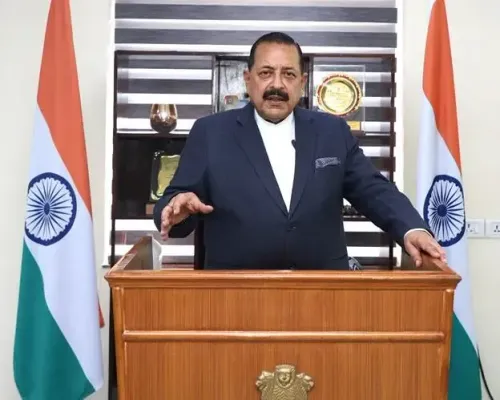
Dr Jitendra Singh: Tech-driven innovation key to India's economic rise
Synopsis
At DST's 56th Foundation Day, Union Minister Dr Jitendra Singh made the case that India's economic future hinges on bridging the lab-to-market gap — pointing to over two lakh startups, a liberalised space sector, and marquee missions like the National Quantum Mission as proof points. The pitch: science must now be measured by economic outcomes, not just citations.
Key Takeaways
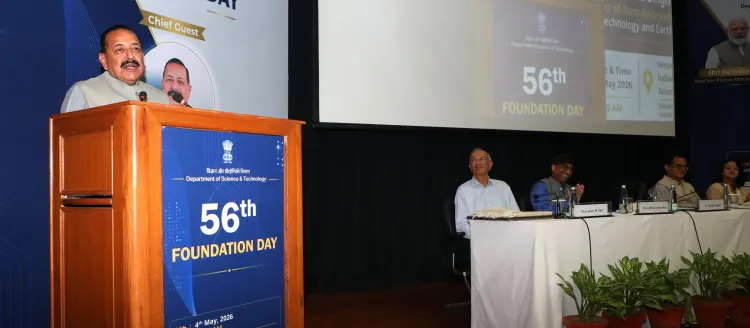
Dr Jitendra Singh addressed the 56th DST Foundation Day at INSA Auditorium, New Delhi on 4 May 2025 .
India's startup ecosystem has grown from a few hundred to over two lakh startups in a decade.
Sectors including space and nuclear energy have been opened to private participation, spurring startup-driven innovation.
Principal Scientific Adviser Prof Ajay Kumar Sood called for aligning research with commercialisation.
DST Secretary Prof Abhay Karandikar highlighted the ANRF , RDI Fund , and National Quantum Mission as pillars of India's science ecosystem.
Union Minister of State Dr Jitendra Singh on Monday, 4 May declared that technology-driven innovation is the cornerstone of India's economic renaissance, urging the scientific community to move "from laboratories to markets and from ideas to impact." He was addressing the 56th Foundation Day of the Department of Science and Technology (DST) at the Indian National Science Academy (INSA) Auditorium in New Delhi.
Key Developments at DST Foundation Day
Dr Singh outlined a sweeping shift in India's science and technology policy over the past decade, pointing to the opening of strategic sectors — including space and nuclear energy — to private participation as a defining turning point. He argued that these policy decisions have unlocked new commercial opportunities for startups and industry while strengthening India's position in the global innovation ecosystem.
Referring to the rapid expansion of the space sector, the minister noted that within a few years of liberalisation, India is witnessing a surge in startup-driven innovation, with new capabilities emerging in satellite technologies that contribute both to economic growth and national preparedness. He added that similar momentum is building across other emerging technology domains.
India's Startup and Research Surge
Dr Singh pointed to the explosive growth of India's startup ecosystem — from a few hundred a decade ago to over two lakh startups today — as concrete evidence of a rapidly maturing innovation landscape. He also highlighted India's growing share of highly cited research publications globally, reflecting improvements in both the quality and impact of domestic scientific output.
"No country can advance in science by remaining isolated from industry and the private sector," he said, calling for deeper collaboration across government, academia, and industry. The remarks signal a continued policy push to bridge the gap between fundamental research and commercial application.
What Senior Officials Said
Principal Scientific Adviser Professor Ajay Kumar Sood emphasised the need to align research with technology development and commercialisation, reinforcing the minister's call for market-oriented science. DST Secretary Professor Abhay Karandikar highlighted major national initiatives designed to deepen India's science and innovation infrastructure, including the Anusandhan National Research Foundation (ANRF), the RDI Fund, and the National Quantum Mission.
Broader Policy Context
This comes amid a broader government effort to position India as a global science and technology hub. The ANRF, established to consolidate research funding, and the National Quantum Mission represent significant bets on frontier technologies. Notably, India's push to integrate private capital into space and nuclear sectors mirrors a global trend of government-industry co-investment in deep tech. The DST Foundation Day address reinforces the Centre's narrative that science policy must now be evaluated not just by publications or patents, but by measurable economic outcomes.
With the ANRF and allied missions in early implementation, the next 12 to 24 months will be critical in determining whether India's innovation push translates into sustained GDP impact or remains largely aspirational.
Point of View
But the structural moves — opening space and nuclear to private capital, launching the ANRF, and committing to a National Quantum Mission — suggest this government is willing to back the narrative with institutional architecture. The harder question is whether two lakh startups, many in consumer tech, translate into deep-tech industrial capacity. India's R&D spend as a share of GDP remains well below the global innovation leaders, and no Foundation Day address changes that arithmetic. The real test for DST is not the number of startups registered, but how many are commercialising frontier science — and that data remains elusive.
NationPress
19 Sept 2026
Frequently Asked Questions
What did Dr Jitendra Singh say at the DST Foundation Day 2025?
Dr Jitendra Singh said technology-driven innovation is central to India's economic renaissance and called for science to move 'from laboratories to markets and from ideas to impact.' He was speaking at the 56th Foundation Day of the Department of Science and Technology in New Delhi on 4 May 2025.
How large is India's startup ecosystem today?
According to Dr Jitendra Singh, India's startup ecosystem has grown from a few hundred startups a decade ago to over two lakh startups today. He cited this growth as evidence of a rapidly maturing innovation landscape.
What is the Anusandhan National Research Foundation (ANRF)?
The ANRF is a national initiative highlighted by DST Secretary Prof Abhay Karandikar to strengthen India's science and innovation ecosystem by consolidating and expanding research funding. It is one of several flagship programmes alongside the RDI Fund and the National Quantum Mission.
Why has India opened the space sector to private players?
According to Dr Jitendra Singh, opening sectors like space and nuclear energy to private participation was a deliberate policy decision to unlock commercial opportunities, spur startup-driven innovation, and strengthen India's position in the global innovation ecosystem.
What is the National Quantum Mission?
The National Quantum Mission is a government initiative aimed at building India's capabilities in quantum technologies. It was cited by DST Secretary Prof Abhay Karandikar as one of the major programmes designed to deepen India's science and innovation infrastructure.