Anand Mahindra meets NPCI chief, switches to BHIM app
Synopsis
Mahindra Group chairman Anand Mahindra met NPCI chief Dilip Asbe, described India's UPI processing over 2,400 crore transactions in September 2026 as a global real-time payments leader, praised Asbe's humility, and announced he had switched to the indigenous BHIM app.
Key Takeaways
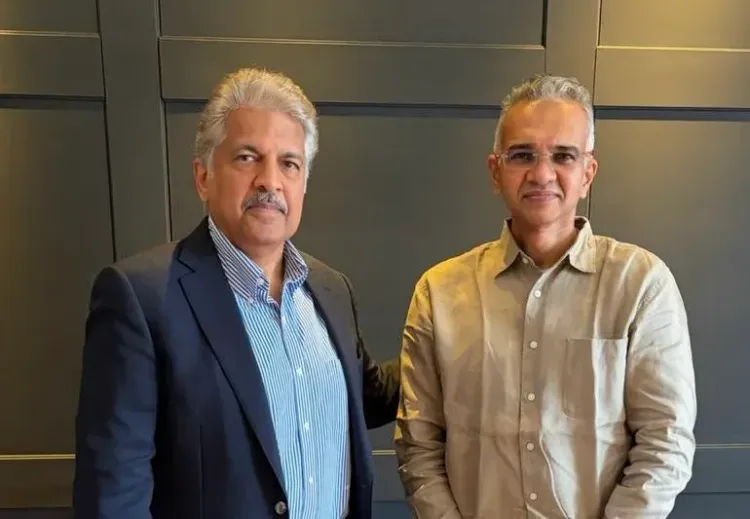
Mahindra Group chairman Anand Mahindra met Dilip Asbe, MD and CEO of NPCI , and called the conversation 'illuminating'.
UPI processed over 2,400 crore transactions in September 2026 — more than 80 crore transactions per day .
India is now the world's largest real-time payments market , built on NPCI's public infrastructure rails.
Apps like PhonePe, Google Pay, Paytm, and BHIM all run on the same NPCI-operated UPI network.
Mahindra highlighted Asbe's humility as his most striking quality, noting his mother was a schoolteacher.
Mahindra announced he has switched to the BHIM app , India's own NPCI-built UPI interface.
A casual question about a payments app led Mahindra Group chairman Anand Mahindra to one of India's most consequential — and least celebrated — architects of the digital economy. On Monday, 26 October 2026, Mahindra shared the story of his conversation with Dilip Asbe, MD and CEO of the National Payments Corporation of India (NPCI), calling it 'illuminating, to put it mildly' — and announcing he had switched to the BHIM app.
The railroad metaphor that reframes how India pays
Mahindra reached for an analogy that cuts straight to the point: 'Think of them as trains running on a railway network. NPCI provides the tracks.' PhonePe, Google Pay, Paytm, BHIM — the apps millions of Indians open dozens of times a day — are all running on infrastructure that NPCI quietly built and maintains. The scale of that infrastructure is staggering.
In September 2026, UPI alone processed over 2,400 crore transactions — more than 80 crore transactions every single day. Mahindra called it a 'true global force multiplier', and by transaction volume, India is now the world's largest real-time payments market. A fact worth sitting with.
UPI's decade-long climb to the top of global payments
The foundation was laid in 2016, when the Reserve Bank of India and NPCI launched the Unified Payments Interface — a low-cost, interoperable instant payment rail designed to let any bank account talk to any other via a mobile phone. The ambition was audacious; the execution, methodical. What followed was one of the fastest adoptions of public financial infrastructure anywhere in the world.
Private fintechs piled onto the rails, competing ferociously on product while the underlying plumbing — real-time settlement, fraud checks, interoperability — stayed public and open. That architecture is precisely why India outpaced every other market on real-time transaction volume. And Asbe has been at the centre of it, overseeing NPCI through its most explosive growth phase while the organisation now eyes new frontiers: credit on UPI, cross-border linkages, and fresh payment rails for wider financial services.
Ambition without airs — what Mahindra took away from the meeting
But Mahindra's post is as much a character portrait as a technology explainer. What struck him most about Asbe, he wrote, was 'not the scale of his achievement, not his knowledge of the technology — his humility.' He described meeting 'a man with no airs, no sense of self-importance and seemingly little interest in the spotlight. Just immense pride in what his team has accomplished.'
He added a detail that landed warmly: Asbe's mother was a teacher, and Mahindra mused that 'mothers who are teachers have a special knack for instilling values that last a lifetime.' It is the kind of observation that turns a business post into a Monday-morning reflection — deliberate, given the #MondayMotivation tag. The kicker Mahindra wrote for himself: 'Ambition and humility can indeed travel together on the railroad to success.'
He also made one concrete move: ditching his previous app for BHIM — India's own, NPCI-built interface to the same UPI rails — a small gesture that carries its own message about backing indigenous digital infrastructure.
Point of View
Cross-border corridors, and new financial rails — markets where private fintechs currently dominate mindshare. His switch to BHIM, however symbolic, signals that the indigenous, government-backed interface deserves a fresh look from high-visibility corporate adopters. For NPCI, the reputational boost of a prominent industrialist's public endorsement — and the accompanying railroad metaphor for public infrastructure — reinforces the 'open-rails, competitive-apps' model that India is actively exporting to other emerging economies. The human-interest angle on Asbe's humility also quietly reframes what 'tech leadership' looks like in India's public sector.
NationPress
26 Oct 2026
Frequently Asked Questions
What is the BHIM app and how is it different from PhonePe or Google Pay?
BHIM (Bharat Interface for Money) is an app developed directly by NPCI to give users a simple, government-backed interface to the UPI network. PhonePe and Google Pay are private apps that also run on the same UPI rails built by NPCI — the difference is ownership and the add-on features each private app layers on top.
What is NPCI and who is Dilip Asbe?
NPCI, the National Payments Corporation of India, is the non-profit entity that operates UPI and other retail payment infrastructure in India. Dilip Asbe is its MD and CEO, overseeing the systems that processed over 2,400 crore transactions in a single month as of September 2026.
How many UPI transactions happen per day in India?
According to Anand Mahindra's post citing figures shared by NPCI chief Dilip Asbe, UPI processed more than 80 crore (800 million) transactions every single day in September 2026.
Is India really the world's largest real-time payments market?
Yes, by transaction volume. India's UPI-powered real-time payments network now processes more transactions than any other country's equivalent system, a position built since UPI's launch in 2016.
Why did Anand Mahindra switch to the BHIM app?
After meeting NPCI chief Dilip Asbe and learning about the scale and ambition of India's payments infrastructure, Mahindra decided to switch to BHIM — India's own NPCI-built UPI app — as a personal endorsement of indigenous digital public infrastructure.