Giriraj Singh Flags UPI Record of ₹29.9 Lakh Crore in May
Synopsis
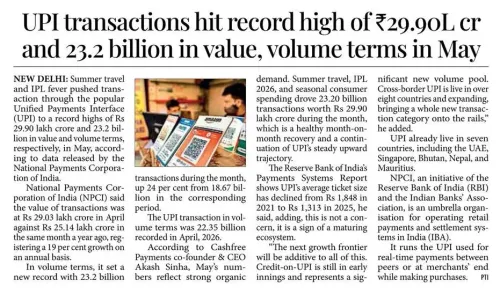
Union Textiles Minister Giriraj Singh flagged a record UPI transaction value of ₹29.9 lakh crore for May 2026, sharing the milestone via the NaMo App on 2 June 2026. The figure underscores India's accelerating shift to digital payments under the Digital India framework, with NPCI's official monthly release expected to confirm the peak.
Key Takeaways
Union Textiles Minister Giriraj Singh shared the UPI data on 2 June 2026 via the NaMo App on X.
UPI transactions reportedly reached a record ₹29.9 lakh crore in May 2026 .
UPI was launched by NPCI in April 2016 and gained rapid adoption after demonetisation.
Monthly UPI records have become a recurring government communication tool under the Digital India programme.
Key stakeholders include retail users, merchants, banks , and fintech firms across India.
The next milestone to watch is the official NPCI data release and any RBI policy signals on UPI expansion.
Union Textiles Minister Giriraj Singh on Tuesday, 2 June 2026 shared data showing that UPI transactions hit a record high of ₹29.9 lakh crore in May 2026, amplifying the milestone via the NaMo App. The post, shared on his official X account, highlighted the figure as a marker of India's expanding digital payments ecosystem.
Context
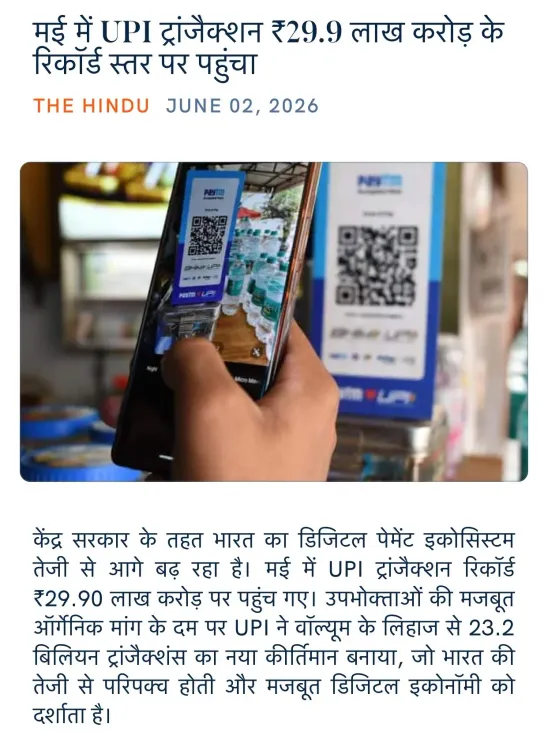
Singh's post, originally in Hindi — 'मई में UPI ट्रांजैक्शन ₹29.9 लाख करोड़ के रिकॉर्ड स्तर पर पहुंचा' ('UPI transactions reached a record level of ₹29.9 lakh crore in May') — was shared through the NaMo App, the official mobile platform of Prime Minister Narendra Modi used by BJP leaders to amplify government-linked announcements. While Singh holds the Textiles portfolio, BJP ministers routinely share economy-wide data as part of the party's broader Digital India communication strategy.
The figure, if confirmed by the National Payments Corporation of India (NPCI), would represent a new monthly peak for the platform. Monthly UPI data is published by NPCI, the umbrella body that owns and operates the system along with other retail payment infrastructure in India.
Policy Backdrop
UPI was launched by NPCI in April 2016 as an instant, real-time inter-bank payment system enabling smartphone-based transfers. Its adoption accelerated sharply after demonetisation in November 2016, when the government intensified promotion of digital payment modes under the Digital India programme.
Over the following decade, successive monthly records became a recurring feature of government communication, with UPI growth positioned as a core indicator of financial inclusion and the formalisation of India's economy. The platform has also been extended internationally, with interoperability linkages established with payment systems in several countries, reinforcing its identity as a global model for real-time retail payments.
Stakeholders and Impact
The primary beneficiaries of rising UPI volumes are retail users, merchants, and the broader fintech and banking sector. Higher transaction values signal greater consumer and business reliance on digital rails over cash, which has downstream implications for tax compliance, credit underwriting, and financial data availability for lenders.
For banks and fintech firms, record volumes translate into increased payment processing activity, though the zero merchant discount rate (MDR) policy on UPI means direct revenue from transactions remains limited. The milestone nonetheless strengthens the case for continued infrastructure investment in digital payments.
What's Next
Attention will now turn to the official NPCI monthly data release for May 2026, which will provide the complete picture including total transaction volume alongside value. Any circulars from the Reserve Bank of India (RBI) on transaction limits, interoperability enhancements, or cross-border UPI expansion would be the next significant policy signals for the sector.
With India's digital payments infrastructure increasingly cited in multilateral forums, sustained record-setting months are likely to feature prominently in the government's economic narrative heading into the second half of 2026.
Point of View
Reinforcing a unified government narrative around Digital India. The choice of the NaMo App as the amplification channel signals this is coordinated messaging, not a spontaneous share. Successive monthly UPI records have become a political asset, framing digital adoption as a direct outcome of BJP governance since 2016. As India approaches key electoral and budgetary cycles, expect such data points to feature more prominently in the party's economic communication.
NationPress
16 Oct 2026
Frequently Asked Questions
What is the UPI transaction record for May 2026?
UPI transactions reportedly reached a record high of ₹29.9 lakh crore in May 2026, as highlighted by Union Textiles Minister Giriraj Singh on 2 June 2026.
Who is Giriraj Singh and why is he sharing UPI data?
Giriraj Singh is India's Union Textiles Minister and a senior BJP leader and Lok Sabha MP from Begusarai, Bihar. BJP ministers across portfolios routinely share economy-wide data as part of the party's Digital India communication strategy.
What is UPI and who operates it?
UPI, or Unified Payments Interface, is India's instant real-time inter-bank payment system. It was developed and is operated by the National Payments Corporation of India (NPCI), which launched it in April 2016.
What is the NaMo App?
The NaMo App is the official mobile application of Prime Minister Narendra Modi, used by BJP leaders and supporters to amplify government announcements and party communications.
What should I watch for next regarding UPI data?
The official NPCI monthly data release for May 2026 will confirm the full transaction volume and value figures. Any Reserve Bank of India circulars on UPI transaction limits, interoperability, or cross-border expansion are also key signals to watch.