Giriraj Singh Hails UPI on Digital India's 11th Year
Synopsis
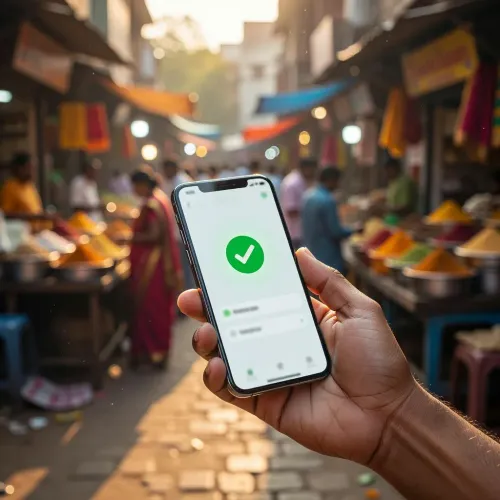
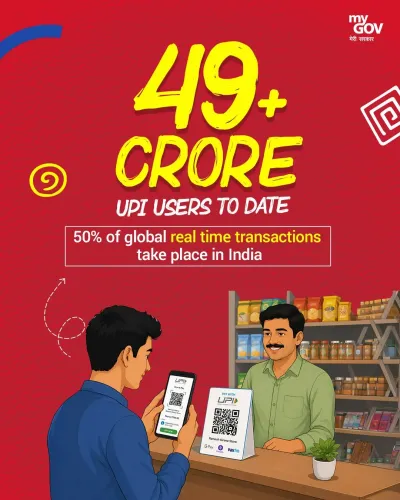
On Digital India's 11th anniversary, Union Textiles Minister Giriraj Singh highlighted UPI's dominance in India's payments ecosystem, pointing to over 24,000 crore transactions in FY 2025-26 as a marker of the country's digital transformation since 2015.
Key Takeaways
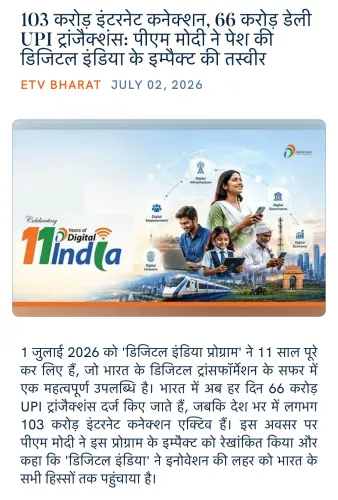
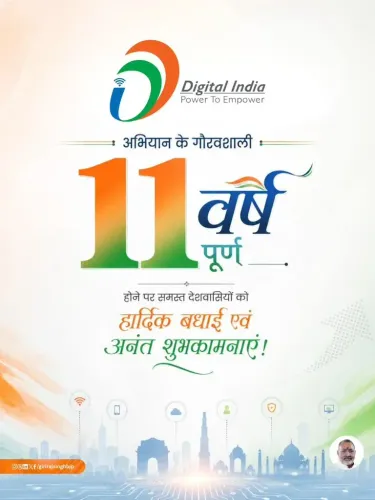
Digital India turned 11 years old on 1 July 2026 , having been launched by the NDA government on 1 July 2015 .
UPI recorded over 24,000 crore transactions in FY 2025-26 , according to the figure cited by Minister Giriraj Singh.
UPI was developed by NPCI and has been operational since April 2016 , a year after Digital India's launch.
The payments platform is a core pillar of India's Digital Public Infrastructure stack, alongside Aadhaar and the Account Aggregator framework .
NPCI is actively expanding UPI's reach through international bilateral payment corridors across Asia, Europe and Latin America .
The Pradhan Mantri Jan Dhan Yojana (launched August 2014 ) created the banked-account base that underpins UPI's mass adoption.
Union Textiles Minister Giriraj Singh on Wednesday, 1 July 2026 marked the 11th anniversary of Digital India by highlighting the Unified Payments Interface's scale, citing over 24,000 crore transactions in FY 2025-26 as evidence of the country's deepening digital payment revolution.
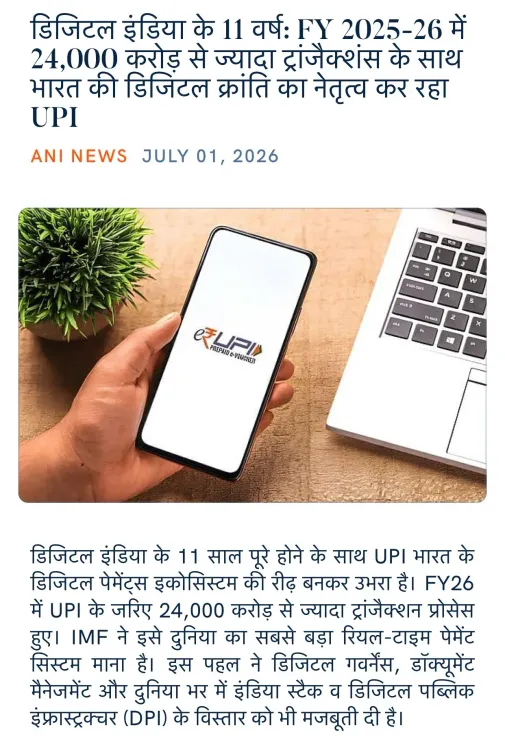
Posting on X via the NaMo App, the minister wrote: 'डिजिटल इंडिया के 11 वर्ष: FY 2025-26 में 24,000 करोड़ से ज्यादा ट्रांजैक्शंस के साथ भारत की डिजिटल क्रांति का नेतृत्व कर रहा UPI' — translated as: '11 years of Digital India: UPI leads India's digital revolution with over 24,000 crore transactions in FY 2025-26.'
Context
The Digital India programme was launched by the National Democratic Alliance government on 1 July 2015, with the stated goal of transforming India into a digitally empowered society and knowledge economy. The anniversary falls each year on 1 July, making it a recurring occasion for the ruling party and its ministers to take stock of the initiative's milestones.
UPI, developed and operated by the National Payments Corporation of India (NPCI), went live in April 2016 — just one year after Digital India's launch — and has since become the dominant retail payment rail in the country, used by hundreds of millions of consumers and merchants.
Policy Backdrop
UPI sits at the heart of India's Digital Public Infrastructure (DPI) stack, alongside Aadhaar and the Account Aggregator framework. Successive Union Budgets and Reserve Bank of India policies have prioritised interoperability and near-zero-cost digital payments as instruments of economic formalisation and financial inclusion.
The groundwork for this ecosystem was laid partly by the Pradhan Mantri Jan Dhan Yojana, launched in August 2014, which brought hundreds of millions of previously unbanked Indians into the formal financial system and created the account base that UPI now rides on. NPCI has also been expanding UPI's international footprint through bilateral payment linkages with countries across Asia, Europe and Latin America.
Stakeholders and Impact
The scale cited — over 24,000 crore transactions in a single financial year — points to UPI's penetration well beyond urban, tech-savvy consumers. Small merchants, street vendors, and rural households have been among the fastest-growing segments on the platform, reflecting the inclusion agenda that underpinned both Digital India and Jan Dhan.
For the broader economy, the formalisation of payments generates a data trail that aids credit underwriting for small businesses, a segment long excluded from institutional finance. NPCI and partner banks continue to build products — from credit on UPI to offline payment modes — to deepen this reach further.
What's Next
Attention will now turn to whether the government uses the Digital India anniversary to announce a second phase of the programme, expand UPI's international corridors, or revise transaction caps. Any such announcements are expected to come through MeitY (the Ministry of Electronics and Information Technology) or the RBI, potentially in the next Union Budget cycle.
As India positions its DPI model as an exportable template for the developing world, the transaction numbers cited by ministers like Giriraj Singh are increasingly part of a diplomatic as well as a domestic narrative — one that frames digital payments as a sovereign infrastructure achievement rather than merely a consumer convenience.
Point of View
000-crore-transaction figure, if borne out, would represent a staggering volume that underscores UPI's structural entrenchment in daily Indian commerce. More broadly, the post fits a pattern in which the ruling party frames digital payment growth as a sovereign achievement, building the case for India's DPI model as a global export. The subtext is also electoral: formalisation of the economy through digital payments is presented as tangible, measurable delivery to ordinary citizens.
NationPress
30 Sept 2026
Frequently Asked Questions
What is Digital India and when was it launched?
Digital India is the flagship government programme launched on 1 July 2015 to provide digital infrastructure, e-governance services and digital literacy across India .
How many UPI transactions happened in FY 2025-26?
According to the figure cited by Union Textiles Minister Giriraj Singh , UPI recorded over 24,000 crore transactions in FY 2025-26 .
Who operates UPI in India?
UPI is owned and operated by the National Payments Corporation of India (NPCI) , a not-for-profit organisation that manages India's core retail payment systems.
What is India's Digital Public Infrastructure?
India's Digital Public Infrastructure (DPI) is a stack of interoperable digital systems including Aadhaar (identity), UPI (payments) and the Account Aggregator framework (data sharing), designed to enable financial inclusion and economic formalisation.
Is UPI available in other countries?
Yes. NPCI has been establishing bilateral payment linkages to extend UPI to countries across Asia, Europe and Latin America , positioning India's payment infrastructure as a model for the developing world.